Timeline & Chronology Errors: Catch Them Before Readers Do
Timeline errors are the continuity mistakes that live in elapsed time — impossible journeys, wrong weekdays, pregnancies too long. How to catch them first.
A timeline error is a contradiction in elapsed time or sequence — a journey that takes an impossible number of days, a Tuesday that falls where the story already put a Friday, a pregnancy that runs eleven months. Unlike a factual slip (green eyes turning brown), it's wrong arithmetic, and it hides in the gap between scenes rather than inside any single one — which is exactly why it survives so many drafts.
Ask a writer to name their worst continuity fear and most will say a character's eye colour or a forgotten name. The error that actually gets published, in book after professionally edited book, is quieter: the calendar doesn't add up. J.K. Rowling's own fan-maintained continuity archive has documented a day in Prisoner of Azkaban written as a Thursday that, on the real calendar the book is set against, was a Sunday. Bram Stoker's Dracula is so famously muddled about when its events happen that scholars have spent a century trying to pin down a single consistent year. This is a practical guide to the error everyone else's advice skips past on the way to eye colour: what a timeline error actually is, why it's structurally different from every other kind of continuity mistake, and how to build a system that catches it before a reader does the arithmetic for you.
Key takeaways
- A timeline error is wrong arithmetic, not a wrong fact. It lives in the gap between scenes — the elapsed time, the sequence, the calendar — which is why re-reading a single scene never catches it.
- It's a genuinely different problem from a continuity error or a plot hole. A continuity error breaks agreement between two facts; a plot hole breaks cause and effect; a timeline error breaks the clock. Different symptom, different fix.
- Revision creates far more timeline errors than drafting does. Moving a scene, cutting a chapter, or compressing a subplot all silently change elapsed time without touching a single visible date.
- Even careful, professionally edited books get this wrong — from Rowling's own corrected printings to Dracula's century-old chronology dispute — because holding a calendar in your head across months of writing is a memory problem, not a talent problem.
- The fix is an explicit chronology kept separately from the prose — an ordered list of events with the elapsed time between them, checked deliberately, not held in memory.
- Software can catch the adjacent facts — location, knowledge, sequence — but calendar arithmetic itself is still a job for a kept timeline, not something a contradiction-scan solves alone.
What is a timeline error, and why is it different from every other continuity mistake?
A timeline error is a break in elapsed time or sequence — the story's internal clock stops adding up. That definition matters because it separates timeline errors from the two continuity problems writers hear about far more often.
A continuity error (the eye-colour kind) is a contradiction between two static facts: brown in chapter three, green in chapter thirty. A plot hole is a contradiction in causation: an event with no adequate cause, or a character who ignores the obvious solution. A timeline error is neither — it's a contradiction in time itself. Nobody's eyes changed, and nothing illogical happened; the story simply claims two things about elapsed duration that can't both be true, like a wound that heals in four days when the text also says a week has passed, or a character who is "eight months pregnant" in a scene the calendar puts eleven months after conception.
The reason this category gets less attention than the others is structural: a continuity error is visible the moment you compare two sentences side by side, and a plot hole is visible the moment you ask "why." A timeline error is only visible if you're doing arithmetic nobody asked you to do — counting the days between two scenes that are, individually, perfectly well-written. That's what makes it the error most likely to survive every read-through you'll give the manuscript.
What are the most common types of timeline error?
Timeline errors cluster into a small number of recognisable shapes, and knowing them makes them searchable instead of just "something felt off."
| Error type | What actually goes wrong | A real-world example |
|---|---|---|
| Elapsed-duration math | An injury, pregnancy, journey, or season takes an impossible or inconsistent length of time | A wound described as "still healing" in a scene the text also places three weeks after the injury |
| Calendar / day-of-week | A named day (Tuesday, "the solstice") doesn't match the story's own established calendar | Prisoner of Azkaban's June 6th is written as a Thursday; on the real 1993–94 calendar the book uses, it was a Sunday |
| Sequence / ordering | Cause is placed after effect, or two events are shown out of the order the story needs them in | A character reacts to news in chapter nine that, per the timeline, they don't receive until chapter eleven |
| Parallel-timeline drift | Two subplots running "at the same time" quietly fall out of sync when their scene counts differ | A subplot that's covered five scenes' worth of story time while the main plot has only covered two |
| Age / birth-year math | A character's stated age doesn't match their stated birth year against the story's current date | A character "born the year the war ended" who is the wrong age for a scene twelve years later |
| Offstage/summary time | Time that passes between chapters, in a line of narration, is inconsistent with what happens in it | A single paragraph says "three weeks passed," but the events it summarises clearly need six |
Dracula is an unusually good case study because its timeline problem is famous and well-documented: when we ran an AI consistency scan across the full text of Dracula, the tool correctly found almost no fact-contradictions — because chronology confusion isn't a fact disagreeing with another fact, it's the calendar itself refusing to resolve to a single consistent year, which is a structurally different problem from the one a contradiction-scan is built to catch.
How is a timeline error different from a plot hole?
They're often mistaken for each other because both can make a scene feel "wrong" without an obvious factual contradiction — but they break different things. A plot hole is broken logic: a character had an obvious solution and ignored it, or an event happened with no cause the story provides. A timeline error is broken arithmetic: the logic of the scene can be flawless and it can still be temporally impossible.
Here's where they get confused in practice: a character travels somewhere in a day that should take a week. If you focus on why — is there a reason they moved that fast? — you're evaluating it as a plot hole. If you focus on whether the days add up — did the story actually give them a week, or did you just forget to track it? — you're evaluating it as a timeline error. Often it's both at once: the impossible journey is a timeline error in isolation, and if it also conveniently gets your character to the climax on time, it's a plot convenience riding on top of it. Treating the two as the same problem is why writers who diligently check their causal logic still publish a chronology nobody actually verified.
Why is elapsed time the hardest thing in a novel to hold in your head?
Because it's cumulative, and cumulative errors are invisible one scene at a time. A continuity error announces itself the instant you write the contradicting sentence, if you happen to remember the earlier one. A timeline error doesn't announce itself at all — each individual scene is temporally fine on its own; it's only the running total across fifty scenes that goes wrong, and nothing about scene thirty-one looks different whether the running total is accurate or three weeks off.
Revision makes this dramatically worse, and it's worth naming why in detail, because most continuity advice treats revision as a place errors get fixed, not created:
- Cutting a scene that covered "two days passing" removes those two days from the manuscript's visible time — but not necessarily from what later chapters assume has happened.
- Moving a chapter earlier for pacing can put an event before the thing that was supposed to cause it, or before enough time has passed for a wound, a journey, or a pregnancy to have progressed as far as a later scene needs it to have.
- Compressing two subplots that ran in parallel — cutting three scenes from one thread and none from the other — quietly desynchronises them, so a reference to "meanwhile" no longer means what it used to.
None of these edits touch a single date written on the page. That's precisely why they're dangerous: you can proofread every sentence in the book and never notice that the distance between sentences has changed.
How do you build a timeline that catches errors before readers do?
Keep the chronology as a separate, explicit record — never in your head, and never only inside the prose. The method that actually holds up over a hundred thousand words:
- List every dated or datable event in story order, not writing order — the day something happens, not the chapter you wrote it in. Include travel time, healing time, and any stated "X weeks/months later."
- Record elapsed time between events, not just the events themselves. "Three days after the fire" is a checkable claim; "some time later" is not, and vague elapsed time is exactly where errors hide.
- Anchor to a real calendar if your story uses named days, seasons, or moon phases. If a character says "it's Tuesday," you've made a promise the rest of the book has to keep — Rowling's own corrected printings exist because a book that names real weekdays is implicitly running against a real calendar, whether the author meant to commit to one or not.
- Track parallel threads on the same timeline, not separate ones. If subplot B is "happening at the same time" as the main plot, put them on one ordered list so a desync is visible as a gap, not buried in two different documents.
- Re-check the timeline specifically after every structural edit — a move, a cut, a compression — because that is precisely when a chronology that was correct becomes wrong without a single date changing.
- Search your own manuscript for the durations you've claimed. "Three days," "a week later," "that same night" — pull every instance for a given stretch of story and confirm they agree with each other, the same way you'd search for a character's eye colour.
This is the same discipline the complete guide to story consistency recommends for every category of continuity error: convert vague description into checkable claims, then check them deliberately instead of trusting memory. Timeline is simply the category where the claims are dates and durations instead of facts about people.
Can AI catch timeline errors automatically?
Partly — and the honest boundary is worth stating precisely, because it's easy to over-promise here. NovelCanon's Consistency Engine extracts the facts each scene commits to — including where a character is and what they now know — into a living registry, and cross-references them across the manuscript. That genuinely catches the timeline-adjacent errors that show up as a factual contradiction: a character who's "suddenly in a city the timeline says she can't have reached," or one who acts on information before the scene where she's actually given it. Those are real, shipped capabilities, and they're timeline errors in every meaningful sense.
What it doesn't do — and what no fact-contradiction pass does on its own — is pure calendar arithmetic: confirming that a named weekday actually falls where the story's own calendar puts it, or that "eleven months" is or isn't a believable pregnancy. We learned this boundary directly, not in theory: when we ran a full scan across Dracula's text, the engine correctly found almost no genuine fact-contradictions, because the book's real problem — a muddled internal calendar — isn't a fact disagreeing with a fact. It's a different kind of error, and pretending otherwise would be exactly the kind of over-claim that erodes trust in a tool built to be trustworthy about what it catches.
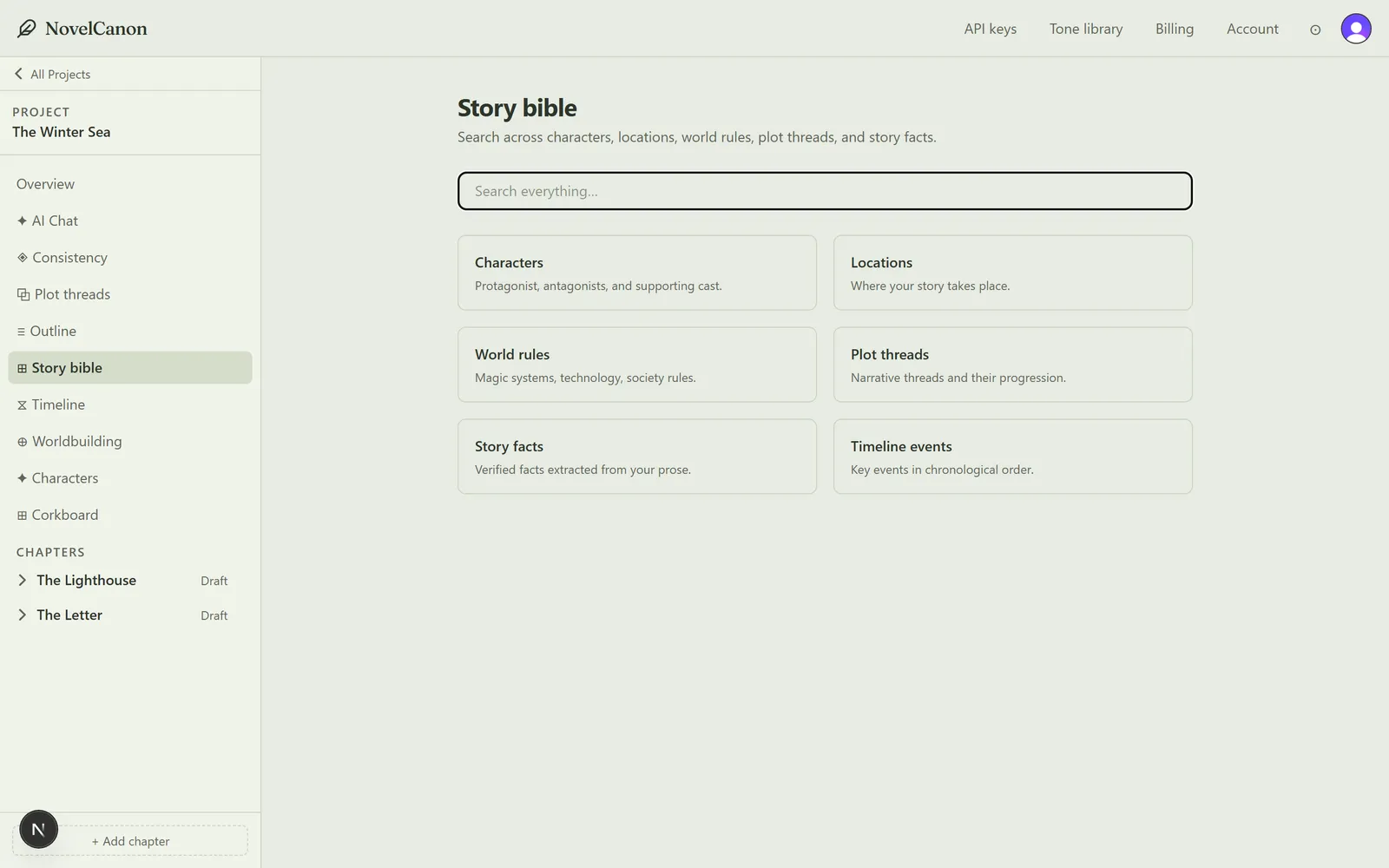
The NovelCanon story bible tracks where characters are and what they know, scene by scene — the factual backbone a timeline check still needs on top of.
So the honest answer is: let the engine handle the facts a timeline depends on — location, knowledge, sequence of who-learned-what — automatically, and keep an explicit chronology for the arithmetic itself. That's not a limitation unique to us; it's the actual shape of the problem, and knowing it saves you from trusting a tool to catch something it was never built to catch. You can see how the fact-extraction side works in how the Consistency Engine tracks facts, or run a check on a draft you already have with a manuscript continuity check. The full three-tier engine is part of NovelCanon Pro; the free plan lets you try the fact-tracking workflow first.
Eye colour gets the jokes. Elapsed time gets published — quietly wrong, in books far more careful than yours. The fix isn't more attention while you draft; it's a chronology that exists outside your memory, checked on purpose, especially the day after you move a chapter for pacing and forget that you also just moved everything downstream of it.
Frequently asked questions
What is a timeline error in a novel?
A timeline error is a contradiction in elapsed time or sequence — a journey that takes an impossible number of days, a pregnancy that runs eleven months, a Tuesday that falls on what the story already established as a Friday. It is different from a factual continuity error (green eyes turning brown): a timeline error is wrong arithmetic or wrong order, not a wrong fact.
How do you keep a novel's timeline consistent?
Build an explicit chronology as you draft: a simple ordered list of every dated or datable event with the elapsed time to the next one, kept separately from the prose. Most writers try to hold this in their head, which works for a short story and silently fails somewhere past 60,000 words, because elapsed time is cumulative and every scene either advances the clock or doesn't.
What's the difference between a timeline error and a plot hole?
A timeline error breaks arithmetic — the calendar doesn't add up. A plot hole breaks causation — an event with no adequate cause, or a character ignoring the obvious. They can overlap (an impossibly fast journey is both a timeline error and, if it lets a character arrive too conveniently, a plot convenience) but the fix is different: a timeline error is fixed with a date or a duration, a plot hole with a missing cause.
Why do timeline errors mostly appear during revision?
Because revision is exactly the set of actions that breaks elapsed time without touching a single date on the page: moving a scene earlier, cutting a chapter that used to cover three "off-page" days, or compressing two subplots that ran in parallel. The dates you wrote were correct when you wrote them — the structural edit is what makes them wrong.
Can AI catch timeline errors in a novel automatically?
Partly, and it is worth being precise about the boundary. AI consistency tools reliably catch facts that contradict each other — a character in a city the established travel time says she can't have reached yet. Pure calendar arithmetic (does June 6th actually fall on a Thursday that year?) and elapsed-duration math (is eleven months a normal pregnancy?) are a different, harder problem that a fact-contradiction pass doesn't solve on its own.
What's a famous example of a timeline error in a published book?
J.K. Rowling's own continuity site has documented that in *Prisoner of Azkaban*, June 6th — the day Sirius and Lupin expose Pettigrew — is written as a Thursday, but was actually a Sunday on the real 1993–94 calendar; a separate line about "two weeks" left before term was corrected to three in a later printing. Careful, professionally edited books still carry these errors, because elapsed time is genuinely hard to hold in your head across months of drafting.
Written by
Munib Ali Laghari
Founder, NovelCanon
Building the writing studio he wished he had for keeping a long story straight — one where the AI never loses the thread.