Story Consistency: The Complete Guide to Keeping a Novel Coherent
A practical system for story consistency — track characters, timelines, plot threads, and world rules so contradictions never reach your readers.
Story consistency is the internal agreement of every fact in your narrative — that a character's eyes, a journey's length, and who knows a secret stay the same unless the story deliberately changes them. Keep it, and readers stay inside the story. Break it, and they surface, every time.
A reader will forgive a slow chapter. They will forgive a subplot that quietly fades. What they will not forgive is the sentence that makes them stop and think: wait — didn't she die two chapters ago? That is a consistency error, and it does something no bad review can: it breaks the spell. This guide is a complete, practical system for making sure that sentence never reaches them.
Key takeaways
- Consistency is a memory problem, not a talent problem. A novel makes hundreds of factual commitments across months of writing, and no one remembers them all.
- A story bible is the oldest fix and still the best — but it only works if you start it early and record facts as you commit them, not "later."
- Track facts as checkable claims ("Elena has never left the capital"), not vague description ("Elena is guarded").
- Contradictions hide at the seams — the joins between scenes written far apart in time. Check there specifically.
- The five error types — character, spatial, timeline, knowledge, and world-rule — each hide in a different place and need a different check.
- Revision is where most errors are born. Every cut, move, and rename is a chance to break something three chapters away.
- The tedious half can be automated. A consistency engine tracks your facts and flags contradictions so your attention stays on the writing.
What is story consistency, and why does it break?
Story consistency is the internal agreement of every fact your narrative asserts. A consistent novel is one where nothing you write later silently contradicts what you wrote before — unless you intend the change and the story marks it.
It breaks for one reason: scale. A short story fits in your head. A novel does not. By the time you are forty thousand words in, you have made hundreds of small factual commitments — a character's age, the colour of a door, how long the road to the coast takes, who was in the room when the letter arrived — and you made them across weeks or months. The version of you writing chapter twenty has genuinely forgotten a detail the chapter-two version invented and never thought about again.
Revision makes it worse, not better. Every time you move a scene, cut a character, or compress a timeline, you open a new opportunity for contradiction. You fix a problem in chapter five and quietly break something in chapter eighteen that depended on it. This is why continuity errors survive into published books by careful, professional authors with professional editors: the human mind is simply not built to hold a hundred thousand words of factual detail in perfect agreement.
The good news is that consistency is not a mystery of craft you either have or lack. It is a system problem, and system problems have system solutions.
What are the five kinds of continuity error?
Not all continuity errors are alike, and treating them as one blurry category is why they slip through. Each type hides in a different place. Naming them is the first step to catching them.
| Error type | A concrete example | Where it hides |
|---|---|---|
| Character | Eyes green in ch. 3, brown in ch. 30; a scar that moves; an age that doesn't add up | Physical descriptions written months apart |
| Spatial | A two-day journey out, a one-week journey back; a house with a shifting number of rooms | Travel and geography treated casually |
| Timeline | A character is pregnant for eleven months; "last Tuesday" that can't have been a Tuesday | Compressed or reordered scenes |
| Knowledge | A character acts on a secret they were never told; someone "remembers" a scene they weren't in | Information revealed out of order after edits |
| World-rule | Magic that costs a life in ch. 4 is suddenly free in ch. 22; established tech that stops working | Rules invented early, forgotten late |
Notice that every one of these is a factual contradiction — two statements that cannot both be true. That is what makes them, unlike prose quality, genuinely checkable.
Continuity error vs. plot hole
It's worth separating two things readers often lump together. A continuity error is a broken fact: green eyes turned brown. A plot hole is broken logic: a character ignores an obvious solution, or an event happens with no plausible cause. Continuity errors are about agreement; plot holes are about causation. This guide is mostly about the first — but a maintained record of your story's facts is also the fastest way to spot the second, because dropped plot threads (a gun on the mantel that never fires) show up the moment you can see every thread laid out.
How do you start a story bible?
The oldest defence against inconsistency is a story bible: a living reference that records the facts of your world as you commit to them. Not the prose — the facts underneath it. Characters, places, rules, dates, relationships.
The single mistake that makes story bibles fail is treating them as a chore for after the draft. Later never comes, and by the time you try, the details are scattered across three hundred pages and reconstructing them is its own miserable project. So the only rule that matters is this:
Start the bible with your first scene, and add to it the moment you invent a fact on the page.
That's it. When you write "the tower had seven bells," the bible gets tower — seven bells. When you name a character's dead sister, she goes in. The discipline is tiny per instance; the payoff compounds across the whole book. Jane Friedman's writers have kept story bibles this way for years, and every professional television writers' room runs on one for exactly this reason: continuity across a long, collaborative narrative is impossible without a shared record.
What goes in a minimal bible:
- Characters — names (and spellings), ages, physical details, relationships, what they know and when.
- Places — layout, distances between them, travel times.
- Timeline — the sequence of events and how much time passes between them.
- World rules — how magic, technology, or society works, and its limits.
- Plot threads — what you've set up that still needs paying off.
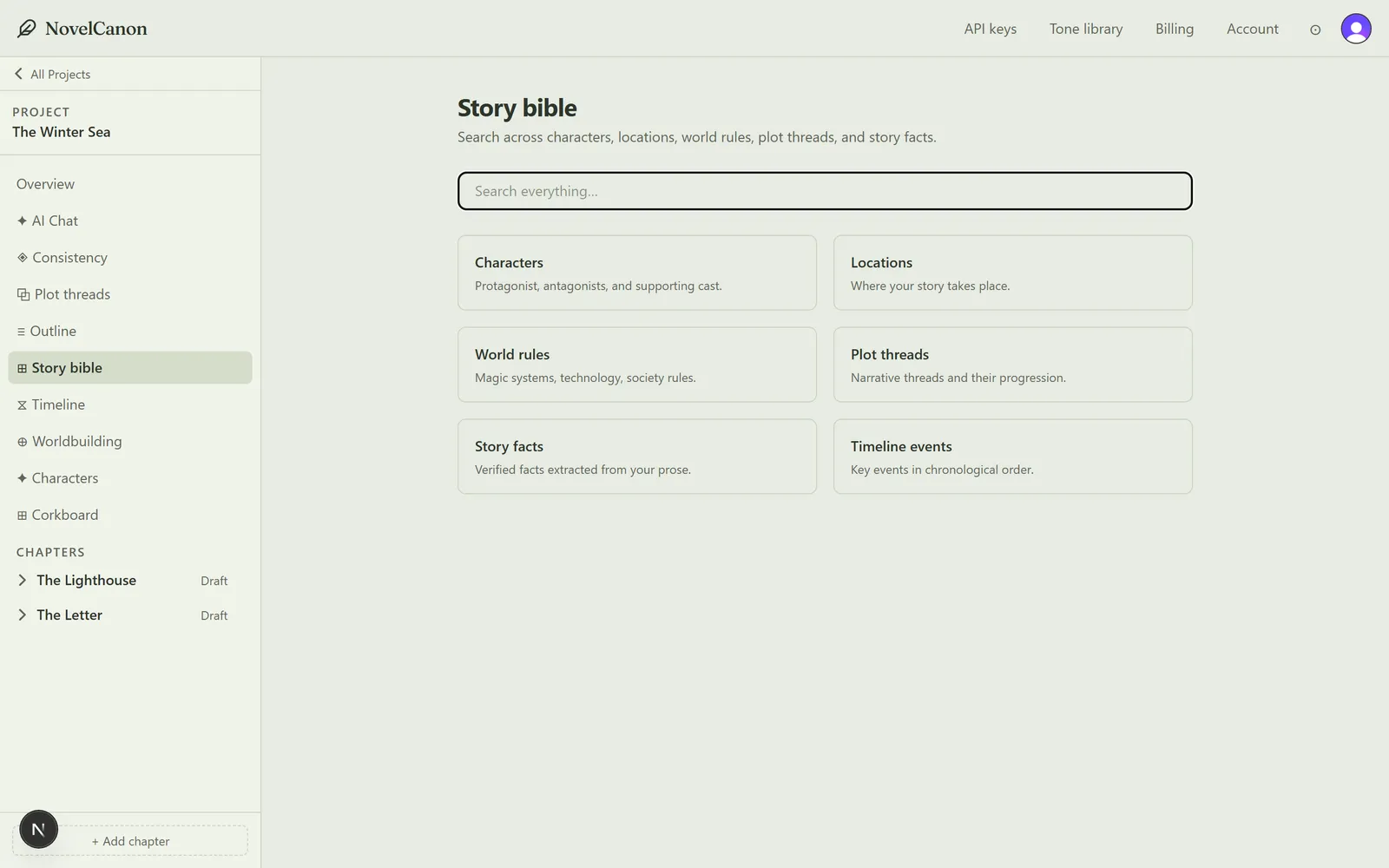
A story bible in NovelCanon — characters, world rules, timeline, and the facts pulled from your prose, all in one place.
Why track facts as claims, not descriptions?
Here is the shift that separates a bible that works from one that gathers dust: record facts as claims that can be checked, not as paragraphs of characterisation.
"Elena is guarded and slow to trust" is characterisation. It's useful for writing her, but it is not checkable — no later sentence can contradict it. "Elena has never left the capital" is a claim. The moment chapter twelve has her reminiscing about the sea, you have a contradiction you can catch, because a claim has a truth value and a scene can violate it.
So write your bible in claims:
- Not "the city is ancient and grand" but "the city wall is exactly seven gates."
- Not "they travelled a long way" but "the journey to the coast takes three days on horseback."
- Not "he's secretive" but "Marcus does not learn his father's name until chapter nine."
Claims are the atoms of consistency. Description tells you how the story feels; claims are the things that can be wrong. When you can see your story as a list of claims, checking it stops being a vague dread and becomes a concrete, finite task.
How do you check for contradictions at the seams?
Contradictions almost never hide within a single scene — you were paying attention while you wrote it. They hide at the seams: the joins between scenes written far apart in time, where the you-of-March and the you-of-June disagree about a fact neither of you was thinking about.
So that is where to look, deliberately. When you finish a scene, run one narrow check — not "is this good?" but a different, colder question:
Does anything in this scene contradict a fact I've already established?
That question is mechanical, and it is dull, which is exactly why writers skip it and exactly why errors survive. A few ways to make it survivable:
- Do a dedicated continuity read. Read the manuscript once looking only for contradictions — not prose, not pacing. Mixing the two passes means you do neither well, because your prose brain and your fact-checking brain want different things.
- Read against the bible, not from memory. Your memory is the thing that failed you in the first place. Check each scene's claims against the record.
- Watch the high-risk edits. After you move, cut, or reorder scenes, the knowledge and timeline errors multiply. Re-check the neighbours of anything you changed.
- Search for specifics. Search your own manuscript for a character's eye colour, a place name, a number. If it appears three ways, one of them is wrong.
A worked example: catching a contradiction across two hundred pages
Abstract advice is easy to nod at and hard to use, so here's how the system plays out on a real-feeling case.
In chapter three you write, almost in passing, that Elena "had never once left the capital in all her thirty years." It's a throwaway line that characterises her — sheltered, incurious about the wider world. Into the bible it goes as a claim: Elena — never left the capital.
Two hundred pages later, deep in a tender scene, you have Elena comfort a frightened child by describing "the grey beaches at Varn, where she'd spent a summer as a girl." It's a lovely image, and in the moment it feels true — you needed her to have a memory of the sea. But it contradicts chapter three, flatly. Both cannot be true.
Without a system, this survives. You wrote the two scenes months apart; neither felt wrong on its own; and on a linear read your eye slides past both because each is locally consistent. A reader, though — especially a re-reader, or a reviewer — does the arithmetic, and the spell breaks. With the claim recorded, the check is trivial: the moment the Varn line lands, it collides with Elena — never left the capital, and you make a deliberate choice. Maybe chapter three softens to "rarely left." Maybe Varn becomes a story she was told, not one she lived. Either way, you chose — instead of a reader catching you not choosing.
This is the whole game in miniature: the error isn't a failure of imagination, it's a failure of memory, and a recorded claim converts an invisible landmine into a visible, fixable decision.
Character, timeline, and world: the three hardest to hold
Three categories deserve their own attention because they drift the most silently.
Character consistency
Physical details are the classic offender — eye and hair colour, height, scars, age — because they're set once, early, and rarely revisited. But the subtler drift is knowledge and behaviour: a character who suddenly knows something they were never told, or who acts against a trait you spent nine chapters establishing. Keep a per-character record of appearance, what they know, and where they are at each point in the story. When a character reappears after a long absence from the page, check them against it before you write a word.
Timeline and chronology
Time is the hardest thing to keep straight because it's cumulative — every scene either advances the clock or doesn't, and the errors compound. Days of the week that can't be those days. Seasons that don't progress. A pregnancy, a wound, or a journey that takes an impossible length of time. The fix is an explicit timeline: a simple ordered list of events with elapsed time between them. If you can't say how many days have passed since chapter one, neither can your reader — and one of them will do the arithmetic.
Worldbuilding and magic-system consistency
In speculative fiction, your world's rules are your promises to the reader, and breaking them is the deepest betrayal of all — worse than a wandering eye colour, because it breaks the logic the whole story rests on. If magic costs something in chapter four, it must cost the same in chapter twenty-two unless the story earns the change. Record every rule and, crucially, every limit — what magic or technology cannot do is what creates tension, and it's the first thing to erode when you need a character out of a corner. A consistent world is one where the reader could, in principle, predict the rules. An inconsistent one feels arbitrary, and arbitrary worlds have no stakes.
Don't drop what you set up: plot-thread continuity
The last kind of consistency isn't about contradiction but about completion. A story sets up expectations — a mysterious letter, a promised confrontation, a Chekhov's gun on the mantel — and readers keep a running tally whether they mean to or not. Leave one unpaid and the ending feels incomplete in a way readers often can't name but always feel.
Track your open threads as a list with a status: set up, developing, resolved. Before you call a draft finished, every thread should be resolved or deliberately abandoned (a thread you consciously drop for effect is a choice; one you forgot is a mistake). Seeing them laid out is the only reliable way to notice the one you forgot — the subplot that mattered in act one and simply evaporated, the character who exits the story without the scene their arc was building toward.
Consistency during revision: where most errors are born
Here's the counterintuitive part most advice skips: the majority of continuity errors don't enter your book while you're writing it. They enter while you're fixing it.
Think about what revision actually does. You cut a scene — and now a later chapter refers to a conversation that no longer happened. You rename a character — and three scenes still use the old name. You move a chapter earlier for pacing — and now a character knows something before they were told it. You compress two weeks into two days — and a wound heals impossibly fast. Every structural edit is a small act of time travel that can break a fact somewhere you're not looking.
So treat revision as the high-risk zone it is:
- Log every structural change and, for each, ask what elsewhere depended on it. A rename has ripples; follow them.
- Re-run your continuity read after big edits, not just after the first draft. The clean draft you checked in April is a different book after a July restructure.
- Be especially careful with knowledge and timeline — the two categories reordering scenes damages most.
A story bible earns its keep most during revision, because it's the map that tells you what a change might have broken. Without it, you're editing blind and hoping.
The tools writers use to stay consistent
There's no single right tool — only the one you'll actually keep up. In rough order of effort and power:
- A document or spreadsheet. The humble character/timeline sheet. Free, universal, and completely dependent on your discipline to keep current — which is exactly where it usually fails on a long project.
- A wiki or note system (Notion, Obsidian, a personal wiki). Better for linking entities and worldbuilding, still fully manual, and prone to the same drift: the moment your notes and your prose disagree, your notes are lying to you.
- Beta readers and a copy-editor. Human continuity-checking is invaluable and catches things software can't — but it happens late, costs money or goodwill, and even careful professionals miss contradictions hundreds of pages apart.
- A dedicated consistency engine. Software that reads your prose, tracks the facts, and audits the whole manuscript for contradictions automatically. It doesn't replace human editors, but it removes the memory burden the manual tools all depend on.
The trade-off across all of them is the same: the manual options give you total control and cost nothing but discipline; the automated option gives up a little control to remove the maintenance and the remembering. Which you want depends on how long your book is and how much of your attention you'd rather spend writing.
How do you do all this without it eating your writing time?
Everything above works. It is also, done entirely by hand, a real tax on the part of you that wants to write. Maintaining a bible, doing continuity reads, searching for eye colours across three hundred pages — it's the mechanical, memory-heavy half of the job, and it's exactly the half a computer is good at.
This is the problem NovelCanon was built around. Its Consistency Engine works in three tiers: instant checks as you type for the obvious slips like name variants, per-scene analysis that extracts the facts you commit to into a story bible that builds itself from your prose, and a full-manuscript deep scan that reads the whole book back and surfaces contradictions, dropped threads, and broken world rules. The facts it tracks are derived from what you actually wrote — fix the contradiction in the text and the flag clears itself, with no separate database to maintain. You can read exactly how the Consistency Engine works under the hood, or see how it compares to a manual story bible in NovelCanon vs Novelcrafter.
None of this replaces the discipline — you still decide what your story's facts are. It automates the remembering and the cross-checking so your attention stays where only you can put it: on the writing. The full engine is part of NovelCanon Pro; the free plan lets you try the workflow first.
Consistency is not the glamorous part of craft. But it is the part that, done badly, quietly undoes all the rest. Track your facts as claims, check your seams, pay off your threads, and mind your revisions — and let the machinery remember what no writer can.
Frequently asked questions
What is story consistency in fiction?
Story consistency is the internal agreement of every fact in your narrative — a character's eye colour, a journey's duration, who knows a secret and when. A story is consistent when nothing on page 300 contradicts what you established on page 3. It is the invisible quality readers only notice when it breaks.
What is the difference between a plot hole and a continuity error?
A continuity error is a factual contradiction — brown eyes that were green three chapters ago. A plot hole is a logical gap — a problem the characters could have solved trivially but didn't, or an event with no plausible cause. Continuity errors break facts; plot holes break logic. Both pull readers out of the story.
Do I need a story bible for a standalone novel?
Yes, though it can be lightweight. Even a single novel makes hundreds of factual commitments across months of drafting, and no writer remembers them all. A one-page bible that records names, key dates, and physical details pays for itself the first time it stops you contradicting chapter two in chapter twenty.
How do professional authors catch continuity errors?
Through a combination of a maintained story bible, a dedicated continuity read (checking only for contradictions, not prose), and — for many — a professional copy-editor whose job includes flagging them. Increasingly, writers also use software that tracks facts across scenes and surfaces contradictions automatically.
Can software check a whole novel for contradictions?
Yes. Tools like NovelCanon's Consistency Engine extract the facts you commit to in each scene and cross-reference them across the entire manuscript, flagging contradictions, dropped plot threads, and broken world rules. It does not replace a human editor, but it catches the mechanical errors humans reliably miss over 100,000 words.
When should I check my novel for consistency — while drafting or after?
Both, but differently. While drafting, keep a running record of facts as you commit them so you don't contradict yourself in the moment. After drafting — and especially after any big structural edit — do a dedicated continuity pass, because revision is where most contradictions are actually born.
Written by
Munib Ali Laghari
Founder, NovelCanon
Building the writing studio he wished he had for keeping a long story straight — one where the AI never loses the thread.