How to Find and Fix Plot Holes in Your Novel
How to find and fix plot holes in your novel: a repeatable method for spotting broken cause-and-effect, closing the shortcuts, and paying off every setup.
A plot hole is a break in your story's chain of cause and effect: an event with no real cause, a character acting against their own logic, or a setup that never pays off. You find them by tracing the plot as a causal chain — each beat following from the last — and you fix them one of two ways: add the missing cause, or cut the effect.
Readers will forgive a lot. They'll forgive a coincidence, a slow chapter, a character they don't much like. What snaps them out of the story is the moment the logic breaks — why didn't she just call the police? — because in that instant they stop living inside the book and start auditing it. This is a practical guide to find and fix plot holes before a reader does the auditing for you: what they actually are, a method for hunting them in your own draft, and the small number of ways to fix one that actually work.
Key takeaways
- A plot hole is broken logic, not a broken fact. A continuity error is green eyes turning brown; a plot hole is an event nothing in the story caused, or a character ignoring the obvious.
- Every plot hole is a broken link in the chain of cause and effect — in the cause, the character's motivation, their capability, or the consequence (a setup with no payoff).
- You find them by reading the plot as a causal chain — each beat should follow with "therefore" or "but," never just "and then."
- You fix a plot hole one of two ways: add the missing cause, or remove the effect. Hoping the reader won't notice is not a third option.
- The most common hole is the unused solution — the story only works because a character doesn't do the obvious thing. Close the shortcut; don't ignore it.
- The dropped-thread kind is the one software can catch. A full-manuscript deep scan flags setups that never pay off and rules the story quietly breaks.
What is a plot hole (and what isn't)?
A plot hole is a gap in a story's internal logic — a place where events don't follow from their causes, or characters don't act according to what they want and know. It's the story asking you to accept something the story itself hasn't earned.
Two distinctions clear up most of the confusion. First, a plot hole is not a continuity error. A continuity error is a broken fact — a scar that changes cheeks, a Tuesday that can't be a Tuesday (the full taxonomy is in the complete guide to story consistency). A plot hole is broken logic — the two are different failures and need different checks. Second, a plot hole is not a plot convenience. A convenience is a lucky break that stays believable; a hole is something that couldn't or wouldn't happen given what you've established. Readers happily accept the hero catching the last train. They balk when the villain, holding every advantage, inexplicably lets the hero live so the plot can continue.
The practical test for whether you have a real hole: can a reader ask a "why" or "why not" question that the story never answers? Why did the guards leave the door unlocked? Why didn't she just tell him the truth in chapter two? If the honest answer is "because the plot needed it," you have a hole, not a choice.
What are the four kinds of plot hole?
Every plot hole is a broken link in the same chain: cause → motivation → capability → consequence. Name the broken link and you know what kind of hole you're looking at — and, later, how to fix it. This is more useful than a vague sense that "something's off," because each link fails in a recognisable way.
| Broken link | The hole | What the reader thinks |
|---|---|---|
| Cause | An event with no adequate cause — the rescue that arrives from nowhere, the coincidence the plot leans on | "That was convenient." |
| Motivation | A character acts against what they want and know, with no reason given | "She'd never do that." |
| Capability | A character does something they had no means or information to do — or fails to use a solution sitting in plain sight | "How did he know that?" / "Why didn't they just…" |
| Consequence | A setup that never pays off — a threat that evaporates, a clue that leads nowhere, a gun on the mantel that never fires | "Whatever happened to…?" |
Two of these deserve a flag. The cause hole in its worst form is the deus ex machina — a problem solved by something the story never set up, which reads as cheating because it is. And the capability hole's most common shape is what's often called the idiot plot: the entire conflict exists only because a character declines to do the obvious, sensible thing. That one is worth its own attention, because it's the hole readers notice most and forgive least.
How do you find plot holes in your own novel?
The core technique is to reverse-outline your finished draft as a chain of cause and effect, then test every link. You're too close to the story to feel the gaps on a normal read — you unconsciously supply the missing logic from your own head, which is exactly the logic the reader doesn't have. So you need methods that force the gaps into the open.
Read the plot as "therefore / but," never "and then." Write a one-line summary of each scene, then try to connect them: this happens, therefore that happens, but then this goes wrong. This is the screenwriting heuristic the creators of South Park describe as the "but / therefore" rule, and it's the single sharpest plot-hole detector there is. Wherever the only honest connector between two beats is "and then" — this happens, and then, unrelatedly, that happens — you've found a broken causal link. A plot that runs on "and then" is a sequence of events; a plot that runs on "therefore" and "but" is a story.
A few more passes that catch what the outline misses:
- The "why / why not" interrogation. Go to every major turn and ask the two reader questions out loud: Why did this happen? (tests cause) and Why didn't the character just do the easy thing? (tests capability). If you can't answer from what's on the page, the reader can't either.
- Read it cold. Put the draft down for a week — longer if you can — then read it as a stranger would, fast, without stopping to fix prose. Distance is the only thing that dissolves the private context in your head that's been papering over the holes.
- Ask readers where they stopped believing. Beta readers are worth more for this than for anything else. Don't ask "did you like it?" Ask "was there a moment you didn't buy?" The place they hesitated is almost always a plot hole you'd stopped being able to see.
A worked example: the witness who didn't call the police
Abstract advice is easy to agree with and hard to apply, so here's the most common hole in commercial fiction, worked end to end.
Your protagonist, Dana, witnesses a murder in chapter two. For your plot to work — the amateur-investigation story you want to tell — she can't simply call the police and let them handle it. So in the first draft, she just… doesn't. She goes home, tells no one, and starts investigating on her own. On the page it reads as a capability hole of the idiot-plot kind: any reasonable person calls 911, and the only reason Dana doesn't is that you need her not to. A reader's belief snaps on page ten and never fully recovers.
Notice that the fix is not to make Dana braver or to add a paragraph of her deciding to be a detective — that treats the symptom. The fix is to close the shortcut: give the story a real reason the easy solution is off the table. Maybe the murderer is a police officer, so going to the police means walking into the killer's arms. Maybe Dana is an undocumented immigrant, or on parole, so the police are a threat to her. Maybe she did call — and the body was gone when they arrived, and now she's the unreliable witness no one believes. Any one of these converts an idiot-plot hole into the engine of the story: now her investigating alone isn't a lapse in logic, it's the only door left open. The hole didn't need a bigger scene. It needed the obvious exit sealed.
How do you fix a plot hole?
There are really only two fixes, and every specific technique is a version of one of them: add the missing cause, or remove the effect. Everything else — hoping, hand-waving, hoping harder — just relocates the hole. Which of the two you reach for depends on the broken link.
- Add the missing cause (plant a setup earlier). For cause and capability holes, the usual fix is a single line, chapters before the payoff, that supplies what was missing. The rescue that felt like a deus ex machina becomes earned if, forty pages earlier, we saw the ally take the road that lets them arrive in time. The trick a character uses in the climax needs to be established as something they could know before they use it. Fixes go upstream: you repair a hole by planting, not by explaining after the fact.
- Close the shortcut (block the easy solution). For the idiot-plot capability hole, don't force the character to act against sense — remove the sensible option, as with Dana above. Raise the cost of the obvious move until it's genuinely the worse choice, or take it off the board entirely.
- Cut the cause (delete the orphaned setup). For consequence holes — a Chekhov's gun that never fires — the cheapest fix is almost always to remove the gun, not to invent a firing. If a subplot, object, or threat leads nowhere, cutting the setup is faster, cleaner, and tightens the book. Don't pay off a promise you never needed to make.
- Acknowledge it, sparingly (the last resort). Occasionally a fix costs more than the hole. Then you can lampshade it — have a character voice the reader's doubt ("I know how this sounds") so the story shows it's aware. Used once, it buys goodwill. Used to wave away a load-bearing hole, it just signposts the problem. This is a patch, not a repair; prefer the first three.
The motivation hole is the one exception to "small fix." If a character acts against who they are, no planted line will save it — you either establish the trait that makes the action believable, or you change the action to fit the character. That's real revision, and it's why motivation holes are the ones worth catching earliest.
When is a plot hole not worth fixing?
When fixing it would cost more than the hole — and the hole is small, fast, and buried in momentum. This is the honest part most advice skips: not every hole must die.
Readers audit slow stories and forgive fast ones. A minor implausibility during a breathless chase gets swept past on adrenaline; the same implausibility in a quiet, reflective chapter sits there being examined. Big-budget films run on this principle — the plot convenience you'd never accept described flatly, you accept in the moment because the story never gives you room to stop. So weigh two things before you spend a week rebuilding act two: how load-bearing is the hole (does the whole plot rest on it, or is it a throwaway?), and how much momentum surrounds it (will the reader even slow down enough to notice?). A tiny, low-stakes convenience wrapped in a great scene is often best left alone. A hole the ending depends on will sink the book no matter how fast you write around it. Fix the ones that bear weight; let the trivial ones go.
Can software help you find plot holes?
Here's the honest division of labour. Some plot holes are judgment calls — is this character's choice believable, does this coincidence feel earned? No software can rule on those, and it shouldn't try. But a whole category of holes is purely mechanical: a setup that never pays off, a plot thread introduced and forgotten, a world rule the story establishes and then quietly breaks. Those aren't matters of taste — they're checkable against the rest of the manuscript. And checking a hundred thousand words for every dangling thread is exactly the job human memory fails at.
That mechanical half is what NovelCanon's Consistency Engine is built to catch. Its full-manuscript deep scan reads the whole book and cross-references every tracked fact, plot thread, and world rule, then surfaces three things: contradictions, dropped threads (the promise you never paid off), and rule-breaks (the limit you set and later crossed). It won't tell you whether Dana's motivation rings true — that's yours to judge — but it will tell you that the sealed letter from chapter five is never opened again, which is the plot hole you'd otherwise find in a one-star review.
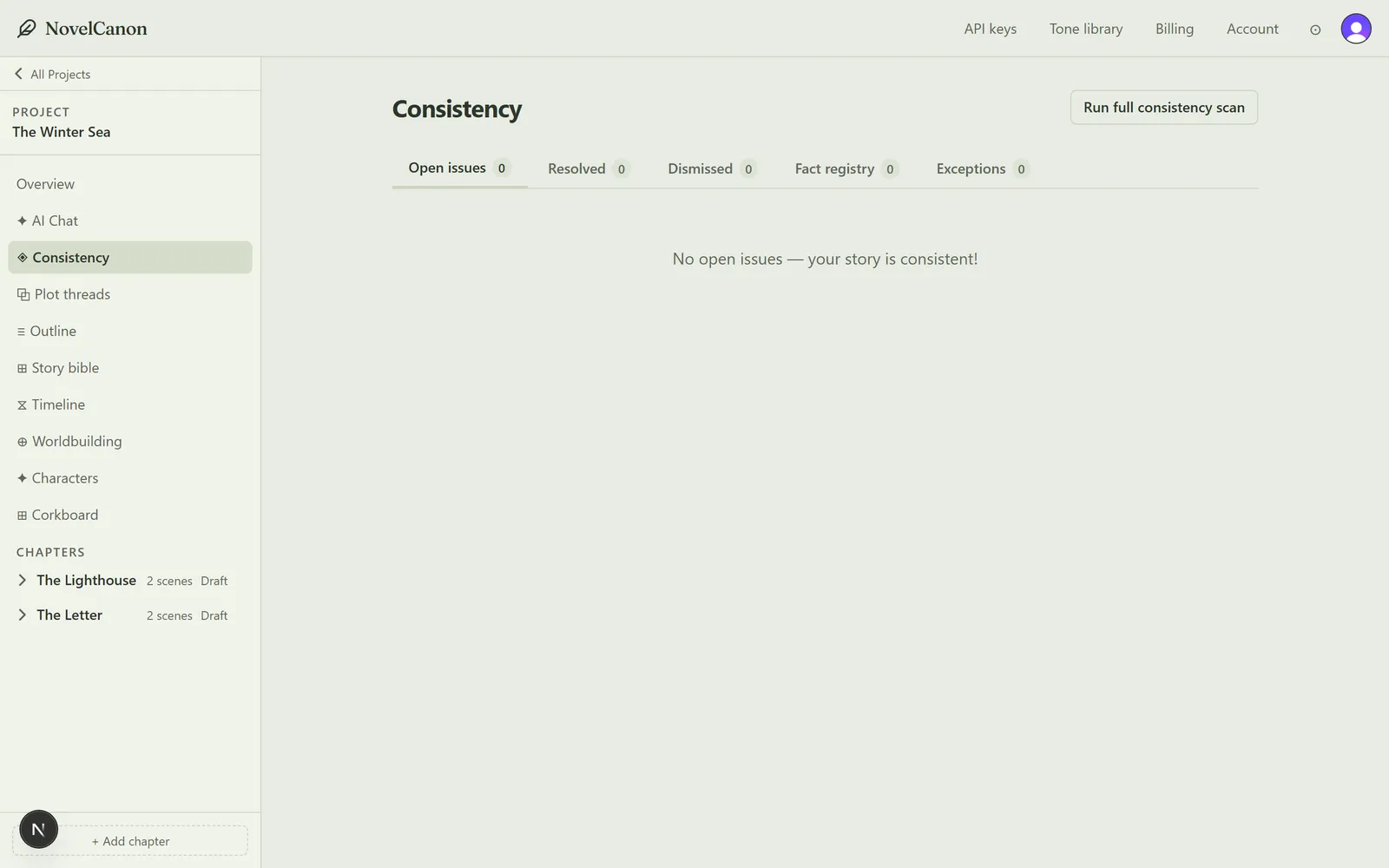
A deep scan surfaces the mechanical holes — dropped threads and broken rules — as reviewable issues, so your attention stays on the judgment calls only you can make.
None of this replaces the reverse-outline, the cold read, or the beta reader's honest flinch — those find the holes of logic and motivation that are the heart of the work. It just takes the tedious, memory-heavy half off your plate. You can see how the deep scan works under the hood, pair it with a system for keeping track of your characters, and try the workflow free before the full engine, which lives in NovelCanon Pro.
Plot holes aren't a sign you can't plot. They're the natural residue of building something large out of a thousand small decisions made over months. Trace your causes, close your shortcuts, pay off your setups — and let the machinery remember the threads no writer can hold all at once.
Frequently asked questions
What exactly is a plot hole?
A plot hole is a break in a story's internal logic — an event with no adequate cause, a character acting against their own goals and knowledge, or a setup that never pays off. It's different from a continuity error, which is a broken fact (green eyes turning brown). A plot hole breaks cause and effect; a continuity error breaks agreement between details.
How do you find plot holes in your own novel?
Reverse-outline the finished draft as a chain of cause and effect: each beat should follow from the last with "therefore" or "but," never just "and then." Wherever you can only write "and then," you've found a weak link. Reading cold after time away, and asking beta readers where they stopped believing, catch the ones you're too close to see.
What's the difference between a plot hole and a plot convenience?
A plot convenience is something lucky that helps the story along but stays plausible; a plot hole is something that couldn't or wouldn't happen given what the story has established. Readers forgive convenience when the stakes are low and the momentum is high. They catch a hole when a character ignores an obvious solution or an event has no believable cause.
Can you fix a plot hole without rewriting the whole book?
Usually, yes. Most holes are fixed with a small, surgical change, not a rewrite: plant a single line earlier that supplies the missing cause, or close off the easy solution a character should have taken. The cheapest fix is often to *cut* the setup that goes nowhere rather than invent a payoff for it. Big rewrites are the exception, not the rule.
Can AI find plot holes in a novel?
Partly. AI reliably catches the mechanical kind — a setup that never pays off, a plot thread left dangling, a world rule the story quietly breaks — because those are checkable against the rest of the manuscript. Whether a character's motivation is believable is still a human judgment. Tools like NovelCanon's deep scan surface the dropped threads and rule-breaks so you can focus on the judgment calls.
Written by
Munib Ali Laghari
Founder, NovelCanon
Building the writing studio he wished he had for keeping a long story straight — one where the AI never loses the thread.