How to Run a Continuity Check on Your Manuscript
A manuscript continuity check tests your story's facts against each other across a whole book. How to run one by hand, how to automate it, and how to triage it.
A manuscript continuity check verifies every factual claim your story makes against every other claim across the whole book — appearances, locations, chronology, who knows what and when. Run one after a complete draft or a major revision, either by building a fact sheet and sweeping the text by keyword, or by scanning the manuscript automatically and triaging the flags.
Ask five authors how to check a novel for continuity errors and you get the same five answers: build a fact sheet, search for keywords, keep a calendar, set the draft aside, hand it to beta readers. The advice is sound. It is also, at 90,000 words, a job most writers start and very few finish — which is why continuity errors tend to be the notes that come back from readers rather than the ones caught in revision.
This is a walkthrough of both versions of that job: the manual pass, honestly described including where it breaks down, and the automated one, step by step, with what it costs and how to read what it hands back.
Key takeaways
- A continuity check is a fact-agreement pass, not a language pass — it ignores prose quality and asks only whether your story's claims agree with each other.
- Run it after a complete draft and again after any structural revision; revision is where most continuity errors are born, not first drafting.
- The manual method works and does not scale: it can only find errors you already thought to put on the fact sheet.
- NovelCanon's automated version is a five-step run from the Consistency page, with an estimated token count and dollar cost shown before you confirm.
- Cost scales with tracked facts, not word count — a tidy 120,000-word manuscript can be cheaper to scan than a sprawling 40,000-word one.
- Expect false positives and plan to triage them. When we scanned Dracula, a naive check flagged 164 conflicts and only 3 survived scrutiny.
What is a manuscript continuity check?
It is a pass that tests the internal facts of your story against each other across the entire manuscript — and it is a different job from every other kind of edit. A line edit improves how a sentence reads. A copyedit fixes what is wrong inside a sentence. A continuity check ignores the sentence completely and asks a question no amount of careful reading answers reliably: does this claim agree with the four hundred other claims this book has already made?
The errors it targets fall into a few recurring shapes:
| Error type | What it looks like in a draft |
|---|---|
| Character detail drift | Green eyes in chapter two, hazel in chapter twenty-nine; a scar that changes shoulders |
| Chronology slips | A three-day journey that takes an afternoon; a Tuesday that follows a Thursday |
| Knowledge errors | A character acting on something they are not told until two chapters later |
| Spatial contradictions | A cottage with two rooms in one scene and a staircase in another |
| World-rule breaks | Magic that costs a life, except in the scene where the plot needed it not to |
| Dropped threads | A setup — a letter, a debt, a prophecy — the book never returns to |
Those last two are the expensive ones, because they are load-bearing. A wrong eye colour irritates a reader; a magic system that quietly changes its own rules costs you their trust in the whole book. If the logic side is what worries you most, the plot-hole guide goes deeper on it.
When should you run a continuity check?
At two moments: when the draft is complete, and after any revision that moves, cuts, or adds material. The first is obvious. The second is the one writers skip, and it is where most continuity errors are actually created.
Think about what a structural revision does. You cut a scene — and the object it introduced now turns up in chapter twelve having never been established. You move a chapter earlier — and a character knows something before they learn it. You rename a minor character halfway through and find-and-replace catches every instance except the nickname. None of these errors existed in the first draft. Revision made them, which is why "I already checked continuity" is a statement with a short shelf life.
A third moment is worth naming: before the manuscript goes to anyone whose attention you are paying for or trading on. Beta readers and editors are excellent at catching continuity errors, and spending them on it is a waste — their attention is better used on the things only a human notices.
How do you run a continuity check by hand?
Build a fact sheet, sweep the manuscript by keyword against it, then check chronology separately on a calendar. This is the standard advice — Writer's Digest and Career Authors both lay out versions of it — and it genuinely works. It is worth understanding properly, including its ceiling.
- Build the fact sheet. For every named character: fixed physical details, age, family, occupation, anything stated once and assumed forever after. Do the same for recurring locations and for the rules of your world. Editors call this a style sheet, and they compile one for every book they touch.
- Sweep by keyword, not by reading. Take each entry and search the manuscript for it — the character's name, "eyes", the name of the inn, "sword". Reading looks for errors; searching finds every instance whether you were alert at that moment or not.
- Put chronology on a calendar of its own. Timeline errors do not surface through keyword search, because the contradiction lives in the arithmetic between two scenes rather than in any word either one uses. Lay the days out and count them.
- Then set it down and come back. Distance is the only thing that restores the ability to read your prose as written rather than as intended.
Here is the honest limitation. The manual method can only find errors you already suspected, because the fact sheet is a list of things you thought to write down. The contradiction you never anticipated — an offhand detail in chapter four that a scene in chapter thirty-one quietly reverses — has no entry to be checked against, so the sweep passes straight over it. That is the specific gap an automated pass closes: it does not decide in advance which facts matter.
How do you run a full consistency scan in NovelCanon?
Open your project's Consistency page, click Run full consistency scan, review the estimated cost, and confirm — five steps, and the scan runs in the background while you keep writing.
- Open the project and click Consistency in the sidebar. The page has five tabs — Open issues, Resolved, Dismissed, Fact registry, and Exceptions — and the scan button sits in the top right.
- (Optional, but do this after an import.) Go to Fact registry → Seed story bible first. It reads every scene and proposes story-bible facts from your existing prose. They arrive as suggestions awaiting review, not canon — nothing is checked for contradictions until you confirm it, either row by row or with Confirm all.
- Click Run full consistency scan. The dialog shows an Analysis model selector, an estimated token count, and an estimated cost in dollars to four decimal places.
- Click Confirm & Scan. The scan runs as a background job through eight phases and is resumable, so an interruption picks up from the last completed phase instead of starting over — and instead of charging you twice.
- Come back to Open issues when it finishes. Each finding is a card you act on; nothing in your manuscript has been changed.
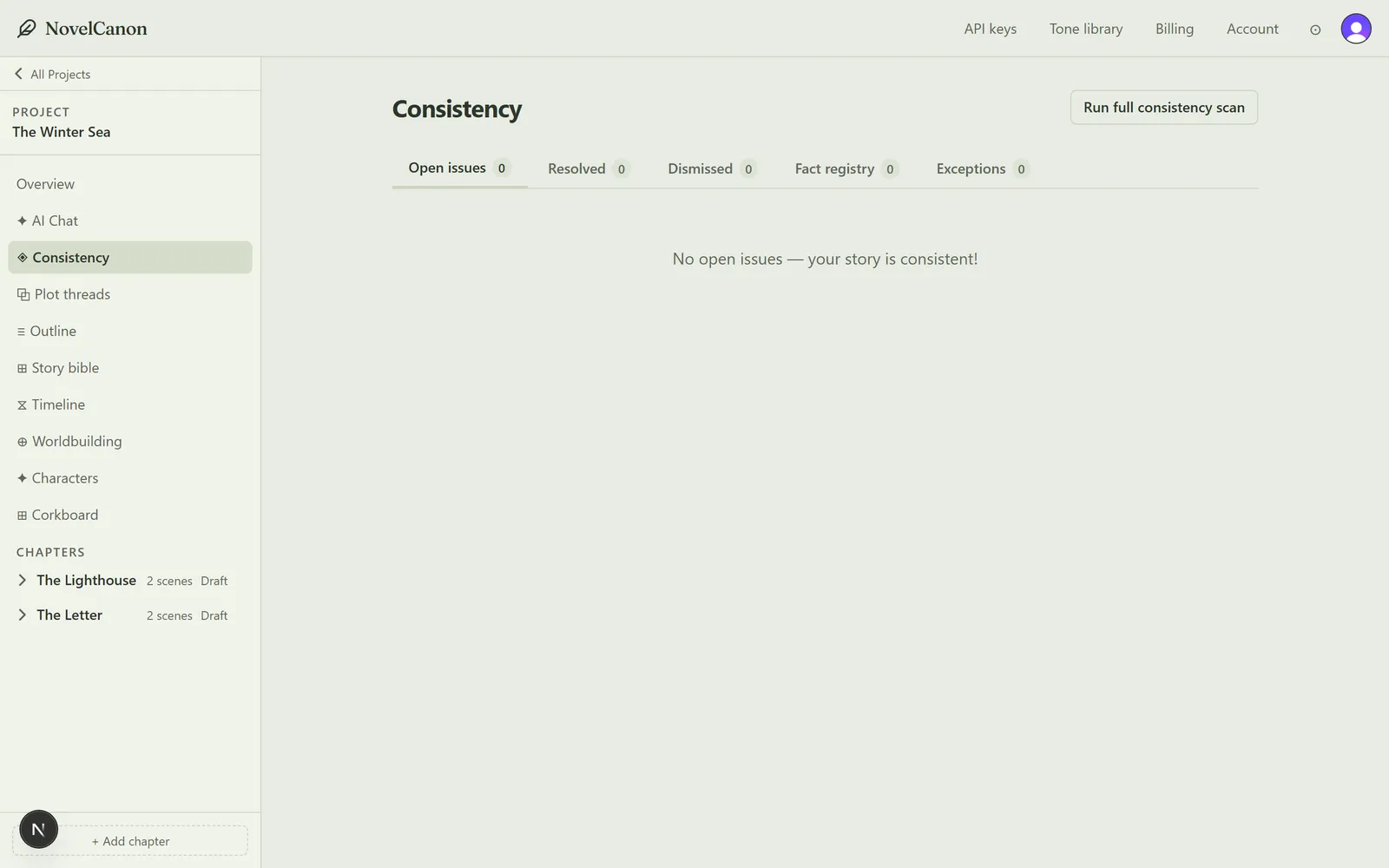
The Consistency page is both where a manuscript continuity check starts and where its results land. This demo project is clean — a real scan fills the Open issues tab.
Two practical notes. The scan needs an internet connection, so the button is disabled while you are working offline; everything else in the editor keeps working. And the full-manuscript deep scan is a NovelCanon Pro feature — the instant as-you-type checks and the per-scene fact extraction are not.
What does a full consistency scan actually check?
Five kinds of agreement, drawn from two different sources: your prose, and what you have declared. That distinction matters more than it sounds like it should, because it tells you what you have to set up before a given check can find anything.
| The check | What it looks for | Fed by |
|---|---|---|
| Contradiction detection | The same subject holding two incompatible values for the same attribute | Facts extracted from your prose |
| Knowledge-timeline sweep | A character acting on information before the story gives it to them | Your prose, plus recorded knowledge |
| Plot-thread analysis | Threads introduced and never resolved before the manuscript ends | The Plot board |
| Relationship validation | Conflicting relationship states, or a relationship resuming after a terminal one | The Characters board |
| World-rule compliance | Scenes that break a rule you have written down | Your Worldbuilding rules |
The first two run automatically from your writing. The last three only work on what you have entered — the engine verifies your plot threads, relationships, and world rules; it does not invent them. So if your magic system's rules have never been written down anywhere, the world-rule pass has nothing to check against and reports nothing. That is not a bug, but it is the most common reason a first scan comes back quieter than expected.
Worth knowing what it does not do, too: contradiction detection compares facts attribute by attribute, so a contradiction expressed in two entirely different vocabularies can slip past it. Semantic matching across differently-worded facts is a planned improvement, not a shipped one. How the Consistency Engine works covers the mechanics and the boundaries in more detail.
What does a continuity check cost to run?
Whatever your own AI provider charges for the analysis, with no markup — and you approve the estimate before anything runs. NovelCanon is bring-your-own-key, so the scan bills to your OpenAI, Anthropic, Google, or OpenRouter account at that provider's rate.
The part that surprises people: the estimate is driven by how many facts your story has, not how many words. It is a function of tracked facts, declared world rules, and recorded character knowledge, because those are what the analysis passes actually compare. A 120,000-word novel with a disciplined registry can cost less to scan than a 40,000-word novella with a cast of forty and a hundred loose world rules.
Two things keep the number low. The scan runs on a pinned economical analysis model, separate from whatever model you write with — you can select a stronger one in the dialog to catch subtler issues, and the estimate updates when you do. And the price is calculated against live model pricing, not a stale table, so the figure in the dialog is the figure you pay. For the wider picture of what AI-assisted drafting costs, we measured ours.
How do you triage the results without chasing false positives?
Read every flag as a question, not a verdict — and expect a good number of them to have a good answer. This is the part of a continuity check nobody warns you about, and it is where the value is won or lost.
We have hard numbers on this, because we ran the scan over the full text of Dracula. It extracted 4,738 checkable facts. A blunt "any changed value is a contradiction" check flagged 164 conflicts. Once facts that are supposed to change were told apart from facts that are not, genuine flags collapsed to three.
| Scanning Dracula | Count |
|---|---|
| Facts extracted from the full text | 4,738 |
| Conflicts a naive check flags | 164 |
| Flags surviving scrutiny | 3 |
Lucy Westenra is alive, then dead, then walking Hampstead Heath. To a naive checker that is a screaming contradiction. It is also the plot. The full write-up goes through what that gap taught us, but the working rule that falls out of it is simple: fixed facts — eye colour, birthplace, species — should never change, while state — health, location, mood, whether someone is alive — is supposed to.
So when you work the Open issues tab, each card offers three honest responses:
- Fix the prose. A contradiction card asks "Which is correct?" and lets you keep one value as canon. Every scene still asserting the other stays flagged, with a → fix link that opens that scene with the offending line highlighted. Keeping a value does not rewrite anything — you still go and change the sentence yourself.
- Mark it intentional. A disguise, an unreliable narrator, a deliberate lie. It's intentional creates an exception you can refine in the Exceptions tab, so the device stops being re-flagged on every future run.
- Ignore it. Not a real problem — hidden, and not re-detected.
Nothing here edits your manuscript. Every finding is a suggestion, and the engine is built to fail open: when it is unsure, it raises the question rather than acting on it.
What happens after you fix a continuity error?
The flag clears itself, because the facts were derived from your prose in the first place. Edit the line that asserted the wrong value and the support for that fact disappears, the fact retires, and the issue it was feeding resolves at the next reconciliation — you never go back and tick anything off by hand. Resolved issues move to the Resolved tab, so you keep the record of what you fixed.
You do not need to re-run the full scan after every fix. Re-run it after a revision — a restructured act, a cut chapter, a new subplot — because that is when new contradictions get made rather than removed. In practice: one scan when the draft is done, one after each structural pass, and a last one before the manuscript goes out.
If your manuscript currently lives somewhere else, that is a smaller obstacle than it looks: NovelCanon imports a Scrivener project directly, along with DOCX, Markdown, and EPUB, and seeding the registry from the imported text gives you something to scan within a few minutes. And if you would rather build the discipline than buy the tool, the complete guide to story consistency covers the manual system properly — the fact sheet, the seams worth checking, and the habits that stop these errors being written in the first place.
Frequently asked questions
How long does a manuscript continuity check take?
By hand, a careful pass over a 90,000-word novel is a multi-day job — you are building a fact sheet and then re-reading the whole book against it. Automated, it runs as a background job while you keep writing, and its duration scales with how many tracked facts your story has rather than how many words, so a long book with a tidy registry finishes faster than a short one with a sprawling cast.
Can ChatGPT do a continuity check on my novel?
Partly, and unreliably. A chat model has no durable memory of your story between conversations, and recall degrades across a novel-length context even when the whole book technically fits — models attend strongly to the beginning and end and lose fidelity in the middle. That makes it fine for checking two chapters against each other and poor at the thing that actually matters: comparing chapter three with chapter thirty.
Do I need a story bible before I can run a continuity check?
No. A continuity check needs a record of what your story claims, but that record can be derived from your prose instead of typed in first. NovelCanon extracts facts from each scene as you write, and after importing a finished manuscript you can seed the registry from the whole book in one pass — the suggestions land in a review queue rather than being treated as canon straight away.
Is a continuity check the same as proofreading or copyediting?
No, and they catch opposite things. Proofreading looks at the surface of a sentence — spelling, grammar, punctuation. A continuity check ignores the sentence entirely and asks whether its claims agree with the rest of the book. A perfectly proofread manuscript can still have a character's eyes change colour in chapter nineteen: the sentence is clean, the fact is wrong.
Can a continuity check flag something that is not actually an error?
Yes, and any honest tool will tell you so. Characters are supposed to change — they age, they move, they die — and a naive check reads every change as a contradiction. Expect false positives, treat every flag as a question rather than a verdict, and use the "It's intentional" and "Ignore" actions so a deliberate device such as a disguise or an unreliable narrator stops being re-flagged on later runs.
Do I have to re-run the whole scan after fixing a continuity error?
Not for a fix that changes the prose. NovelCanon's facts are derived from your scenes, so editing the offending line removes the support for the wrong fact and the issue retires itself on the next reconciliation. You would re-run a full scan after a substantial revision — a restructure, a new subplot, a cut chapter — because that is when new contradictions are actually created.
Written by
Munib Ali Laghari
Founder, NovelCanon
Building the writing studio he wished he had for keeping a long story straight — one where the AI never loses the thread.