Character Consistency: Stopping Eye-Colour & Backstory Drift
Character consistency means eye colour, age, and backstory hold steady unless the story changes them on purpose. How drift happens, and how to catch it.
Character consistency means a character's established facts — eye colour, age, backstory, what they know — hold steady unless the story deliberately changes them, and their behaviour stays true to who they are even as they grow. It breaks not from carelessness but from memory: a detail set once, early, and reinvented later by a writer who has, understandably, forgotten it.
Eye colour is the error everyone jokes about. Anne Rice's Lestat can't settle on one across the Vampire Chronicles. Julia Quinn has admitted, on her own FAQ page, that Eloise Bridgerton's eyes are blue in book one, green in book two, and grey in book five. It's a real, well-documented category of mistake — and it's also the least damaging kind. The one that actually costs you a reader's trust is quieter: a character's backstory shifting underneath them, so the person acting in chapter twenty doesn't have the same history as the person you introduced in chapter two. This is a guide to both — why they happen, why they're not the same problem, and how to catch each before a reader does.
Key takeaways
- Character consistency has two failure modes, and they're not equally dangerous. A wandering eye colour is a cosmetic slip readers roll their eyes at. A drifting backstory is a logic error — it can quietly invalidate a character's motivation.
- Both happen for the same reason: a detail set once, early, and never checked again. Nobody forgets a fact on purpose. They forget because nothing forced them to look it up.
- Consistency isn't the same as staying static. A character can change completely across a book — the test is whether the story earned the change, not whether they're the same person on the last page as the first.
- Backstory drift is harder to catch than physical drift because it's usually delivered in dialogue and narration, scattered across many scenes, not one describable detail you can search for.
- Revision is when most drift enters, not drafting. Moving, cutting, and rewriting scenes is exactly what disconnects a later reference from the version you actually settled on.
- A record that tracks facts as claims — not just descriptions — catches both kinds automatically. See how to keep track of characters without a spreadsheet for the full method.
What is character consistency, and why does it break?
Character consistency is the agreement between every fact your story asserts about a character, across every scene it appears in. It breaks for an unglamorous reason: you set most character facts once, early, in a single sentence — "her eyes were the grey of a winter sky" — and then you don't revisit that sentence for another two hundred pages. By the time a later scene needs the detail again, you're working from memory of a story you've since rewritten twice, and memory is exactly the tool that fails at this job.
It's worth separating this from a related but different idea: consistency is not sameness. A character who is the same person, wanting the same thing, reacting the same way on page 300 as page 3 usually isn't consistent — they're static, and static characters are the actual craft failure most writing advice warns about. What consistency protects is the facts underneath the character — their history, their fixed attributes, what they've learned and when — so that their growth, when it happens, is a change the reader can trace to a cause, not a discontinuity they can't explain.
What are the most common character consistency errors?
Physical description drifts most often because it's the easiest fact to set and forget — but it's also the error readers forgive fastest. Below it, in ascending order of how much damage they do to a story, sit the errors that touch what a character actually is.
| Error type | What actually changes | How much it costs the story |
|---|---|---|
| Physical description | Eye or hair colour, height, a scar that moves, handedness | Low — readers notice, some readers mock it, few readers stop reading |
| Age / timeline | A birth year that doesn't add up, an age that jumps unexplained | Medium — undermines specific scenes that depend on the math |
| Voice and mannerism | Speech patterns, vocabulary, tics that vanish or swap between characters | Medium — readers lose the thing that let them tell characters apart |
| Relationships | Who a character has met, how they know each other, the state of a bond | Medium-high — later scenes can become logically impossible |
| Backstory / history | Where they grew up, how a parent died, when they learned a skill | High — drives motivation, so the whole character's logic can bend |
| Knowledge | Acting on information they were never given, or forgetting what they were | High — breaks the specific scene it appears in, immediately and visibly |
Two well-documented real examples show how even careful, professional authors lose the easiest category. In her own FAQ, Julia Quinn confirms Eloise Bridgerton's eyes are described as blue in The Duke and I, green in An Offer from a Gentleman, and grey in To Sir Phillip, With Love — three books, three colours, caught by readers long before Quinn addressed it herself. Anne Rice's Lestat fares no better across the Vampire Chronicles, where his self-described eye colour shifts repeatedly across the series. Neither writer was careless. Both were managing a cast across hundreds of thousands of words with nothing forcing a check against the earlier books — which is precisely the condition under which this error is inevitable, not exceptional.
Why is backstory drift more dangerous than eye colour?
Because eye colour is decorative and backstory is structural — it's the thing a character's choices are built on, so when it drifts, the choices stop making sense too. A wandering eye colour embarrasses a writer. A wandering backstory can quietly break the story's logic while looking, on a scene-by-scene read, completely fine.
Here's the shape of it. Say you establish in chapter four that Marcus's father died when Marcus was seven, and that loss is why Marcus can't trust authority. It's load-bearing — his entire arc runs on that wound. Then, drafting a flashback in chapter twenty-two, you write his father dying when Marcus was twelve, older, present enough to remember him as a real person rather than an absence. Nothing about the sentence itself looks wrong. It reads as good, specific detail. But it quietly changes why Marcus doesn't trust authority — a five-year gap is the difference between a wound that shaped him before he had language for it and one he actively remembers forming. The contradiction isn't in one detail; it's in every scene downstream that assumed the first version.
This is why backstory drift survives so much longer than a wandering eye colour: physical description is something you can search a manuscript for — "grey" and "blue" and "green" all next to a character's name — and catch on sight. Backstory is scattered across dialogue, narration, and other characters' reactions, in a dozen different phrasings, and none of it announces itself as the same fact restated. You don't catch it by searching. You catch it by tracking the fact itself, not the sentences that mention it.
Is character growth the same as inconsistency?
No, and confusing the two is the single most common reason writers under-correct real drift or over-correct real growth. They look identical from the outside — a character behaving differently at the end of the book than at the start — and opposite underneath.
The test is causation, not difference. Growth is a change a reader can trace to a scene: Elena distrusts strangers in chapter one because you show her being betrayed by one; by chapter thirty she trusts a stranger, and it costs her something to do it, because you've shown the six scenes that earned it. Inconsistency is the same surface change with no scene behind it — Elena distrusts strangers in chapter one and, with nothing in between to explain it, acts warmly toward one in chapter fifteen because that's what the scene needed in the moment. Ask the question directly: could I explain this change to a reader who stopped and asked why? If yes, it's an arc. If you'd have to invent the answer after the fact, it was never earned — it drifted.
This matters practically because the fix is different for each. Real drift gets corrected — pick the version that's actually canon and fix the rest. Real growth gets protected — make sure the causal scene is actually on the page and not just in your head, because a reader can't credit a change they never saw happen.
How do you catch character consistency errors before readers do?
Separate what you're tracking into two categories that behave differently, and check each the way it actually breaks. Fixed attributes — name, age, appearance, core backstory facts — barely change and are easy to search for once you know to look. Dynamic state — what a character currently knows, where they are, who they've met — changes every scene and is where knowledge and relationship errors live.
The practical method:
- Write a one-page profile per major character with the facts you'd be embarrassed to contradict: name and its exact spelling, age, physical details, the two or three backstory facts the character's arc depends on. Keep it short enough that you'll actually maintain it.
- Record backstory as a checkable claim, not a description. Not "his father died when he was young" but "Marcus's father died when Marcus was seven." A claim has a truth value a later scene can violate; a vague description doesn't.
- Do a dedicated continuity read for characters specifically — not a full editing pass, just a search for every mention of a character's fixed facts, checked against the profile.
- Watch revision harder than drafting. Moving a flashback, cutting an origin scene, or rewriting a character's introduction is exactly when the version in your head and the version on the page split apart.
- Search for the specific detail across the whole manuscript. If a character's hometown, age, or defining backstory fact appears in three different forms, one of them is wrong — and now you know which scenes to check.
This is the same discipline as tracking a character's changing state day to day, just applied to the facts that barely move. For the deeper method — including how to track what a character knows at each point in the story, which is where most character errors during revision actually originate — see how to keep track of characters in a novel without a spreadsheet.
Can AI writing tools cause character drift?
Yes, and it's worth understanding the mechanism, because it's different from a human forgetting a detail. A language model generating your next paragraph is choosing the statistically likely continuation of the text it can see — and if your character's grey eyes were established forty pages and one context window ago, "brown," being the far more common eye colour in the model's training data, is a genuinely more probable next word than the one you actually chose. The model isn't forgetting; it never had reliable access to the fact in the first place, and it will quietly regress toward the generic version the longer a scene runs.
The fix is structural, not vigilance: check every AI-generated passage against your established facts before you accept it, not after you've written three more chapters on top of it. This is exactly why NovelCanon audits AI-generated text against your story before you keep it — a passage gets checked against your established characters, timeline, and point of view, with the result surfaced right on the suggestion, so if a generated scene quietly gives Elena the wrong eye colour or has Marcus reference a father who died at the wrong age, you see it while the passage is still highlighted and reversible, not two hundred pages later when the drift has compounded into a dozen more scenes built on top of it.
How does NovelCanon catch character consistency automatically?
Everything above works by hand, and for a short story or a lean cast, by hand is genuinely fine. It gets expensive exactly when it matters most — a large cast, a long series, months between when you set a fact and when you need to remember it.
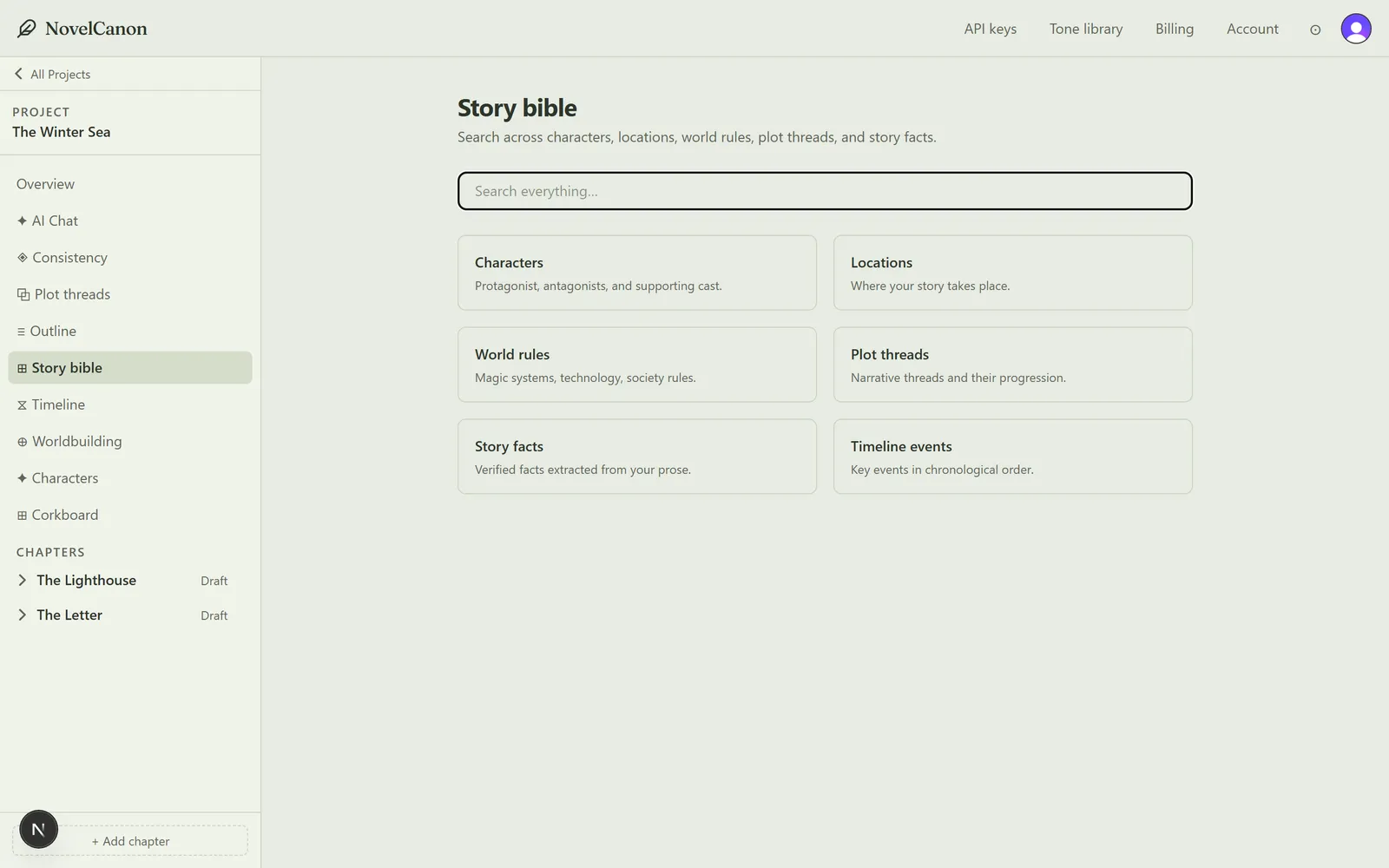
Character records in the NovelCanon story bible — built from the scenes themselves, so a character's tracked facts can't quietly drift from what you actually wrote.
NovelCanon's Consistency Engine handles character consistency at three different speeds. As you type, instant checks catch the cheap slip — type "Katharine" after ninety uses of "Katherine" and it's flagged in the editor before you finish the sentence, zero AI cost. As you finish each scene, it reads the prose and extracts the facts you've committed to — a character's age, appearance, and backstory details — into a registry that updates itself from what you wrote, so there's no separate document that can fall out of sync with the manuscript. And a full-manuscript deep scan cross-references every one of those facts against every other mention of the same character, across the whole book, surfacing the contradiction that's four hundred pages and one forgotten detail away from where you're currently writing.
None of it replaces your judgement about who your characters are — a genuine arc still needs you to write the scene that earns it, and the engine won't tell you whether a change feels true. What it removes is the memory tax: the searching, the re-reading, the hoping you remembered Marcus's age correctly. You can see the full system in the complete guide to story consistency, read how the Consistency Engine tracks facts under the hood, or run the check on a draft you already have with a manuscript continuity check. The full three-tier engine is part of NovelCanon Pro; the free plan lets you try the workflow first.
Eye colour is the mistake everyone catches and nobody minds much. Backstory is the one that quietly rewrites why your character does anything at all — and it's worth exactly as much attention as the plot itself, because to your reader, it is the plot.
Frequently asked questions
What is character consistency in writing?
Character consistency means a character's established facts — appearance, age, history, what they know — stay true unless the story deliberately changes them, and their behaviour stays true to their established values even as they grow. It is not sameness: a character can change completely over a book, as long as the change is earned on the page, not silently assumed by the writer.
Why does a character's eye colour change partway through a novel?
Almost always because the detail was set once, early, in a single line of description, and never referenced again until a much later scene needed a physical beat — at which point the writer, working from memory instead of a record, picks whichever colour feels right in the moment. It is a memory failure, not a research failure: nobody forgets on purpose.
What is backstory drift?
Backstory drift is when a character's stated history changes across a manuscript — where they grew up, how a parent died, when they learned a skill — usually because the detail was mentioned once in dialogue or narration and reinvented later without checking. It is more dangerous than a physical slip because backstory drives motivation, so the contradiction can quietly break a character's logic, not just their description.
Does character growth count as an inconsistency?
No — growth and inconsistency look similar on the page but are opposites underneath. Growth is a change the story earns: a scene or sequence of scenes causes it, and a reader can point to why. Inconsistency is a change with no cause the reader can see. The test isn't whether a character is different by chapter thirty; it's whether you could explain the difference to a reader who asked.
Can AI writing tools cause character drift?
Yes, and for a specific reason: language models generate the statistically likely next word, and the most common eye colour or the most common backstory detail in their training data is more likely than the one you actually established two chapters ago. Left unchecked, a long AI-assisted scene will quietly drift toward the generic. The fix is checking every AI passage against your established facts before you keep it, not after.
How do you fix a character consistency error you've already published or drafted?
Decide which version is canon, then search your manuscript for every mention of that detail and correct the rest — a project-wide find-and-replace handles the mechanical part safely if you snapshot first. For backstory drift, check what else in the story was built on the wrong version, since a changed history can ripple into motivation and dialogue, not just one sentence.
Written by
Munib Ali Laghari
Founder, NovelCanon
Building the writing studio he wished he had for keeping a long story straight — one where the AI never loses the thread.