What Is a Story Bible? (And the One That Maintains Itself)
What is a story bible? A living record of your novel's characters, world, timeline, and rules — plus why most drift, and how a self-maintaining one fixes it.
A story bible is a living reference document that records everything your novel commits to — characters, world rules, timeline, relationships, and open plot threads — so the book never contradicts itself. Borrowed from television writers' rooms, it's the single source of truth you check your story against once it grows too large to hold in your head.
Somewhere around forty thousand words, every novelist meets the same wall: the story no longer fits in memory. You've named a hundred things, set a dozen rules, and made small promises you've already half-forgotten. A story bible is the oldest, most reliable answer to that problem — and, increasingly, it's an answer that can keep itself up to date. This guide covers what a story bible actually is, what goes in one, how to build it, and the one failure that quietly defeats most of them.
Key takeaways
- A story bible is a single, living record of your story's facts — characters, world, timeline, rules, and open threads — that you check the book against so it can't contradict itself.
- It came from television. Writers' rooms invented the series bible so a rotating staff could keep a show consistent across seasons — the same problem a novelist faces alone across months.
- Scale it to the story. A standalone romance needs a lean one; a six-book epic needs a deep one. Track what you're most likely to forget, not everything.
- Start it with your first scene. The habit that makes bibles work is adding to it the moment you invent a fact — "later" never comes.
- Every story bible has one failure mode: drift. The moment your notes and your manuscript disagree, the bible is lying to you — and to any AI reading it.
- A bible derived from your prose can't drift. A self-maintaining story bible reads the facts out of your scenes, so the record stays true to the text.
What is a story bible?
A story bible is the authoritative reference for everything true inside your fiction — the facts a reader would notice you breaking. Not the prose, and not the plot outline: the facts underneath them. A character's age and the spelling of her name. How far it is to the coast. What magic costs. Who knows the secret, and since when. It's a single place that answers the question what has this story already committed to? so you never have to answer it from memory — the faculty that fails you across a book-length project.
The idea isn't new, and it isn't ours. It comes from screenwriting: the series bible was invented in television writers' rooms so that a rotating staff of writers could keep a long-running show consistent. Seasons stretch on, writers come and go, and without a shared record the show would drift — a character's history contradicting itself, an established rule quietly broken. The bible was the fix: one reference every new writer was handed so the show stayed itself. A novelist faces exactly that challenge, only compressed into one skull across months of solo work. You are the writers' room, and the you of chapter twenty has forgotten what the you of chapter two invented.
That's the whole rationale. A story bible externalises the memory a novel needs but no writer has.
What goes in a story bible?
Everything checkable — the facts a later scene could contradict — organised so you can find them fast. The exact sections vary by genre, but a complete story bible covers six kinds of thing:
| Section | What it records | The error it prevents |
|---|---|---|
| Characters | Names and spellings, ages, appearance, relationships, what each knows and when | Eye colour that drifts; a character who acts on a secret they were never told |
| World & rules | How magic, technology, or society works — and its limits | Magic that costs a life in chapter 4 and nothing in chapter 22 |
| Timeline | The order of events and how much time passes between them | A journey that takes three days out and a week back; an impossible pregnancy |
| Places | Layout, distances, travel times | A house that gains rooms; a two-day ride that's suddenly overnight |
| Plot threads | What you've set up that still needs paying off, and its status | The sealed letter introduced in chapter 5 and never opened again |
| Style sheet | Spelling and hyphenation choices, invented terms, capitalisation | "grey" and "gray" both appearing; an invented place spelled two ways |
Two of these are quietly the most valuable. The world rules section should record not just what's possible but what isn't — because limits are what create tension, and they're the first thing to erode when you need a character out of a corner. And the style sheet is the professional's secret: copy-editors keep one for every book precisely because invented words and spelling choices are impossible to keep straight otherwise. As Jane Friedman notes in her guide to the story bible, the point is a reference that's current and specific enough to stop the novel contradicting itself three chapters later — so record the things you'll forget, not the things you'll obviously remember.
Do you need a story bible for a standalone novel?
Yes — though a standalone's bible can be lightweight. The instinct that bibles are only for sprawling fantasy series is the reason so many standalone novels ship with contradictions. Even a single contemporary novel makes hundreds of factual commitments across months of drafting, and no writer holds them all. A two-page bible that records names, key dates, and physical details pays for itself the first time it stops you contradicting chapter two in chapter twenty.
The rule is to scale the bible to the story. A lean romance needs little more than a cast list, a rough timeline, and a style sheet. A six-book epic with an invented magic system, three continents, and a century of backstory needs a deep, cross-referenced one — because the volume of things that can silently disagree is enormous. Match the effort to the risk: track what's most likely to trip you, and leave the obvious alone. For a series specifically, the bible has to persist across books, since the nastiest continuity errors live at the seams between instalments written years apart.
How do you make a story bible?
Set up the sections above before you draft if you can, then add to it relentlessly as you write. The mechanics barely matter — the discipline is everything. You can build a story bible in a plain document, a spreadsheet, a wiki like Notion or Obsidian, index cards, or a dedicated app. Pick whatever you'll actually keep open beside the manuscript.
There's really only one rule that determines whether a story bible works:
Start it with your first scene, and update it the moment you invent a fact on the page — not "later."
This is where most bibles die. Treated as a chore for after the draft, they never get built, because reconstructing three hundred pages of scattered detail is its own miserable project and "later" never arrives. Treated as a running habit — when you write "the tower had seven bells," the bible gets tower: seven bells — the cost per entry is tiny and the payoff compounds across the whole book. A few practical notes:
- Record facts as claims, not description. "Elena is guarded" can't be contradicted; "Elena has never left the capital" can. Write the checkable version — a claim has a truth value a later scene can violate, which is the whole point. (More on this in the complete guide to story consistency.)
- Give major characters their own page. Appearance, what they know, where they are. Minor characters can share one — but track them too; the misremembered spear-carrier is a classic error. This is the heart of keeping track of your characters.
- Keep it findable. A bible you can't search fast, you won't consult mid-scene — and a bible you don't consult is just decoration.
Why do most story bibles fail?
Because they have one failure mode, and it's fatal: drift. A story bible is a copy of your story's facts, kept by hand alongside the real thing — the manuscript. And the instant the two disagree, the bible stops helping and starts actively lying. You rename a character in the prose but not the bible; you change a rule in chapter eighteen and forget to update the entry; you compress a timeline in revision and the bible still shows the old one. Now your source of truth is wrong, and worse than nothing, because you trust it.
Every manual method — document, wiki, spreadsheet, cards — shares this weakness, because they all depend on the same fragile thing: your discipline to keep two records in sync forever. And keeping two things in sync by hand, over a hundred thousand words and many months, is precisely the labour the human mind is worst at. It's the same weakness that put the error in your manuscript in the first place. A bible fights inconsistency with more of the exact bookkeeping that caused it — which is why bibles so often fall out of date around the same chapter the contradictions start.
This isn't an argument against story bibles. It's an argument about where the bible should live. If the record and the manuscript keep drifting apart, the fix is to stop keeping them apart.
What is a story bible that maintains itself?
It's a story bible that isn't a separate document you maintain, but a projection of your prose that the software keeps in sync for you. Instead of you copying facts into a reference, the tool reads each scene as you finish it and extracts the facts out of it — the characters present, what they now know, the rules established — and files them automatically. The record can't drift from the manuscript, because it's derived from the manuscript.
A growing number of writing tools now offer some version of this, and it's worth being clear-eyed about the difference between them, because "self-updating" covers a lot of ground. The shallow version just auto-tags names — it spots that "Elena" is a character and makes her a card. Useful for saving typing; useless for catching errors, because a list of names can't tell you that chapter thirty contradicts chapter three. The version that matters extracts the claims each scene makes and connects them to a checker, so the bible doesn't just populate — it notices when a new scene disagrees with an established fact.
That deeper approach is how NovelCanon's story bible works. Its Consistency Engine reads each finished scene and builds a living registry of your story's facts from the prose itself — a story bible you never typed. Because the facts are derived, the record self-heals: fix a contradiction in the text and the fact that supported the old version simply retires, no settings panel required. And crucially, the registry feeds a full-manuscript deep scan that cross-references every tracked fact, thread, and rule — so the bible isn't a passive document, it's the memory a checker uses to catch the contradiction four hundred pages away.
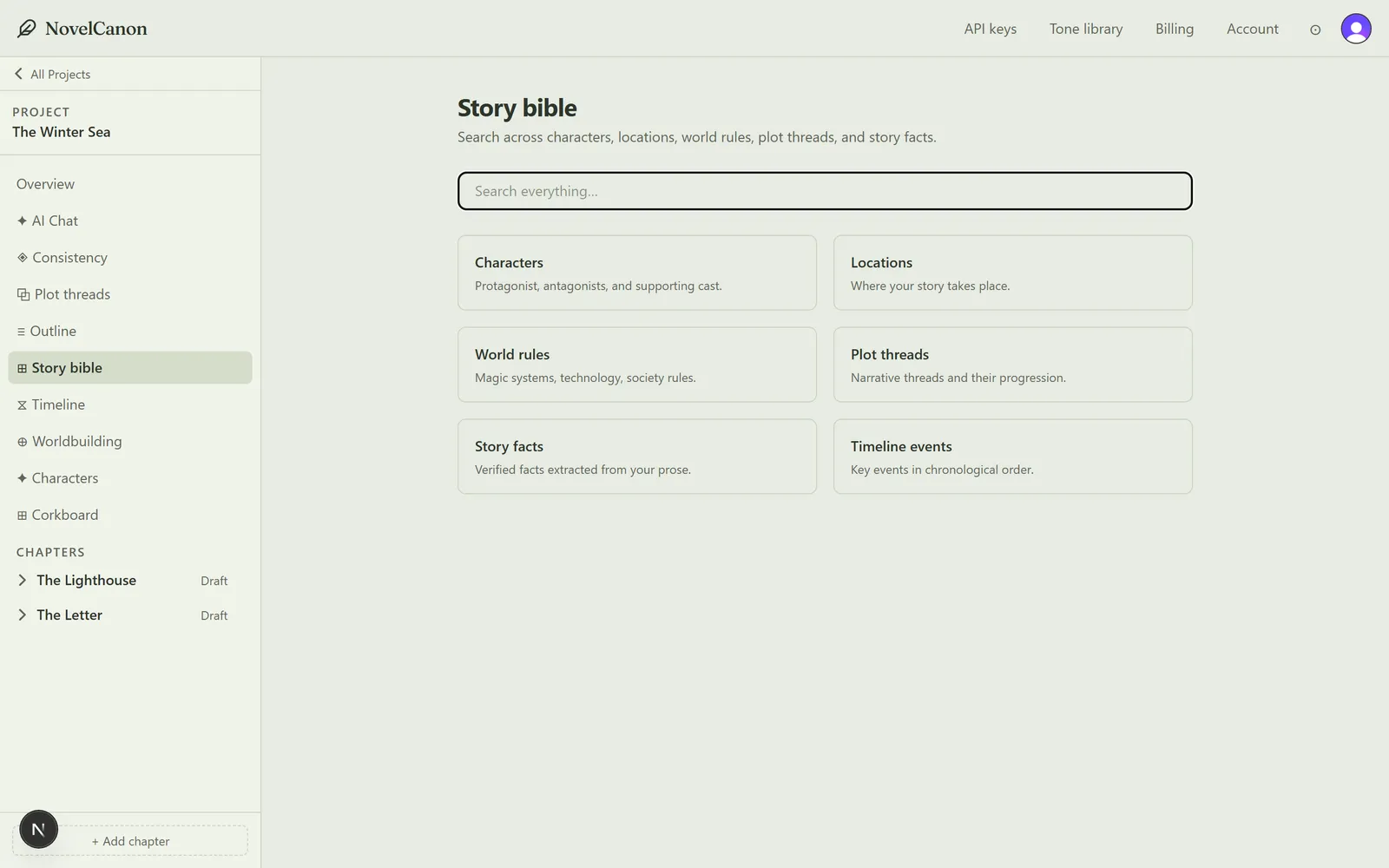
A story bible in NovelCanon — characters, world rules, timeline, and plot threads, populated from the prose itself rather than typed and maintained by hand.
It doesn't replace your judgement about what your story's facts are — you still decide them, and you can correct anything the engine reads wrong. What it removes is the copying and the remembering: the exact chores that make hand-kept bibles drift. If you're comparing this to a traditional manual codex, that contrast is the whole story of NovelCanon vs Novelcrafter; if you want the mechanics, here's how the engine tracks facts across a manuscript. The full engine is part of NovelCanon Pro; the free plan lets you try the workflow first.
A story bible was always the right idea — a single source of truth so your novel never contradicts itself. For most of its history, keeping that truth current was a second job. The only thing that's changed is that the record can now keep itself, by living where the facts actually come from: your own words on the page.
Frequently asked questions
What's the difference between a story bible and a series bible?
A story bible covers one book; a series bible covers the whole series and persists across every instalment. They hold the same kinds of information — characters, world, timeline, rules — but a series bible has to outlive any single manuscript, because the worst continuity errors in a series appear at the seams between books written years apart. In practice a series bible is just a story bible you never close.
When should you start a story bible?
With your first scene. The single habit that makes a story bible work is adding to it the moment you invent a fact on the page, rather than reconstructing it "later" — later never comes, and by then the details are scattered across hundreds of pages. If you're already deep in a draft, start now with your main characters and world rules and build forward.
How long should a story bible be?
As long as the story needs and no longer. A standalone contemporary romance might need two pages; a six-book epic fantasy needs far more, because there is simply more to keep straight. Track the things you're most likely to forget or contradict — invented names, world limits, who knows what — not every detail. A bible so elaborate you won't maintain it is worse than a short one you will.
Do you need a story bible if you don't outline (pantsing)?
Especially then. A discovery writer generates facts unpredictably as they draft, so there's no outline to check against — which makes a running record of what you've already committed to more valuable, not less. You don't have to plan ahead; you just have to write down what you've decided. A story bible that builds itself from your prose suits pantsers best, because it needs no upfront structure.
Can a story bible update itself automatically?
Yes — a growing number of tools now read your manuscript and populate a story bible from it. The difference that matters is depth: some only tag character and place names, while a true self-maintaining bible extracts the factual claims each scene makes and cross-references them so it can flag when a later chapter contradicts an earlier one. Auto-tagging saves typing; a connected registry actually catches errors.
Written by
Munib Ali Laghari
Founder, NovelCanon
Building the writing studio he wished he had for keeping a long story straight — one where the AI never loses the thread.