Plot Threads: How to Track Them (and Catch Dropped Ones)
What plot threads are, how many a novel needs, and how to track every one, with a chapter-by-chapter map of every thread in The Hound of the Baskervilles.
A plot thread is one line of story running through a novel: a question, goal or promise that opens in one scene and closes in a later one. To track plot threads, list each one with the scene where it opens, every scene that moves it and the scene where it closes. One that never closes is a dropped thread.
Every novel makes promises. A letter arrives that nobody opens. A stranger is seen on the hill. A boot goes missing from a hotel corridor. Each one is a plot thread, and the reader holds on to it until the book lets go. Close it well and the ending feels earned. Forget it and someone writes "what happened to the letter?" in a review.
This guide covers what plot threads are, how they differ from subplots, how many a novel can carry, and how to track every one through a draft. To make it concrete, we mapped every thread in The Hound of the Baskervilles, chapter by chapter: when each one opens, how long it goes quiet, and how it ends.
Key takeaways
- A plot thread is a promise with an opening scene and a closing scene. Main plots, subplots, clues and secrets are all made of threads.
- Count the threads open at once, not the total. The Hound of the Baskervilles opens 14 threads but never has more than 10 open at the same time, and it opens no new ones in its last five chapters.
- A thread can close four ways: a payoff, a dead end shown on the page, an explanation after the fact, or an open ending the book admits to. The only bad ending is silence.
- Quiet stretches are fine if you remind the reader. Doyle's longest silence is five chapters, and the thread is mentioned again before it pays off.
- Tracking threads means tying each beat to a scene. Then a dropped thread shows up as one whose last beat comes long before the end.
What is a plot thread?
A plot thread is a single line of story that the reader follows across scenes: a question that needs an answer, a goal that needs an outcome, or a setup that needs a payoff. It opens when the story raises it and closes when the story settles it.
Threads come in every size. The main plot is the biggest thread in the book, opened by the inciting incident and closed by the climax. Below it sit subplots, and inside those sit smaller threads: a clue, a rivalry, an injury, an object that has gone missing. What makes something a thread isn't its size. It's that the reader expects it to come back.
Arthur Conan Doyle used the word himself. In chapter 5 of The Hound of the Baskervilles, two leads fail in one evening and Holmes says, "There go two of my threads, Watson." Pages later a third one fails: "Snap goes our third thread, and we end where we began." He even titled the chapter "Three Broken Threads." Holmes treats a case the way a novelist should treat a draft: as a set of open lines, each of which has to end somewhere.
What's the difference between a plot thread and a subplot?
A subplot is a secondary storyline with its own arc, usually following a supporting character or a relationship. A plot thread is any open question the reader is tracking, so it's often smaller than a subplot and can belong to the main plot.
In Hound, the escaped convict is a subplot: he has his own arc, from news of his escape in chapter 6 to his death on the moor in chapter 12. The note pasted together from newspaper words is a thread but not a subplot. It's one unanswered question (who sent it?) that sits inside the main mystery.
This matters for tracking, because a thread-level list catches things a subplot list misses. Writers rarely forget a whole subplot. They forget the small promise inside one.
How many plot threads should a novel have?
There's no fixed number, but a useful range exists. A 2012 article in The Writer, Keep your plot threads under control, recommends six to eleven threads, a figure its author arrived at by examining published novels. It's a fair starting point, and it raises a better question: six to eleven at once, or in total?
We counted. The Hound of the Baskervilles (15 chapters, about 59,000 words) opens 14 threads, not counting the main mystery that runs the whole book. That's above the range in total. But they never pile up: the most open at the end of any chapter is 10.
| End of chapter | 1 | 2 | 3 | 4 | 5 | 6 | 7 | 8 | 9 | 10 | 11 | 12 | 13 | 14 | 15 |
|---|---|---|---|---|---|---|---|---|---|---|---|---|---|---|---|
| Threads open | 1 | 1 | 2 | 6 | 6 | 8 | 9 | 9 | 9 | 10 | 8 | 6 | 4 | 2 | 0 |
Threads open at the end of each chapter of The Hound of the Baskervilles, excluding the main mystery. Counted from the Project Gutenberg text.
The shape is the useful part. Threads open steadily through the first two thirds of the book and stop: the last new one appears in chapter 10. From chapter 11 on, the book only closes threads, two per chapter, until none are left. That's what a satisfying ending feels like from the inside. The reader isn't being handed new questions while the old ones are still waiting.
So instead of asking "how many threads?", ask two things: how many is the reader holding at the busiest point, and are you still opening new ones when you should be closing them?
Every thread in The Hound of the Baskervilles
Here is the full map. "Moves in" lists the chapters where the thread comes back between its opening and its close. We counted a thread as any question the book raises and later settles, and checked every chapter number against the text.
| Thread | Opens | Moves in | Closes | How it closes |
|---|---|---|---|---|
| Who owns the walking stick? | 1 | – | 1 | Payoff: Dr. Mortimer arrives |
| Dr. Mortimer's spaniel | 1 | 3, 6, 10 (lost on the moor) | 14 | Payoff: its skeleton in the hound's den |
| Rodger, "the very image" of Hugo's portrait | 3 | 6, 8 | 13 | Payoff: Holmes sees Stapleton's face in the portrait |
| The note pasted from newspaper words | 4 | 5, 10 | 15 | Explained: Beryl sent it |
| Searching 23 hotels for the cut newspaper | 4 | – | 5 | Dead end: "unable to trace" |
| The bearded man in the cab | 4 | 5, 7, 10 | 15 | Explained: Stapleton, shadowing them |
| Sir Henry's missing boots | 4 | 5, 6, 12 | 14 | Payoff: the old boot found in the mire |
| The test telegram to Barrymore | 5 | 7 | 8 | Dead end: "the test was worthless" |
| Selden, the escaped convict | 6 | 8, 9, 10, 11 | 12 | Payoff: dies in Sir Henry's old clothes |
| Sobbing at night, a candle at the window | 6 | 7, 8 | 9 | Payoff: Selden is Mrs. Barrymore's brother |
| Beryl's warning: "Go back!" | 7 | 9 | 12 | Payoff: she is Stapleton's wife |
| Frankland and his telescope | 8 | 10 | 11 | Payoff: he spots the boy who leads Watson to the hut |
| The man on the tor | 9 | 10 | 11 | Payoff: it's Holmes |
| A letter signed "L. L." | 10 | 11, 12 | 13 | Payoff: Laura Lyons confesses |
Text: The Hound of the Baskervilles, Project Gutenberg.
Fourteen threads, fourteen closes. Nothing is dropped. And even the smallest promise, a dog mentioned in the first chapter as the owner of some tooth marks on a walking stick, comes back thirteen chapters later, as a skeleton in the den where the hound was kept.
How can a plot thread end?
A plot thread can end four ways, and all four work. What they share is that the book tells the reader where the thread stands. The one ending that fails is silence.
- Payoff on the page. The setup comes back and settles in a scene. Ten of Doyle's fourteen threads end this way: the boot is found, the man on the tor steps into the light.
- A dead end the reader sees. The lead goes nowhere, and the book says so. Two threads end like this, and both close fast (one chapter and three chapters), which keeps a failed lead from feeling like a forgotten one. Dead ends earn their place by raising the pressure: Holmes calls the case "stimulating" precisely because everything is going against him.
- An explanation after the fact. A character explains what the reader never saw. Two threads close in the final chapter's retrospective, including the warning note. This works for a mystery, where explaining is part of the genre, but it's the weakest of the four in most other novels, so use it for a thread or two, not for your subplots.
- An open ending the book admits to. The thread stays unresolved on purpose: the question can't be answered, or it belongs to a sequel. Hound has none, but plenty of novels do. It works when the story acknowledges the open thread near the end.
- Silence. This is the dropped thread. The thread just stops. The reader is left holding it, waits, and finally decides the author forgot. Which is usually true.
The difference between a dead end and a dropped thread is a single sentence. "Visited twenty-three hotels as directed, but sorry to report unable to trace cut sheet of Times" closes a thread in one line. Without that telegram, the hotel search would be a loose end.
How long can a plot thread go quiet?
Longer than you'd think, provided the reader is reminded before the payoff. The longest silence in Hound is Sir Henry's boots: after chapter 6 ("it is gone forever") they disappear for five chapters. Then, in chapter 12, Holmes guesses that the hound was set on the scent of "the boot which was abstracted in the hotel", and two chapters later the boot turns up in the mire.
The same pattern repeats. The warning note goes quiet for four chapters, gets a single line of recall in chapter 10 ("the letter which warned Sir Henry against the moor"), then pays off in chapter 15. The spaniel goes missing in chapter 10 in one passing paragraph, and its fate lands in chapter 14.
The rule this suggests is simple: before a quiet thread pays off, mention it once. One line is enough. A payoff that arrives cold, with nothing since its setup ten chapters back, makes the reader stop and search their memory instead of enjoying the moment. And a thread that never gets its reminder is the one you're most likely to forget yourself.
How do you keep track of plot threads and subplots?
Keep a thread ledger: one row per thread, with the scene where it opens, every scene that moves it, its status, and the scene where it closes. The table above is one. Here's how to build yours.
- Name each thread as a question. "Who sent the warning?" is easier to check than "the warning subplot", because you can see when it's been answered.
- Pin the opening scene. Note where the reader first meets the thread. If you can't find a scene, the thread may exist only in your head.
- Log every beat against a scene. Each time the thread moves, add a line: what happened, and in which scene. Index cards colour-coded by thread work, and so does a spreadsheet with a row per thread and a column per chapter.
- Give each thread a status. Open while it's being set up or developed, then resolved, or abandoned if you cut it on purpose. An abandoned thread needs its setup removed from the draft too.
- Check the ledger at the end of every draft. Look for two things: any open thread whose last beat comes before your final chapter, and any thread that goes quiet for a long stretch before its payoff.
The point of tying beats to scenes is that it turns a feeling ("didn't I set something up about the letter?") into something you can look up. The thread starts at its first beat and ends at its last. If the last beat is in chapter 4 of a 30-chapter book and the thread is still open, you've found a dropped thread.
The hard part isn't the method. It's keeping the ledger current across months of drafting and revision, when you cut a scene and forget that it carried the only reminder of a thread. That's also when most plot holes get in.
How do you find a dropped plot thread in a finished draft?
Work backwards from the ending. List every question your final chapters answer, then list every question your first half raises, and compare. Anything in the second list that isn't in the first is either a dropped thread or a deliberate open ending, and you should know which.
Then, for each thread, find its last appearance. A thread whose last appearance is far from the end, with no close in between, is the one to fix. You have three options:
- Pay it off. Add the scene or the line that settles it.
- Close it as a dead end. One sentence that tells the reader the lead went nowhere.
- Cut the setup. If the thread no longer serves the book, remove the scene that promised it, so there's nothing left to drop.
A full continuity read is the natural moment to do this, alongside the character and timeline checks. On a long book, it's a slow read, which is why it's worth doing as you go rather than once at the end.
Tracking plot threads in NovelCanon
We make NovelCanon, a novel-writing app with a built-in story bible, so here's how the method above works in it. Every plan, Free included, has a Plot threads page. Each thread has a title, a description and a status (Setup, Active, Resolved or Abandoned), and a beat timeline where each beat has a type (setup, development, complication, climax, resolution or reference) and is tied to the scene where it happens.
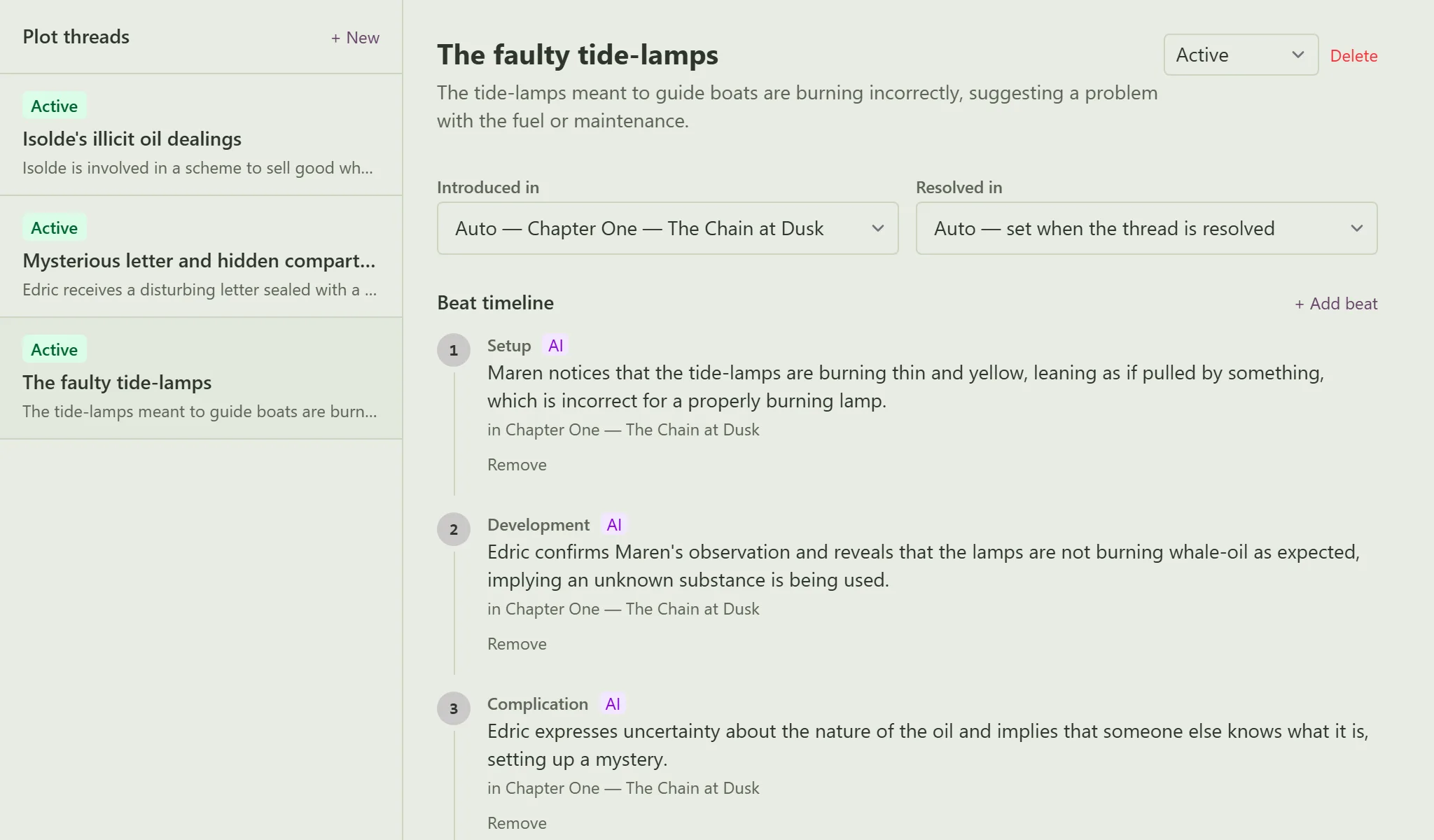
Three things follow from tying beats to scenes:
- The thread's start and end fill in by themselves. "Introduced in" is the scene of its earliest beat, and once you mark the thread resolved, "Resolved in" is its resolution beat. You can pin either one to a scene yourself.
- The AI knows which threads are open. When you ask the AI to continue a scene or answer a question, it's told about your open threads and their latest beats up to the scene you're writing, so its suggestions follow the threads you've set up without reaching ahead to beats you haven't written yet.
- Dropped threads can be checked. On Pro, Check for contradictions reads the whole book and flags any open thread whose last beat comes before the final scene, along with contradictions, broken world rules and characters acting on what they haven't learned yet. It shows a cost estimate before it runs.
We test this on a 12-chapter demo novel with a planted dropped thread: a sealed letter appears in chapter 3, goes missing from its hiding place behind a loose stone in chapter 4, and is never mentioned again. The whole-book check flagged it. The cost estimate before the scan was $0.011, paid to the AI provider on our own key: NovelCanon connects to your own account with an AI provider (bring your own key), so you pay the provider directly, with no markup.
You don't have to type every thread yourself, either. On the Manuscript and Pro plans, importing a manuscript or clicking Scan for new entries suggests plot threads with their beats, each tied to the scene it came from, for you to accept or dismiss. The step-by-step is in the help article on tracking plot threads.
The check reads the threads you track. A thread you left open on purpose won't be flagged once you mark it Resolved or Abandoned, and whether a payoff satisfies is still your call. What it removes is the part memory can't do: holding every open promise across 100,000 words and noticing the one that went quiet. The Plot page is on every plan, and the whole-book check is on Pro.
Every thread is a promise
Doyle opened fourteen threads in The Hound of the Baskervilles and closed every one, some with a payoff, some with a shrug on the page, two with an explanation in the final chapter. None of them just stopped. That's the whole discipline: open threads where the reader can see them, remind the reader before a payoff, stop opening new ones when it's time to close, and make sure each one ends somewhere. For the rest of the continuity work around it, the story consistency guide covers characters, facts and timelines the same way.
Frequently asked questions
What are plot threads?
A plot thread is one line of story that runs through a novel: a question, goal, mystery or promise that opens in one scene and closes in a later one. The main plot is the biggest thread, and subplots are made of smaller ones. A clue, a rivalry, a missing object or a secret can each be a thread. What makes something a thread is that the reader expects it to come back.
What is the difference between a plot thread and a subplot?
A subplot is a secondary storyline with its own arc, usually following a supporting character. A plot thread is any open question the reader is tracking, so it can be smaller than a subplot. A romance is a subplot; the unexplained warning note in chapter four is a thread. Most subplots contain several threads, and a thread can belong to the main plot.
How many plot threads should a novel have?
An article in The Writer suggests six to eleven, based on its author's reading of published novels. Count the threads open at the same time rather than the total. The Hound of the Baskervilles opens 14 threads but never has more than 10 open at once, and it opens no new ones in its last five chapters. More threads widen the story; fewer keep it tight.
What is a dropped plot thread?
A dropped plot thread is one the story opens and then never mentions again: a letter that is never read, a rival who disappears, a question nobody answers. Readers notice even when they can't name what's missing, and the ending feels incomplete. It's different from a thread that ends in a dead end or is deliberately left open, because in those cases the book tells the reader where the thread stands.
Is it OK to leave a plot thread unresolved?
Yes, if it's a choice the reader can see. An open ending, a question the book says can't be answered, or a hook for a sequel are all fine, as long as the story acknowledges the thread at the end. What doesn't work is silence: a thread that simply stops appearing reads as a mistake, not as ambiguity.
What are A, B and C plots?
They rank a story's storylines by weight, a convention from television writing. The A plot is the main story and gets most of the pages. The B plot is the main subplot, often a relationship or the protagonist's inner conflict. C plots are smaller threads, frequently attached to supporting characters, that add texture, relief or setup. Novels use the same layering without the labels.
Written by
Munib Ali Laghari
Founder, NovelCanon
Munib founded NovelCanon to give novelists a writing studio that keeps every character, world rule and plot thread consistent across the whole book.
About NovelCanonGet the next post by email