Best AI Novel Writing Software in 2026: An Honest Comparison
An honest comparison of the best AI novel writing software in 2026 — top tools ranked on prose, consistency, pricing, and which fits your book.
The best AI novel writing software in 2026 depends on your priority: Sudowrite for fiction-tuned prose, Novelcrafter for deep control, NovelCanon for whole-manuscript consistency and at-cost pricing, and Scrivener if you'd rather skip generative AI. There is no single winner — match the tool to the job your book most needs done.
"Best AI novel writing software" is one of the most searched — and most dishonestly answered — questions in writing tech. Most lists rank whoever pays the best affiliate commission, and every entry sounds identical. This is a different kind of comparison: an evaluation framework, honest verdicts including where each tool loses, and full disclosure that we build one of the tools on it. The goal is that you leave knowing which one fits your book, even if that isn't ours.
Key takeaways
- There is no single "best." The right tool depends on whether you value prose, consistency, control, budget, or planning — the honest answer is always "best for what."
- The hidden dividing line is consistency. Nearly every tool helps you write; very few audit a finished manuscript for contradictions across a whole book. It's the criterion most roundups skip and the one that matters most for long or series fiction.
- Pricing splits two ways: credit-based (Sudowrite) vs bring-your-own-key at cost (NovelCanon, Novelcrafter). Which is cheaper depends entirely on how much you generate.
- AI here is an assistant, not a ghostwriter. The tools worth using keep you deciding every word; the ones promising a one-click novel are selling something you won't want to publish.
- Disclosure: we make NovelCanon. This comparison says plainly when Sudowrite, Novelcrafter, or another tool is the better pick — because a comparison that never does isn't worth your trust.
What is AI novel writing software (and what it isn't)?
AI novel writing software is a purpose-built environment for long-form fiction — it combines a manuscript editor, planning and organisation tools, a story bible or "codex" that gives the AI context, and generation features tuned for narrative, in one place. That's what separates it from a general chatbot: it's built to hold an entire novel, not answer a single prompt.
It is not a machine that writes your book for you. The honest tools in this category are explicit about this, and so are we: current models are extraordinary sentence-by-sentence and unreliable book-by-book. They lose track of who knows what, contradict a detail from three chapters ago, and drift from your voice into generic "AI prose" if you let them run unsupervised. The category exists precisely because raw AI can't write a coherent novel alone — good software is the scaffolding that keeps a human in control while borrowing the AI's speed for the parts that benefit from it.
So the useful question isn't "which AI is smartest." Every serious tool can call the same frontier models. The question is what the software does around the model — how it keeps your story straight, what it costs, how much control it gives you, and whether it fits how you actually write.
What should you look for? Six criteria that actually matter
Judge AI novel writing software on six things, weighted by your own priorities: prose generation, consistency, pricing model, customisation, organisation, and privacy. Most "best of" lists compare only the first. Here's why all six matter.
- Prose generation and control. How good is the output, and how much say do you have over it? Some tools are tuned specifically for fiction and produce prose that needs less cleanup; others give you general frontier models plus tools to shape them. Related to this is control: does generated text land silently in your manuscript, or wait for your approval?
- Consistency and continuity. Can the tool keep a long story straight — and, crucially, can it check whether it did? This is the difference between feeding the AI context so it writes coherently and auditing a finished draft for contradictions it (or you) introduced. Most tools do the first; few do the second.
- Pricing model. The real fork is credits vs bring-your-own-key. Credit tools bundle the AI into a subscription (simple, but the cost of a heavy session is fuzzy). Bring-your-own-key (BYOK) tools charge a flat software fee and let you pay your AI provider directly at cost — often cents, or free with free models — in exchange for a few minutes of setup.
- Customisation and control. Do you want to tune every prompt and build your world in a structured database, or do you want opinionated defaults that get out of your way? Neither is better; they suit different temperaments.
- Organisation, planning, and export. Corkboards, outlines, beat sheets, and — the one people forget until they need it — clean export to DOCX, EPUB, and PDF so you can actually publish what you wrote.
- Privacy and ownership. Is your manuscript used to train anyone's model? Can you export a full backup and leave whenever you want? For many writers this is the quiet dealbreaker.
Write down which two or three of these matter most to you before you read another list. It turns "which is best" into a question with an answer.
How did we evaluate these tools?
Every tool below is judged on the same six criteria, from the same seat: a novelist trying to finish a coherent book, not a reviewer counting features. Where we could use a tool first-hand we did; where we couldn't, we relied on each tool's own documentation and current public pricing, and we've dated and hedged anything that shifts often. Most importantly, where a competitor beats NovelCanon on one of the six, we say so plainly — a roundup that only flatters the tool its own authors make is worthless, and it's the fastest way to lose your trust. Plans and prices move quickly in this category, so treat every number here as a starting point and verify the current terms on each tool's own site before you buy.
The best AI novel writing software in 2026, at a glance
| Tool | Best for | Pricing model | Continuity approach |
|---|---|---|---|
| NovelCanon | Whole-manuscript consistency + at-cost AI | BYOK, flat fee | Self-maintaining registry + full-book contradiction audit |
| Sudowrite | Fiction-tuned prose generation | Credits | Story Bible (context for generation) |
| Novelcrafter | Power users who want control | BYOK, tiered | Manual Codex |
| NovelAI | Tinkerers & sandbox storytelling | Own hosted models, subscription | Lorebook (manual) |
| Squibler | Fast, high-volume drafting | Subscription | Light; generation-first |
| Type.ai | Frictionless drafting | Managed, free tier | Light |
| DreamGen | Creative freedom & role-play | Free tier + paid | Story steering, not an audit |
| Dabble | Planning-first writers | Subscription, AI add-on | Planning tools, not an audit |
| Scrivener | Organising a manuscript without AI | One-time (~$60) | Manual; no AI |
Pricing and features are approximate as of 2026 — always verify on each tool's own site before buying.
The tools, by what each is best at
NovelCanon — best for consistency and at-cost AI
What it's best at: keeping a long story coherent. NovelCanon is a bring-your-own-key studio built around a three-tier Consistency Engine that extracts the facts from your prose into a story bible that maintains itself, then runs a full-manuscript deep scan for contradictions, dropped plot threads, and broken world rules. It also generates writer-first (every AI passage waits for your approval and is auto-checked against your characters and timeline), supports free models at cost, works offline as an installable app, and exports DOCX/EPUB/PDF.
Where it falls short: the prompt system is curated and opinionated rather than infinitely tweakable, and it's built for a single author, so it isn't the pick if you want deep prompt customisation or live team collaboration. The full engine is a paid feature (Pro is $15/month or $144/year; a genuine free plan lets you try the workflow first).
Choose it if your real anxiety is "will this book still hold together in chapter forty." See how it stacks up directly in NovelCanon vs Sudowrite and NovelCanon vs Novelcrafter.
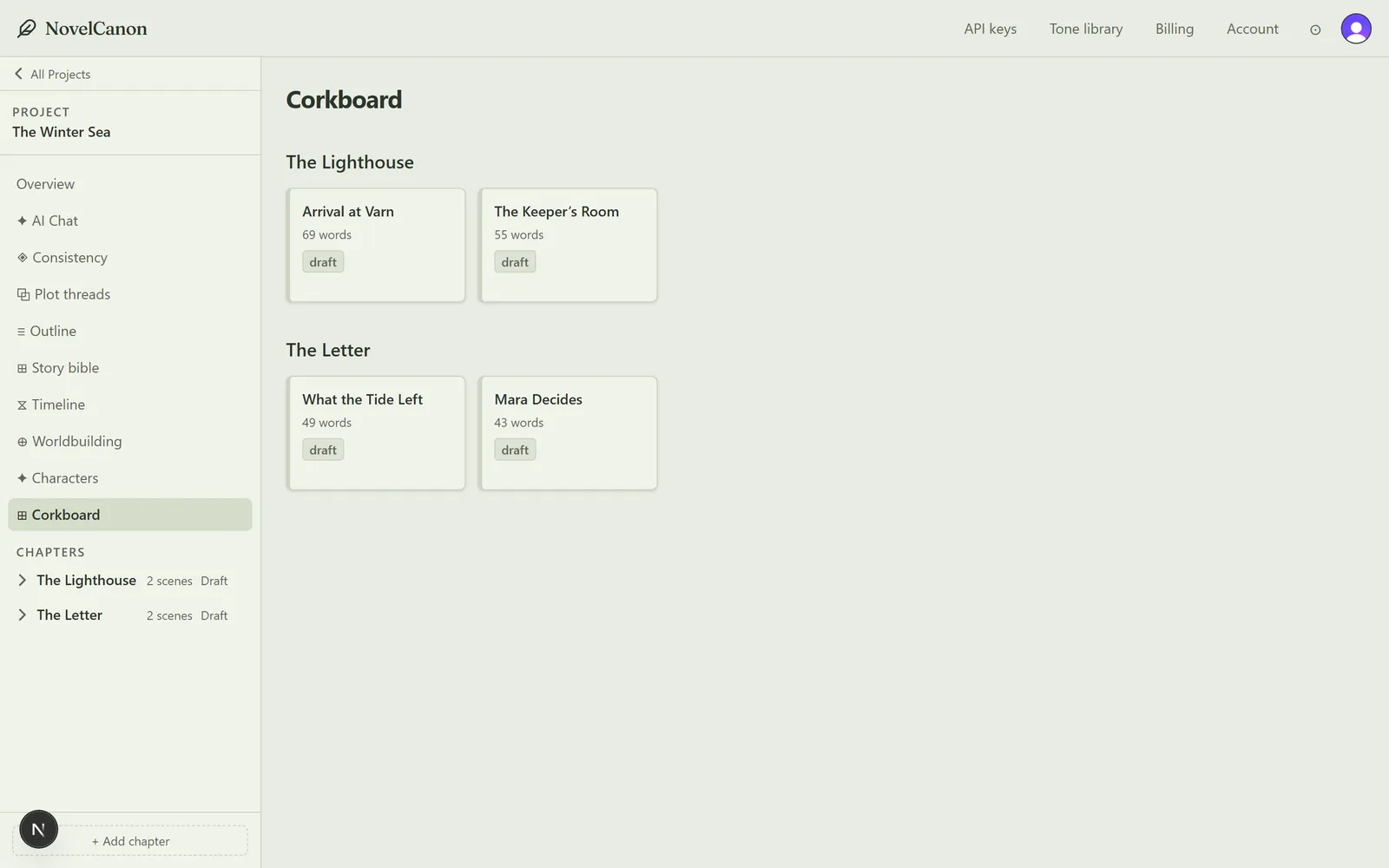
NovelCanon's corkboard — reorder scenes and chapters visually, without touching a word of prose.
Sudowrite — best for fiction-tuned prose
What it's best at: generation. Sudowrite has spent years building a rich creative toolkit — Describe, Rewrite, the Story Engine — and its proprietary Muse model is fine-tuned on published fiction, so its output often has a feel for scene rhythm and dialogue that general models don't reach out of the box, with less cleanup.
Where it falls short: it's credit-based, so heavy generation on premium models spends fast and can be hard to predict, and there's no bring-your-own-key option. Its consistency answer is the Story Bible feeding context to generation, not a manuscript-wide audit.
Choose it if prose quality with zero setup is your top priority and credits don't bother you.
Novelcrafter — best for control
What it's best at: customisation. Novelcrafter centres on the Codex — a linked, manually built story bible — plus a deeply configurable prompt system that power users love (it's sometimes called "the Photoshop of AI fiction"). It's bring-your-own-key, has a mature community, and offers collaboration on its top tier.
Where it falls short: the Codex is powerful but manual — it's only as current as you keep it — and there's no dedicated manuscript-wide contradiction scan.
Choose it if you enjoy building the machine and driving it, or need team features.
NovelAI — best for tinkerers and sandbox storytelling
What it's best at: a "make it yours" experience. NovelAI runs its own hosted models with fine-grained generation control, a lorebook system, and even image generation — a distinctive creative sandbox with a loyal following.
Where it falls short: it's lighter on publication-oriented organisation and continuity auditing, and you use its models rather than bringing your own key.
Choose it if you love tuning a model's behaviour and exploratory, sandbox storytelling more than shepherding a publication-ready manuscript.
Squibler — best for fast, high-volume drafting
What it's best at: speed. Squibler's AI Novel Writer is oriented toward getting a lot of manuscript out quickly, which suits writers publishing at pace.
Where it falls short: generation-first speed tends to come at the cost of the deep continuity auditing and fine control that meticulous long-form and series writers want.
Choose it if volume and momentum are your priority.
Type.ai — best for frictionless drafting
What it's best at: flow. Type.ai keeps AI tools inside a clean, distraction-light editor with a gentle learning curve — good for drafting momentum with minimal setup.
Where it falls short: it's lighter on deep worldbuilding, series continuity, and manuscript-audit features.
Choose it if you want a fast, clean surface to draft in, not a series bookkeeping system.
DreamGen — best for creative freedom and a free tier
What it's best at: open-ended, character-driven storytelling and role-play, with a notably generous free tier for trying serious AI storytelling without paying up front.
Where it falls short: it's more oriented to interactive storytelling than to producing and organising a publication-ready manuscript, and lighter on formal continuity and export.
Choose it if you want an immersive sandbox and a free way in.
Dabble — best for planning-first writers
What it's best at: structure. Dabble pairs a calm, uncluttered editor with strong planning tools (plot grid, story notes) and offers AI as an add-on rather than the main event.
Where it falls short: AI is a companion, not the core, so it isn't the pick if you want a deeply integrated AI collaborator or a dedicated consistency engine.
Choose it if you lead with outlining and want organisation first, AI second.
Scrivener — best for organising without generative AI
What it's best at: manuscript organisation, full stop. Scrivener is the long-standing, one-time-purchase powerhouse — corkboard, binder, compile — with no built-in generative AI and total control over your files.
Where it falls short: no AI assistance or consistency checking at all, and a steeper learning curve.
Choose it if stepping back from generative AI is exactly why you're here. (If you later want AI, tools like NovelCanon import Scrivener projects.)
Why a general chatbot isn't enough for a novel
ChatGPT and Claude are excellent for scenes and terrible for whole novels — and the reason is structural, not a matter of intelligence. You can absolutely brainstorm, unstick a plot, or draft a paragraph in a chatbot, and many writers start there. But two limits break down over a book.
First, no persistent memory: each conversation starts fresh, so the model has no durable, structured record of what your story has established across a hundred thousand words. Second, a limited context window: it can only "see" so much text at once, so it physically can't hold your whole manuscript in view to check a claim in chapter three against one in chapter thirty. The result is the classic failure mode — an AI-assisted draft that reads well locally and quietly contradicts itself globally.
This is the entire reason dedicated software exists. Purpose-built tools wrap the same models in the two things a chat lacks: a durable story bible that persists between sessions, and a way to work through the manuscript systematically rather than hoping the two relevant scenes land in the same prompt. If you take one thing from this comparison, let it be this: judge a tool by what it remembers and checks, not by which model it can call.
The criterion most roundups skip: consistency
Here's where nearly every "best AI writing software" list goes quiet, because it's the hardest thing to build and the easiest to fake. Almost all of these tools help you write consistently — they feed the AI context (a story bible, a codex, a lorebook) so what it generates fits your story in the moment. Far fewer check whether you did, across the finished book.
That gap matters most exactly where writers hurt most: long novels and series, where a detail you commit to in book one has to survive into book three, across words you may have written years apart. A continuity error — brown eyes that were green, a journey that changes length, a character who knows a secret they were never told — is the kind of mistake that survives careful drafting and even professional editing, because the human mind isn't built to hold a hundred thousand facts in perfect agreement. Software is. A tool that reads your whole manuscript and surfaces the contradictions is doing a genuinely different job from one that just gives the AI good context — and it's the job we built NovelCanon's Consistency Engine to do.
We're obviously biased here, so weigh it accordingly. But whichever tool you pick, ask it the consistency question directly: does this help me write coherently, or does it also audit whether I did? Most will only answer the first half.
How much does AI novel writing software cost?
Expect to pay in one of three ways — credits, a bring-your-own-key subscription, or a one-time license — and which is cheapest depends entirely on how much you generate. There's no flat answer, but the patterns are clear.
- Credit tools (Sudowrite) bundle the AI into monthly plans, roughly $10–$44/month depending on tier and how heavily you generate. Simple and managed; the trade-off is that a premium model spends credits fast and the true cost of a session stays fuzzy.
- Bring-your-own-key tools (NovelCanon, Novelcrafter) charge a smaller flat software fee — Novelcrafter's tiers run about $4–$20/month, NovelCanon is $15/month or $144/year — and you pay your AI provider directly at cost. In practice a heavy week on a mid-tier model is often a few cents to a couple of dollars, and with free models the AI itself can cost nothing. You trade a few minutes of setup for an exact, transparent bill.
- One-time tools (Scrivener, ~$60) cost nothing per month but include no AI; you'd pair them with a separate tool for generation.
Is there a genuinely free option? Yes — but read the limits. NovelCanon's free plan is ongoing (one project up to three chapters, bring-your-own-key with free models, up to 20 AI actions a day) rather than a time-limited trial; DreamGen and Type.ai offer free tiers; and several tools have free trials. The catch is always what gets capped — features, projects, or usage — so match a free tier to how you actually write before assuming it's enough. For most writers the honest cost question isn't the subscription; it's how much AI you'll run, which is exactly why the credits-versus-at-cost distinction matters more than the sticker price.
Which AI novel writing software should you choose?
Skip the "best overall" framing and choose by your actual priority:
- Continuity in a long book or series? → NovelCanon.
- The most fiction-native prose with zero setup? → Sudowrite.
- Maximum control and a customisable prompt system? → Novelcrafter.
- A tinkerer's sandbox and your own hosted models? → NovelAI.
- Fast, high-volume drafting? → Squibler.
- Frictionless flow in a clean editor? → Type.ai.
- Creative freedom and a free tier to explore? → DreamGen.
- Planning and structure first, AI second? → Dabble.
- Organisation with no generative AI at all? → Scrivener.
A practical way to decide: shortlist two, run the same chapter of your work-in-progress through each for a week, and notice which friction you feel most — the price meter, the maintenance, the setup, or the nagging doubt about whether your story still holds together. The tool that removes your specific friction is your tool. If you're weighing the two most common bring-your-own-key options, our roundup of the best Sudowrite alternatives goes deeper on the field.
A note on our bias
We build NovelCanon, so treat everything above as disclosed bias — and the honest truth is that we're not the right answer for everyone. If your priority is the most fiction-native prose generation, we'd genuinely point you to Sudowrite. If you want to live inside a deeply customisable prompt system, Novelcrafter. If you want to step away from generative AI entirely, Scrivener. NovelCanon is built for one specific, common worry — keeping a long story consistent without maintaining a bible by hand — plus at-cost, bring-your-own-key pricing. If that's your worry, we're confident we're the best fit; if it isn't, one of the others honestly is, and we'd rather you use the right tool than the wrong one with our name on it.
If your deciding question is "which tool keeps my story straight," start with NovelCanon — try it free, read how the Consistency Engine works, or begin with the complete guide to story consistency for the craft behind the feature.
Frequently asked questions
What is the best AI novel writing software?
There is no single best — it depends on your priority. Sudowrite leads on fiction-tuned prose, Novelcrafter on deep customisation, NovelCanon on whole-manuscript consistency and at-cost pricing, and Scrivener if you would rather organise a manuscript without generative AI. Pick by the job your book most needs done, not a leaderboard.
Can AI write a whole novel by itself?
Not well, and not unattended. AI can draft passages, expand a scene, or brainstorm, but a novel-length story needs a consistent plot, characters, and voice that today's models lose track of over 100,000 words. The tools worth using are assistants, not ghostwriters — you make the decisions and the AI helps you make them faster.
Is there free AI novel writing software?
Yes. NovelCanon has an ongoing free plan (one project, bring-your-own-key with free models), DreamGen and Type.ai offer free tiers, and several tools have free trials. "Free" varies — some cap features, some cap usage — so match a free tier's limits to how you actually write before committing.
What is the difference between using ChatGPT and dedicated AI novel writing software?
A general chatbot has no persistent memory of your story and a limited context window, so it forgets facts between chats and can't compare chapter three with chapter thirty. Dedicated software keeps a durable story bible, feeds it to the AI as context, and — in some tools — audits the whole manuscript for contradictions.
What should I look for in AI novel writing software?
Six things: prose generation and control, consistency and continuity tools, the pricing model (credits vs bring-your-own-key), how customisable it is, planning and export features, and privacy and ownership of your work. Weight them by what matters to your book — a series writer and a first-drafter want very different things.
Written by
Munib Ali Laghari
Founder, NovelCanon
Building the writing studio he wished he had for keeping a long story straight — one where the AI never loses the thread.