NovelCanon vs ChatGPT, Claude & Gemini for Novels (2026)
NovelCanon vs ChatGPT, Claude and Gemini for writing a novel — an honest look at what a raw chat window can and can't do across 100,000 words.
ChatGPT, Claude, and Gemini can write a genuinely good scene — the sentence-level prose is excellent. What none of them does is remember your novel between sessions or check chapter thirty against chapter three. NovelCanon isn't a rival AI to any of them; with bring-your-own-key, it can run on the very same models, wrapped in a story bible and a manuscript-wide consistency check that a chat window doesn't have.
There's a real trend worth naming honestly: a lot of people drafting fiction right now aren't using a novel-writing app at all. They've got ChatGPT or Claude open in a browser tab, and it's working, for a while. This isn't a post telling you that's wrong — it's a look at exactly where it stops working, and why, because the answer isn't "the AI isn't good enough." It's something more specific and more fixable than that.
Key takeaways
- This isn't NovelCanon's AI vs a better AI. With bring-your-own-key, NovelCanon runs on GPT, Claude, or Gemini directly. The real comparison is a raw chat window vs. a purpose-built environment around the same models.
- The problem is structural, not a matter of intelligence. A chat window forgets what you told it last week and can't hold a full manuscript in its context at once. That's true no matter how good the model gets.
- Pricing shape is opposite. ChatGPT Plus and Claude Pro are flat ~$20/month whether you write one page or fifty. NovelCanon is a $15/month software fee plus your actual AI usage, billed at cost — often cents.
- None of the three chatbots has a real story bible, worldbuilding tracker, corkboard, or plot-thread list. Those are the things a novel actually needs organised, and a chat thread isn't built to organise them.
- A raw chatbot is genuinely the right call for a lot of writing — a short story, one scene, brainstorming. The case for a dedicated tool is specifically about the length and duration of a novel.
NovelCanon vs ChatGPT, Claude & Gemini at a glance
| NovelCanon | ChatGPT / Claude / Gemini | |
|---|---|---|
| AI model | Bring your own key — GPT, Claude, Gemini, OpenRouter, incl. free models | Whichever one you subscribed to |
| Pricing | $15/mo or $144/yr flat, + AI billed at your provider's cost | ChatGPT Plus & Claude Pro ~$20/mo; Google AI Pro (Gemini) $19.99/mo — flat, regardless of use |
| Story memory | A living registry, built from your prose, that persists across the whole project | No structured memory of a novel; general "memory" features recall facts about you, not your book |
| Consistency check | Full-manuscript scan for contradictions, dropped threads, broken rules | None — nothing cross-references chapter three against chapter thirty |
| Worldbuilding & story bible | Characters, locations, world rules, plot threads — organised and fed into every AI request | You paste your own notes into the chat each time, if you remember to |
| Outlining / structure | Beat sheets (Three-Act, Save the Cat, Hero's Journey), a drag-and-drop corkboard | None built in — plan elsewhere and copy it in manually |
| Manuscript editor | Full scene-by-scene editor, versioning, offline PWA | A single scrolling chat thread |
| Export | DOCX, EPUB, PDF + full backup | Copy and paste, or export a raw chat transcript |
| Free option | Ongoing free plan (1 project, 3 chapters, free models) | Free tiers exist on all three, with lower usage caps and older/lighter models |
Chatbot pricing reflects each provider's own published consumer plan as of 17 September 2026; always check current terms.
Can ChatGPT, Claude, or Gemini actually write a novel?
Yes, scene by scene — and no, not a whole coherent one without you doing the organisational work by hand. This is worth being precise about, because the honest answer isn't "AI can't write fiction." It clearly can, at the sentence and paragraph level, remarkably well. The limits show up somewhere else entirely.
The context window is the first wall. Every model has a maximum amount of text it can actually "see" at once — your conversation, plus whatever you've pasted in. A novel is 80,000 to 120,000 words. Long before you reach that, older parts of the conversation start falling out of the model's working attention, even on models with generous context limits, because a long chat thread fills up with false starts, revisions, and back-and-forth that isn't your manuscript. By the third act, the model is working from a hazy sense of your story, not the actual text of chapter one.
The memory gap is the second, and it's the one that trips people up without warning. Close the tab, come back tomorrow, and Claude has no memory of yesterday's session at all — each conversation starts cold. ChatGPT and Gemini both now offer general memory features, but they're built to remember things about you — your preferences, your name, facts you've told them in passing — not to hold a structured record of a novel's characters, timeline, and world rules. Ask any of the three "what colour are Elena's eyes" three weeks into a project and the honest answer, most of the time, is that it doesn't know unless you tell it again.
Neither limit is a flaw in the model. They're both a mismatch between what a chat interface is built for — a conversation — and what a novel actually is: a single, enormous, internally-consistent document that has to hang together across months of writing.
You're not choosing a different AI — you're choosing what surrounds it
Here's the part most comparisons like this one skip past, and it's the honest core of this one: NovelCanon doesn't compete with ChatGPT, Claude, or Gemini as an AI. Because it's bring-your-own-key, you can point NovelCanon directly at any of them — the same GPT model, the same Claude model, the same Gemini model you'd use in their own apps. If you love a specific model's prose, you keep using that exact model.
What changes is everything around the model. In a chat window, "context" is whatever you happen to paste in that message — your notes, if you remember to bring them, formatted however you formatted them that day. In NovelCanon, as you write, the engine reads each scene and extracts what it establishes — who's in it, what they now know, where they are — into a registry that's automatically handed to the AI on every request. You're not re-explaining your world every session; the tool already knows it, because it built that knowledge from the actual pages you wrote.
So the real question this comparison is answering isn't "which AI is smarter." It's "do you want to be the one manually re-supplying your novel's context every single time, or do you want a tool that remembers it for you and checks it against what you've already written?"
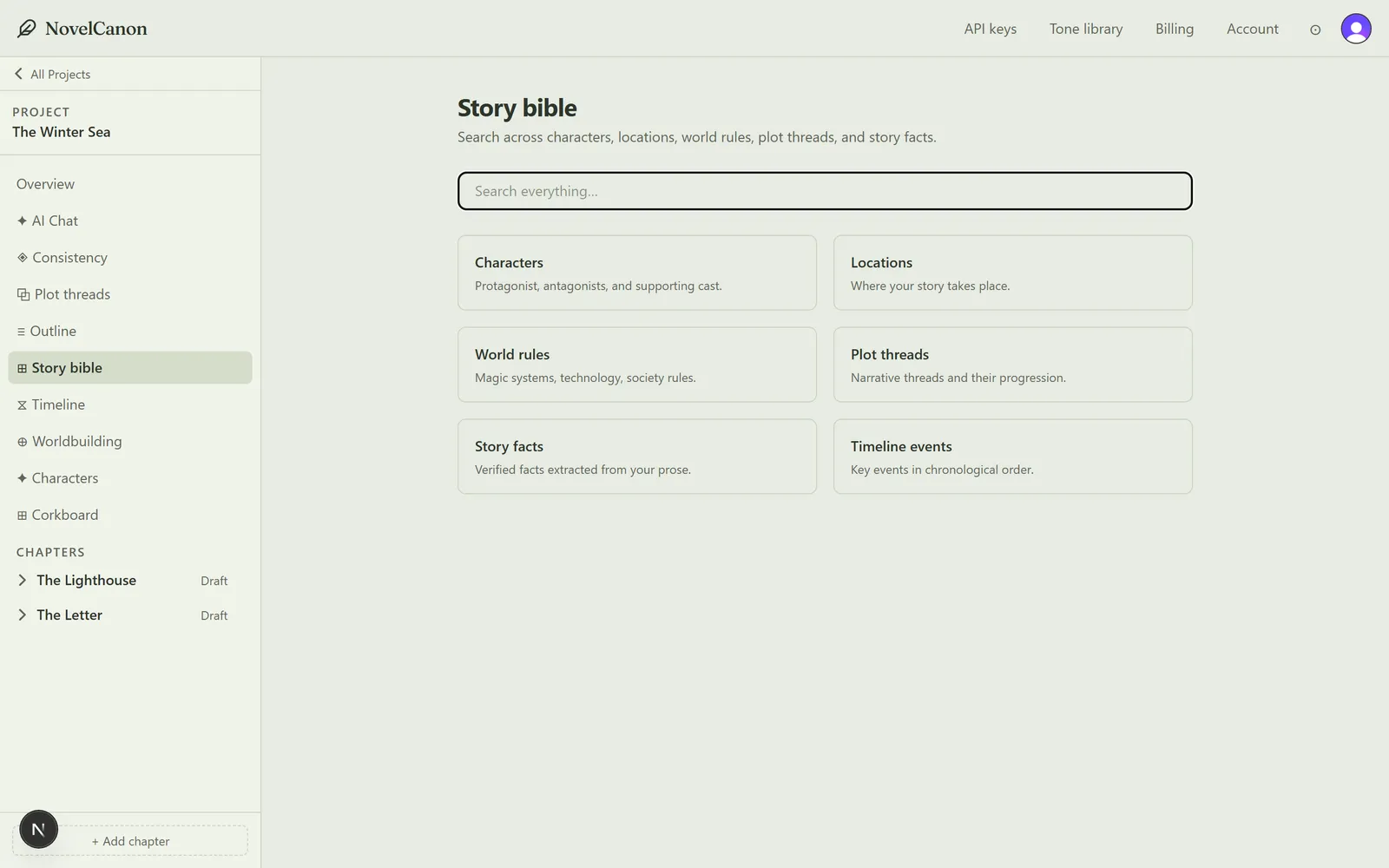
Characters, world rules, and plot threads, organised automatically from your prose — the layer a chat window has no place to put.
Pricing: a flat chat subscription vs a flat fee plus at-cost AI
The two pricing shapes are opposite, and it's worth seeing exactly how.
ChatGPT Plus and Claude Pro are both roughly $20 a month, and Google AI Pro (what used to be branded Gemini Advanced) is $19.99 a month — flat, whether you send five messages that month or five thousand. That's genuinely appealing if you use it constantly: no meter to watch, no surprise bill.
NovelCanon separates the software from the AI. You pay $15/month or $144/year for the app itself, then connect your own key and pay your provider directly for what you actually use — with no markup added on top. For most fiction-writing usage, that's a small amount: our own logged assistant-style actions have averaged well under a cent each. Use one of the free models available through providers like OpenRouter, and the AI itself costs nothing — you're only paying the flat software fee.
Which is cheaper depends entirely on how you write. Someone who lives inside ChatGPT constantly, for everything, all day, may already be getting their money's worth from the flat $20. Someone using AI specifically to help draft a novel — a scene here, a rewrite there, a few sessions a week — will usually find bring-your-own-key at cost adds up to less than a flat $20 subscription, on top of getting the story-bible and consistency layer a general chat plan doesn't include at any price.
What a novel actually needs that a chat thread doesn't have
Put plainly, without the pricing angle: a chatbot is a conversation, and a novel is a hundred thousand words of structure. Here's what that structure actually requires, one piece at a time.
A story bible. Characters, their traits, their relationships, and what they know at each point in the story — this needs to live somewhere durable, not in a scroll-back chat history that gets harder to search every week.
Worldbuilding. Magic systems, technology, social rules, and their limits need recording once and referencing forever, not re-explaining every time you open a new chat.
Plot threads. A subplot you set up in chapter four and need to pay off in chapter twenty-eight needs to be tracked as an open item somewhere, or it quietly evaporates the way unresolved chat topics do.
An outline or corkboard. Restructuring a book — moving a scene, merging two chapters — is a spatial, visual task. Doing it inside a linear chat transcript means scrolling and hoping you remember where everything was.
A consistency check. The single biggest gap: nothing about a chat interface cross-references what you're writing now against everything you've already written. A dedicated engine that extracts facts scene by scene and scans the whole manuscript for contradictions is doing a job a conversation was never built to do.
None of this is about the AI being smart enough. GPT, Claude, and Gemini are all more than capable of drafting a beautiful paragraph. The gap is entirely in the scaffolding around the model — and that scaffolding is what a purpose-built app like NovelCanon, or honestly several others in the category, actually is. We cover the wider field, not just us, in the best AI novel writing software.
When ChatGPT, Claude, or Gemini alone is genuinely the right call
It would be dishonest to pretend a dedicated tool is always the answer, so here's when it isn't:
- You're writing a short story, where the whole thing comfortably fits in one conversation and there's no multi-chapter continuity to track.
- You're brainstorming, not drafting — kicking around premises, character names, or "what if" scenarios before you've committed to a project.
- You're testing whether AI-assisted writing is even for you, before deciding to invest time learning a new tool.
- You already have a rock-solid system elsewhere — a spreadsheet, a wiki, a Scrivener project — and you're only ever pasting a scene in for a quick rewrite, not asking the AI to hold the whole story.
In every one of these cases, the free tier of whichever chatbot you already like is genuinely enough, and paying for anything more would be solving a problem you don't actually have.
When you need something built for the whole novel
The moment usually announces itself: you're forty thousand words in, you've just asked "wait, did I already say what colour her eyes were," and you realise you're the one holding the whole book together, not the AI. That's the specific gap NovelCanon exists to close — not a smarter model, but a place for a novel's facts to live and be checked automatically, running on whichever model you already trust.
You can try it with the exact provider you already use — connect a GPT, Claude, or Gemini key on the free plan — or see how the Consistency Engine tracks facts under the hood first. If you're comparing the wider field rather than just us, NovelCanon vs Sudowrite and NovelCanon vs Novelcrafter cover the dedicated-tool side of the category, and the complete guide to story consistency covers the underlying problem regardless of which tool you pick to solve it.
Frequently asked questions
Can ChatGPT, Claude, or Gemini write a whole novel?
They can write very good individual scenes, but not a coherent whole novel unattended. Each has a context window that can't hold a full manuscript once it grows past roughly the first act, and none keeps a persistent memory of your story between separate chats. They're excellent collaborators for a scene at a time; none is built to hold an entire book in its head.
What's the real difference between NovelCanon and just using ChatGPT?
NovelCanon isn't a different AI competing with ChatGPT — with bring-your-own-key, it can run on the same GPT, Claude, or Gemini models. The difference is what surrounds the model: a persistent story bible that survives between sessions, a full-manuscript contradiction scan, and a manuscript editor built for a 100,000-word project instead of a single chat thread.
Is NovelCanon cheaper than ChatGPT Plus or Claude Pro?
For light-to-moderate writers, usually yes. ChatGPT Plus and Claude Pro are both around $20/month regardless of how much you use them. NovelCanon's Pro plan is $15/month ($144/year), and you pay your AI provider separately at cost — often a few cents to a few dollars a week, and free if you use a free model. Heavy daily generation can cost more either way; check your own usage.
Do ChatGPT, Claude, or Gemini have a story bible for novels?
Not in the way a novel-writing tool means it. ChatGPT and Gemini offer general memory features that recall preferences and facts about you, not a structured registry of a novel's characters, timeline, and world rules. Claude has no persistent cross-chat memory at all as of 2026. None extracts facts from your prose or checks a new chapter against everything you've already written.
Can I use ChatGPT, Claude, or Gemini inside NovelCanon?
Yes. NovelCanon is bring-your-own-key, so you connect an OpenAI, Anthropic, Google, or OpenRouter key and choose the model yourself, including GPT, Claude, and Gemini directly. You're not switching away from the model you like — you're adding a story bible, a contradiction scan, and a manuscript editor around it.
Should I just use ChatGPT for free instead of paying for a novel-writing tool?
For a short story, a single scene, or brainstorming, yes — a free chatbot is genuinely enough and there's no reason to pay for more. The case for a dedicated tool shows up specifically at novel length, once you're juggling more characters and chapters than you can reliably hold in your own memory, let alone re-paste into a chat window every session.
Written by
Munib Ali Laghari
Founder, NovelCanon
Building the writing studio he wished he had for keeping a long story straight — one where the AI never loses the thread.