NovelCanon vs Sudowrite: BYOK vs Credits, Compared (2026)
NovelCanon vs Sudowrite, compared honestly — bring-your-own-key pricing vs credits, and a self-maintaining consistency engine vs the Story Bible.
NovelCanon and Sudowrite are both AI writing tools for novelists, but they optimise for different things. Sudowrite is a polished, all-in-one creative partner with credit-based pricing and a fiction-tuned model. NovelCanon is a bring-your-own-key studio built around a consistency engine that audits your whole manuscript for contradictions. Your priority — prose generation or continuity — should decide.
If you're comparing NovelCanon and Sudowrite, you've probably noticed they get described as competitors but feel like different kinds of product. This is an honest, hands-on comparison — including the cases where Sudowrite is the better pick, because a comparison that never says that isn't worth reading.
Key takeaways
- Pricing model is the biggest difference. Sudowrite bundles AI into credits; NovelCanon is bring-your-own-key, so you pay your provider at cost with no markup — and free models actually work.
- Consistency is NovelCanon's wedge. Its three-tier engine audits the whole manuscript for contradictions; Sudowrite's Story Bible feeds context to generation.
- Sudowrite is stronger at prose generation — the Muse model and tools like Describe are genuinely good, and there's no API key to set up.
- NovelCanon is stronger for long/series continuity, predictable cost, offline writing, and privacy.
- Try NovelCanon free or read how its Consistency Engine works.
NovelCanon vs Sudowrite at a glance
| NovelCanon | Sudowrite | |
|---|---|---|
| AI model | Bring your own key (OpenAI, Anthropic, Google, OpenRouter — incl. free models) | Managed; credits, incl. its fiction-tuned Muse model |
| Pricing | Flat software fee: $15/mo or $144/yr; AI billed by your provider at cost | Credit plans, ~$10–$44/mo billed annually (2026) |
| Consistency | Three-tier engine: fact extraction + full-manuscript contradiction scan | Story Bible + chapter-continuity for generation-time context |
| Prose tools | Continue, rewrite, brainstorm, chat; self-audited | Describe, Rewrite, Story Engine, Muse — a deep creative toolkit |
| Setup | Connect an API key once | None — fully managed |
| Offline | Installable PWA, write offline | Web, online |
| Export | DOCX, EPUB, PDF + full backup | Export to common formats |
| Free option | Ongoing free plan (1 project, 3 chapters, 20 AI actions/day) | One-time 10,000-credit trial |
Competitor details reflect Sudowrite's public pricing as of 2026; always check current terms.
Pricing: bring-your-own-key at cost vs credits
This is the fork that shapes everything else.
Sudowrite bundles the model into credits. You choose a plan and get a monthly credit allowance; different models spend credits at different rates, so a premium model like Muse or Claude Opus burns through them far faster than a light one. The upside is real: it's fully managed, there's no API key, and you never think about a provider bill. The downside is predictability — credits are an abstraction over cost, and it's easy to lose track of how fast a given model is spending them, which is a common complaint from writers who generate a lot.
NovelCanon separates the two. You pay a flat fee for the software and connect your own AI key, paying the provider directly for what you use — with no markup from us. In practice a heavy week of drafting on a mid-tier model is often a few cents to a couple of dollars, and if you use one of the free models available through OpenRouter, the AI is genuinely free; you're only paying the software subscription. For light-to-moderate writers this usually works out cheaper, and it's always transparent, because you see the provider's real meter.
Pricing scenarios, honestly
Because the two price so differently, the only fair way to compare is by how you actually write:
- The occasional writer (a few AI nudges a week). On NovelCanon, the free plan or Pro plus a few cents of provider usage covers it; on Sudowrite, even the lowest credit tier may be more than you need. Edge: NovelCanon.
- The steady drafter (daily sessions, mid-tier model). NovelCanon Pro at $15/month plus perhaps a few dollars of provider cost; Sudowrite's mid tier at ~$22/month with credits that a mid model spends at a moderate rate. Roughly comparable — decide on features, not price.
- The heavy generator (long daily output on premium models). This is where credits get unpredictable fastest, and where at-cost billing is most transparent — but also where a heavy NovelCanon user's provider bill climbs too. Estimate your token volume either way; neither is automatically cheaper.
Neither is universally "cheaper" — it depends on your volume and model choice. But they feel very different: credits are convenience with a fuzzy cost; bring-your-own-key is a little setup for an exact one.
Consistency: a self-maintaining registry vs the Story Bible
Both tools know continuity matters, and both have an answer — but the answers work differently.
Sudowrite's Story Bible stores your characters, locations, and plot details and feeds them to the AI as context during generation, which helps the model stay on-model as it writes. It's a solid feature for keeping generated prose coherent in the moment, and Sudowrite has built chapter-continuity tools on top of it.
NovelCanon's Consistency Engine does something adjacent but distinct: it treats consistency as an audit problem, not just a context problem. It extracts the factual claims from each scene into a story bible that builds itself from your prose, then a full-manuscript deep scan cross-references every fact, plot thread, and world rule to surface contradictions, dropped threads, and rule-breaks — including the ones four hundred pages apart. Because the facts are derived from your text, fixing the prose clears the flag automatically; there's no bible to maintain by hand. You can read exactly how that works.
The honest framing: Sudowrite helps you write consistently; NovelCanon additionally checks whether you did, across the whole book. If continuity in a long or multi-book story is your top worry, that audit layer is the reason to look at NovelCanon.
Prose generation and creative tools
Here's where Sudowrite genuinely leads, and it would be dishonest to pretend otherwise. Sudowrite has spent years building a rich creative toolkit — Describe (sensory expansion of a moment), Rewrite (style variations), the Story Engine for guided drafting — and its proprietary Muse model is fine-tuned specifically on published fiction, so it often has a feel for scene rhythm and dialogue that general models don't reach out of the box. If your priority is generation — getting a lot of usable prose out of the machine, with expressive tools to shape it — Sudowrite is excellent at it, and its output frequently needs less cleanup than a general model's.
NovelCanon's generation is deliberately writer-first and more restrained: continue, rewrite, brainstorm, and chat, always acting only when asked, with every AI passage highlighted until you accept it and auto-checked against your characters and timeline first. It's designed around the idea that you write the book and the AI assists — not the other way around. And because you bring your own key, you can point it at whichever frontier model you prefer for drafting. But if you want a large, expressive generation toolkit tuned specifically for fiction, Sudowrite's is more mature.
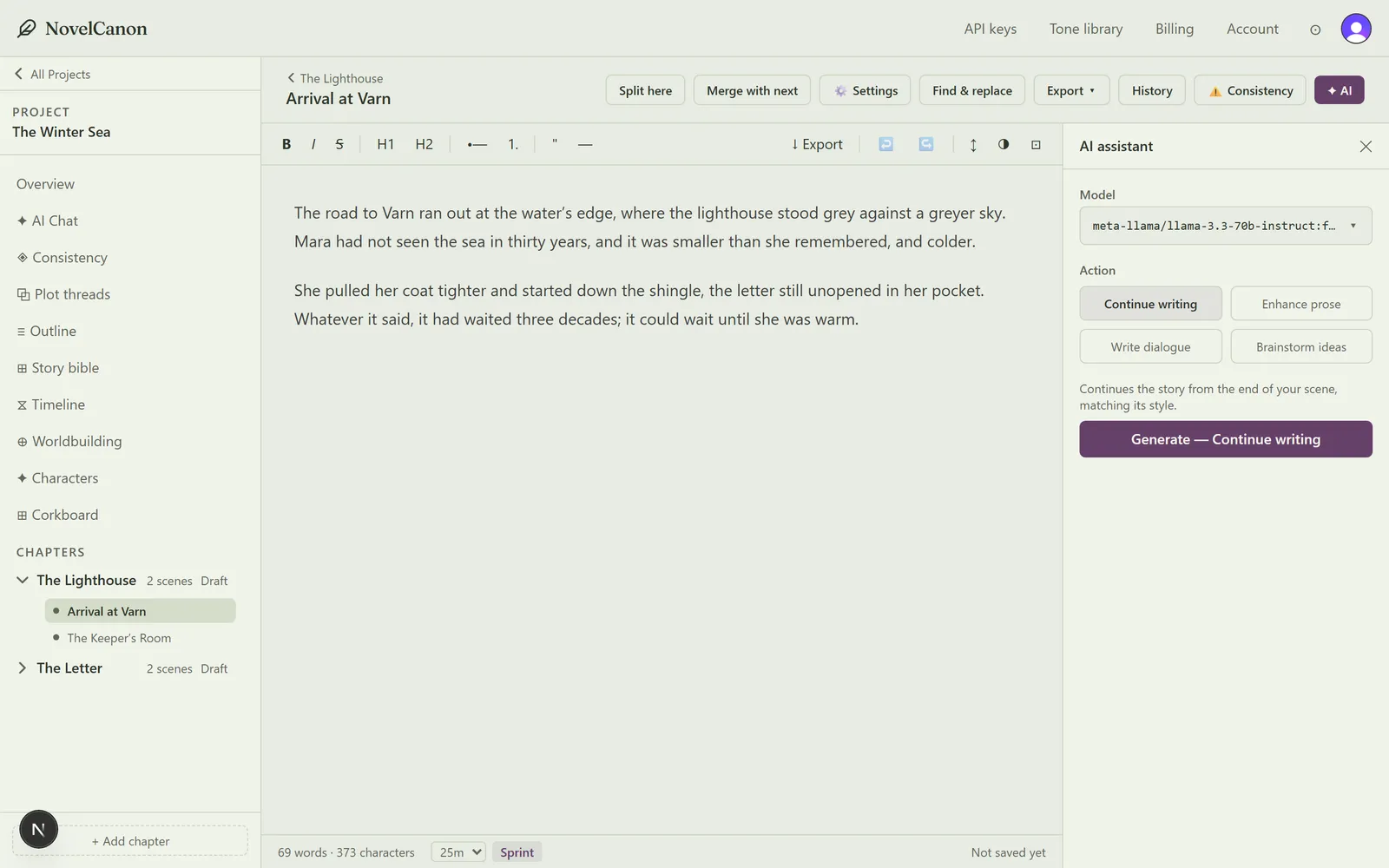
NovelCanon's AI panel is writer-first — choose an action and generate, and every suggestion stays highlighted until you accept it.
What about output quality?
Prose quality is the question every comparison dodges, so let's be direct. Sudowrite's Muse model is fine-tuned on published fiction, and it often produces prose with a stronger instinctive feel for pacing and dialogue than a general model gives you out of the box — genuinely one of its best features. NovelCanon takes a different route: because you bring your own key, its output quality is whatever frontier model you choose delivers — the latest Claude, GPT, or Gemini — which are extraordinarily capable and improving constantly, but tuned for general use rather than fiction specifically. In practice, a strong frontier model with good context (your characters, your world, your voice profile) closes most of the gap, and NovelCanon's voice matching lets it draft in your voice rather than a house style. If you want the most fiction-native feel with zero configuration, Sudowrite has an edge; if you'd rather ride the best general models and shape them to your voice, bring-your-own-key gives you more headroom.
Setup, privacy, and ownership
Setup: Sudowrite wins on simplicity — sign up and write, no key required. NovelCanon asks you to connect a provider key once, which takes a few minutes and is the price of paying at cost.
Privacy: NovelCanon leans hard into this. Your key is encrypted and only decrypted in memory for the request you make; your manuscripts are never used to train AI; and you can export a full backup (DOCX, EPUB, PDF) or delete everything at any time. With any tool, remember that AI features send your text to a model provider under that provider's terms — with bring-your-own-key you also get to choose which provider, and can favour the ones with the strongest data policies.
Offline: NovelCanon installs as a PWA and lets you keep writing without a connection, syncing when you reconnect — useful on a plane or a flaky café Wi-Fi. Sudowrite is web-based and online.
Migrating from Sudowrite
Switching isn't a trap. Export your manuscript from Sudowrite as DOCX or Markdown, and NovelCanon will import it (it also imports EPUB and native Scrivener projects). Your Story Bible won't carry over as structured data — but that matters less than it sounds, because NovelCanon's registry rebuilds itself from your prose as the engine reads your scenes. In other words, you don't re-enter your world; you just keep writing, and the bible reassembles. You can try the whole thing on the free plan before committing a full manuscript.
When Sudowrite is the better choice
- You want the most polished, fiction-tuned prose generation and a deep toolkit to shape it (Describe, Story Engine, Muse).
- You'd rather not set up an API key and prefer a fully managed, all-in-one experience.
- You value momentum and idea generation over manuscript-wide auditing.
When NovelCanon is the better choice
- Continuity is your priority — a long novel or a series where contradictions are the real risk, and you want a tool that audits for them.
- You want predictable, at-cost pricing and the option of free models, instead of credits.
- You want to write offline (installable PWA), keep a strong privacy posture, and own and export everything easily.
- You prefer a writer-first assistant that never commits a word without your say-so.
Both are good tools; they're just built for different anxieties. If yours is "will this book still make sense in chapter forty," start with NovelCanon — try it free, see how the engine works, or compare it with the other bring-your-own-key option in NovelCanon vs Novelcrafter. Still shopping around? Our roundup of the best Sudowrite alternatives covers the wider field, and our guide to the best AI novel writing software compares the whole category.
Frequently asked questions
Is NovelCanon or Sudowrite cheaper?
It depends on how much you write. Sudowrite bundles AI into credit-based plans (roughly $10–$44/month billed annually as of 2026). NovelCanon charges a flat software fee ($144/year or $15/month) and you pay your AI provider directly at cost — often cents for a heavy week, and free with free models. Light-to-moderate writers usually pay less on NovelCanon; check both current prices.
Can I use my own API key with Sudowrite?
No. As of 2026 Sudowrite is credit-based — you buy credits that different models consume at different rates, rather than connecting your own OpenAI or Anthropic key. NovelCanon and Novelcrafter are bring-your-own-key. If avoiding any API setup matters most to you, Sudowrite's managed model is the simpler path.
Does Sudowrite have a consistency checker?
Sudowrite has a Story Bible and chapter-continuity features that give the AI context and help keep continuity while you generate. NovelCanon adds a dedicated audit layer: a three-tier engine that extracts facts from your prose and scans the whole manuscript for contradictions, dropped threads, and broken world rules after they're written.
Which is better for writing a long series?
For multi-book continuity, NovelCanon's self-maintaining fact registry and full-manuscript deep scan are built for exactly that problem. Sudowrite is strong for drafting momentum and prose generation. Many series writers care most about not contradicting book one in book three, which is the specific job NovelCanon's Consistency Engine does.
Does NovelCanon have a free plan like Sudowrite's trial?
Yes, but they differ. Sudowrite offers a one-time free trial of 10,000 credits with no time limit. NovelCanon has an ongoing free plan — one project up to three chapters, bring-your-own-key with free models, and up to 20 AI actions a day — so you can keep using it indefinitely at no cost.
Can I move my Sudowrite manuscript into NovelCanon?
Yes. NovelCanon imports DOCX, Markdown, EPUB, and Scrivener projects, so you can export your manuscript from Sudowrite as DOCX and import it. Your story bible won't transfer as structured data, but NovelCanon rebuilds its own registry automatically from your prose as you work.
Written by
Munib Ali Laghari
Founder, NovelCanon
Building the writing studio he wished he had for keeping a long story straight — one where the AI never loses the thread.