7 Best Sudowrite Alternatives in 2026 (Tested & Honest)
The best Sudowrite alternatives in 2026, tested honestly — from bring-your-own-key studios to planning-first tools, and how to pick the right one.
The best Sudowrite alternative depends on what you want more than generation: for continuity and at-cost pricing, NovelCanon; for deep customisation, Novelcrafter; for fast, clean drafting, Type.ai; for creative freedom with a free tier, DreamGen; for planning-first writing, Dabble; and Scrivener if you'd rather step back from generative AI entirely.
Sudowrite is a good tool — but it's credit-based, it doesn't let you bring your own AI key, and its strengths (prose generation) aren't everyone's priority. If you're looking for something that fits your book better, here are seven genuine alternatives, what each is actually best at, and where each falls short. No leaderboard theatre — just an honest map.
Key takeaways
- There's no single winner — the right pick depends on whether you value continuity, control, speed, freedom, or planning.
- Bring-your-own-key tools (NovelCanon, Novelcrafter) let you pay your AI provider at cost instead of buying credits.
- NovelCanon is the pick if consistency across a long book or series is your worry; Novelcrafter if you want maximum customisation.
- Free options exist — NovelCanon and DreamGen both have real free access.
- Try NovelCanon free or read the head-to-head, NovelCanon vs Sudowrite.
Why look for a Sudowrite alternative?
Writers usually go looking for one of three reasons. First, pricing: Sudowrite's credit system is genuinely useful (it's managed, no API key) but hard to predict, since premium models drain credits far faster than light ones. Second, bring-your-own-key: many writers would rather connect their own OpenAI or Anthropic key and pay the provider directly at cost. Third, continuity: Sudowrite is generation-first, and writers working on long or multi-book stories often want stronger tools for keeping the story straight, not just producing more of it.
None of these mean Sudowrite is bad — it remains one of the best at prose generation. They just mean a different tool might fit you better.
How we evaluated these
To keep this honest rather than a list of logos, each tool below is assessed on the same five things that actually matter to a novelist: pricing model (credits, subscription, or bring-your-own-key), continuity tools (how it helps you keep a long story straight), generation quality and control, organisation and export (can you get a publication-ready manuscript out), and who it's genuinely best for. Where a competitor beats NovelCanon on one of these, we say so — a roundup that only flatters the host isn't worth your time, and it's the fastest way to lose your trust.
The 7 best Sudowrite alternatives at a glance
| Tool | Best for | AI model | Rough pricing (2026) |
|---|---|---|---|
| NovelCanon | Consistency + at-cost AI | Bring your own key | Free plan; $15/mo or $144/yr |
| Novelcrafter | Power users who want control | Bring your own key | ~$4–$20/mo |
| NovelAI | Deep customisation & tuning | Its own hosted models | Subscription, ~$10–$25/mo |
| Type.ai | Fast, clean drafting | Managed | Free tier + subscription |
| DreamGen | Creative freedom + free tier | Managed/hosted | Generous free tier + paid |
| Dabble | Planning-first writers | Managed (add-on) | Subscription tiers |
| Scrivener | Organisation without AI | None (pair with any AI) | One-time license (~$60) |
Prices are approximate as of 2026 — always verify on each tool's own site before buying.
1. NovelCanon — best for consistency and at-cost AI
What it is: A bring-your-own-key writing studio built around a three-tier Consistency Engine that tracks the facts of your story and audits the whole manuscript for contradictions, dropped threads, and broken world rules.
Best for: Writers of long novels and series whose biggest worry is continuity — and anyone who wants predictable, at-cost pricing instead of credits.
Strengths: A story bible that builds itself from your prose and self-heals when you edit; bring-your-own-key with free models supported; offline drafting as an installable app; strong privacy (keys encrypted, never trained on your work); voice matching; and a genuine free plan.
Where it falls short: The prompt system is curated and writer-first rather than infinitely tweakable, and it's built around a single author, so it isn't the pick if you want deep prompt customisation or live team collaboration.
Pricing: Free plan (one project, three chapters, free models); Pro at $15/month or $144/year.
Bottom line: The strongest choice if your real anxiety is "will this book still hold together in chapter forty."
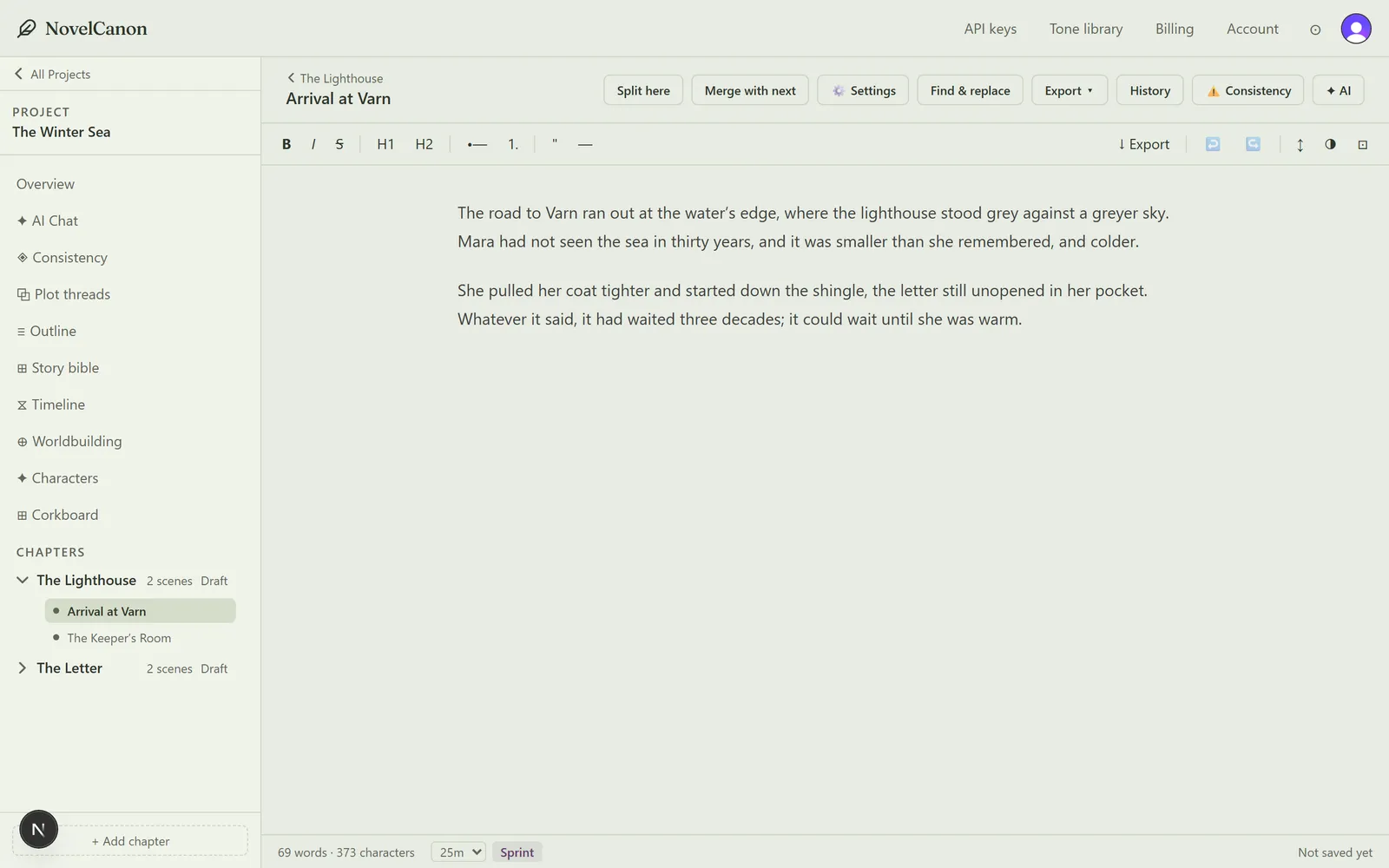
NovelCanon's writing studio — the manuscript front and centre, with the story bible, consistency scan, and AI panel a click away.
2. Novelcrafter — best for power users who want control
What it is: A mature bring-your-own-key tool centred on the Codex, a linked manual story bible that injects relevant entries into your prompts.
Best for: Writers who enjoy configuring their tools — deep prompt customisation, a structured worldbuilding database, and a collaboration tier for co-authors.
Strengths: Possibly the most customisable tool in the category; a strong community and ecosystem; team features on the top tier; low entry price.
Where it falls short: The Codex is powerful but manual — you build and maintain it — and there's no dedicated manuscript-wide contradiction scan. See the full NovelCanon vs Novelcrafter breakdown.
Pricing: Software tiers roughly $4–$20/month; you add your own AI key.
Bottom line: The power user's pick — maximum control, if you're happy to maintain the machine.
3. NovelAI — best for deep customisation and tuning
What it is: A subscription service with its own hosted models, known for fine-grained control over generation and a strong following among writers who like to tinker.
Best for: Writers who want to shape the model's behaviour closely and value customisation, lorebooks, and a distinctive creative sandbox (it also does image generation).
Strengths: Deep personalisation, unique models, and a loyal community; a very "make it yours" experience.
Where it falls short: It's a different philosophy from a structured manuscript tool — lighter on publication-oriented organisation and continuity auditing, and you're using its models rather than bringing your own key.
Pricing: Subscription tiers (roughly $10–$25/month; verify current tiers).
Bottom line: Great for tinkerers and sandbox storytellers; less so for shepherding a publication-ready novel.
4. Type.ai — best for fast, clean drafting
What it is: A streamlined AI writing tool that keeps generation right inside a clean editor, aimed at getting good prose out with minimal friction.
Best for: Writers who prioritise flow and speed — fewer panels, less setup, more writing.
Strengths: A clean, distraction-light editor with AI tools in-line; a gentle learning curve; good for drafting momentum.
Where it falls short: Lighter on the deep worldbuilding, series continuity, and manuscript-audit features that heavy novelists want; more generalist than fiction-specialist in places.
Pricing: Free tier plus paid subscription.
Bottom line: A frictionless drafting surface — pick it for speed, not for series bookkeeping.
5. DreamGen — best for creative freedom and a free tier
What it is: A storytelling-focused tool known for creative latitude, story steering, and multi-character role-play, with a notably generous free tier.
Best for: Writers who want an immersive, unrestricted creative sandbox and a way to try serious AI storytelling without paying up front.
Strengths: Story steering and character control; a generous free tier; a strong option for exploratory, character-driven drafting.
Where it falls short: More oriented to interactive storytelling than to producing and organising a publication-ready manuscript; lighter on formal continuity auditing and export.
Pricing: Generous free tier; paid plans for more.
Bottom line: The most fun to explore in for free — lighter on the "finish and publish a novel" end.
6. Dabble — best for planning-first writers
What it is: A clean, web-based novel-writing app with strong planning tools (plot grid, story notes) and AI available as an add-on.
Best for: Writers who lead with structure and outlining and want a calm, organised writing home with optional AI, not an AI-first tool.
Strengths: Excellent organisation and plotting features; a pleasant, uncluttered interface; syncs across devices.
Where it falls short: AI is more of a companion than the core, so it's not the pick if you want a powerful, deeply integrated AI collaborator or a dedicated consistency engine.
Pricing: Subscription tiers; AI features on higher plans.
Bottom line: Best for the outliner who wants organisation first and AI as a bonus.
7. Scrivener — best if you want organisation without generative AI
What it is: The long-standing, one-time-purchase writing powerhouse — unmatched for structuring a big manuscript, with no built-in generative AI.
Best for: Writers who want maximum organisation and a one-time cost, and who'd rather step back from AI generation (or pair Scrivener with a separate editing tool).
Strengths: Deep organisation (corkboard, binder, compile), a one-time license instead of a subscription, and total control over your files. If AI fatigue is why you're leaving Sudowrite, this is the honest answer.
Where it falls short: No AI assistance or consistency checking at all, and a steeper learning curve; you'd import into NovelCanon or another tool if you later want those. (NovelCanon imports Scrivener projects, if you go that way.)
Pricing: One-time license (around $60).
Bottom line: The no-AI, own-your-files classic — perfect if generative AI is exactly what you're trying to leave.
What we'd pick, and why it's not always us
We build NovelCanon, so treat this as disclosed bias — but the honest truth is that we're not the right answer for everyone, and pretending otherwise would make this whole list worthless. If your priority is the most fiction-native prose generation with zero setup, we'd point you to Sudowrite. If you want to live inside a deeply customisable prompt system, Novelcrafter. If you want to write fast with almost no friction, Type.ai. If you want to explore for free, DreamGen. NovelCanon is the pick for one specific, common worry — keeping a long story consistent without maintaining a bible by hand — and for wanting at-cost, bring-your-own-key pricing. If that's your worry, we're confident we're the best fit; if it isn't, one of the others genuinely is, and we'd rather you use the right tool than the wrong one with our name on it.
How to choose
Skip the "best overall" framing and pick by your actual priority:
- Continuity in a long book or series? → NovelCanon.
- Maximum control and customisation? → Novelcrafter.
- Fast, frictionless drafting? → Type.ai.
- Creative freedom and a free tier to explore? → DreamGen.
- Planning and structure first? → Dabble.
- Organisation without generative AI? → Scrivener.
A practical way to decide: shortlist two, run the same chapter of your work-in-progress through each for a week, and notice which friction you feel — the price meter, the maintenance, the setup, or the nagging doubt about continuity. The tool that removes your specific friction is your tool.
If your honest answer is "I want to stop worrying whether my story still holds together," that's the specific problem NovelCanon was built for. Try it free, read how the Consistency Engine works, or start with the complete guide to story consistency. For the broader category beyond Sudowrite, see our best AI novel writing software comparison.
Frequently asked questions
What is the best Sudowrite alternative?
There isn't one best for everyone — it depends on your priority. For continuity and at-cost pricing, NovelCanon; for deep customisation, Novelcrafter; for fast clean drafting, Type.ai; for creative freedom with a free tier, DreamGen. Pick by the job you most need done, not by a leaderboard.
Is there a free alternative to Sudowrite?
Yes. NovelCanon has an ongoing free plan (one project, bring-your-own-key with free models), and DreamGen offers a generous free tier. Several others have free trials. "Free" varies — some cap features, some cap usage — so match the free tier's limits to how you actually write.
What is the best Sudowrite alternative for bring-your-own-key?
NovelCanon and Novelcrafter are the two main bring-your-own-key options. Both let you connect your own AI key and pay your provider at cost. NovelCanon adds a self-maintaining consistency engine; Novelcrafter offers a deeply customisable manual Codex. Sudowrite itself is credit-based, not bring-your-own-key.
Why do writers switch from Sudowrite?
The most common reasons are credit-based pricing that's hard to predict, wanting to bring their own AI key to pay at cost, and wanting stronger continuity tools for long or series fiction. Sudowrite remains strong for prose generation — writers usually leave for cost control or a different feature priority, not because it's bad.
Is there a cheaper alternative to Sudowrite?
Often, yes — bring-your-own-key tools like NovelCanon and Novelcrafter separate the software fee from AI cost, so if you write moderate amounts or use free models, your total can be lower than a credit plan. Your real cost depends on how much AI you use, so estimate your volume before deciding.
Is Sudowrite still worth it in 2026?
For prose generation, yes — its fiction-tuned Muse model and creative tools are among the best. Whether it's worth it for you depends on whether you value that over predictable pricing and continuity auditing. If generation is your main need and credits don't bother you, Sudowrite remains a strong choice.
Written by
Munib Ali Laghari
Founder, NovelCanon
Building the writing studio he wished he had for keeping a long story straight — one where the AI never loses the thread.