NovelCanon vs Novelcrafter: The Codex That Maintains Itself (2026)
NovelCanon vs Novelcrafter, compared honestly — Novelcrafter's manual Codex vs NovelCanon's self-maintaining registry and contradiction audit.
NovelCanon and Novelcrafter are both bring-your-own-key writing studios, so the real question isn't pricing — it's philosophy. Novelcrafter gives power users a deeply customisable manual Codex and prompt system. NovelCanon gives you a story bible that builds itself from your prose and audits the whole manuscript for contradictions. Control vs automation.
Because NovelCanon and Novelcrafter share the same bring-your-own-key foundation, comparing them is unusually clean: the money works the same way, so you can focus entirely on what each tool actually does with your story. This is an honest look — including where Novelcrafter is the better choice.
Key takeaways
- Same cost model. Both are bring-your-own-key; you pay your AI provider directly, so neither wins on markup.
- The Codex is manual; the registry is automatic. Novelcrafter's Codex is a powerful bible you build and maintain by hand. NovelCanon's registry is derived from your prose and self-heals.
- NovelCanon adds a contradiction audit — a manuscript-wide deep scan Novelcrafter doesn't have.
- Novelcrafter wins on customisation and collaboration — deep prompt control, a mature ecosystem, and team features.
- Try NovelCanon free or read how its Consistency Engine works.
NovelCanon vs Novelcrafter at a glance
| NovelCanon | Novelcrafter | |
|---|---|---|
| AI model | Bring your own key (OpenAI, Anthropic, Google, OpenRouter) | Bring your own key (same providers, via OpenRouter/direct) |
| Pricing | $15/mo or $144/yr; ongoing free plan | Tiers ~$4–$20/mo (2026); AI from mid-tier |
| Story bible | Derived from your prose — self-maintaining | Codex — powerful, manually built and linked |
| Contradiction audit | Yes — three-tier engine + full-manuscript deep scan | Not a dedicated scan; Codex + extraction for continuity |
| Prompt control | Curated, writer-first | Deep, customisable prompt system |
| Collaboration | Single-author today | Team/collaboration on top tier |
| Voice matching | Yes (drafts in your voice) | Not a dedicated feature |
| Offline | Installable PWA, offline | Web |
Competitor details reflect Novelcrafter's public pricing as of 2026; check current terms.
The core difference: a Codex you build vs a bible that builds itself
Both tools solve the same underlying problem — the AI needs to know your story, and you need to keep your story straight — but they take opposite routes.
Novelcrafter's Codex is a linked reference system you construct: you create entries for characters, locations, factions, magic systems, and lore, connect them, and when you generate or edit a scene, Novelcrafter injects the relevant Codex entries into the prompt so the model stays on-model. It's genuinely well-built, and for writers who enjoy worldbuilding in a structured database, the control is a feature, not a chore. The trade-off is that it's manual: the Codex is only as complete and current as you keep it, and the moment your prose and your Codex disagree, the Codex is quietly feeding the AI something the book no longer says.
NovelCanon's registry inverts that. Instead of you filling in a bible, the engine extracts the facts from your prose automatically — who's present, what they know, where and when — and files them. The bible is a projection of your text, so it can't drift from the manuscript, and it self-heals: fix a contradiction in the prose and the stale fact retires itself. You give up some of the hands-on control Novelcrafter offers; you get back the hours of maintenance, and a bible that's never out of date.
A concrete example
Say you rename a character in chapter twenty — Marcus becomes Marius — and change a detail about his past. In Novelcrafter, you'd update the prose, then remember to update his Codex entry (and any linked entries) so the AI and your notes stay accurate; miss it, and the Codex now describes someone who no longer exists. In NovelCanon, you change the prose, and the registry re-derives from the text on its next pass: the old facts lose their supporting scenes and retire, the new ones take their place, and any contradiction the change introduced elsewhere gets flagged. The difference isn't subtle over a whole book — it's the difference between a bible you serve and one that serves you.
Consistency: context vs audit
This is where NovelCanon's design goes somewhere Novelcrafter doesn't.
Novelcrafter's continuity tools — the Codex, character extraction, scene summaries — are all oriented around giving the AI good context so what it generates fits your story. That's valuable, and it's most of what "consistency" means in a generation-first tool.
NovelCanon treats consistency as a second, separate job: auditing the finished prose. Its three-tier engine runs instant checks as you type, extracts facts per scene, and then — on demand — runs a full-manuscript deep scan that cross-references every fact, plot thread, and world rule to surface contradictions, dropped threads, and rule-breaks. It's the difference between a tool that helps you write consistently and one that also checks whether you did, across the whole book. If you've ever finished a draft with a nagging fear that chapter thirty contradicts chapter three, that audit is the feature you're looking for — here's how it works.
A day in each tool
The philosophies show up in the daily rhythm. In Novelcrafter, a productive session often means tending your world: refining Codex entries, tuning the prompt behind an action, wiring up the exact context you want the model to see, then generating with that precision. It rewards a writer who likes to build the machine and then drive it.
In NovelCanon, the loop is closer to just writing: you draft, the engine reads along and keeps the registry current, Tier 1 underlines a name slip the moment it happens, and when you want reassurance you run a scan and review what it found. It rewards a writer who wants the bookkeeping to disappear. Neither rhythm is better in the abstract — but they suit different temperaments, and you probably already know which one is yours.
Customisation and ecosystem: Novelcrafter's strengths
It would be dishonest to skip what Novelcrafter does better.
- Prompt customisation. Novelcrafter gives power users deep control over the prompts behind every AI action — a saved, editable prompt library you can tune to your exact taste. If you like being under the hood, it's one of the most configurable tools in the category, which is why it's sometimes called "the Photoshop of AI fiction."
- A mature ecosystem. It's been around, has an active community, courses, and a lot of accumulated workflow knowledge. Maturity has real value: fewer rough edges, more answers when you get stuck.
- Collaboration. Its top tier includes team management and collaboration — genuinely useful if you write with a co-author or work closely with an editor inside the tool.
- A low entry price. Its cheapest tier is an inexpensive way to get organised even before you add AI.
NovelCanon, by contrast, is deliberately more curated — the prompts are writer-first and opinionated rather than infinitely tweakable — and it's built around a single author today. If maximum control or team collaboration is central to how you work, Novelcrafter has the edge.
Pricing, honestly
Both are bring-your-own-key, so your AI provider bill is roughly the same either way — the subscription is the only real difference, and it's small. Novelcrafter lets you start cheaply (a low-cost organising tier, with AI features arriving mid-range) and scale up to a collaboration tier. NovelCanon is a single Pro tier at $15/month or $144/year that includes everything — the full Consistency Engine, voice matching, and all export formats — plus a genuine free plan to start. If you want to pay only for organisation at first, Novelcrafter's ladder is appealing; if you'd rather one price with nothing gated behind higher tiers, NovelCanon is simpler. Neither will surprise you on the AI bill, because you control the key.
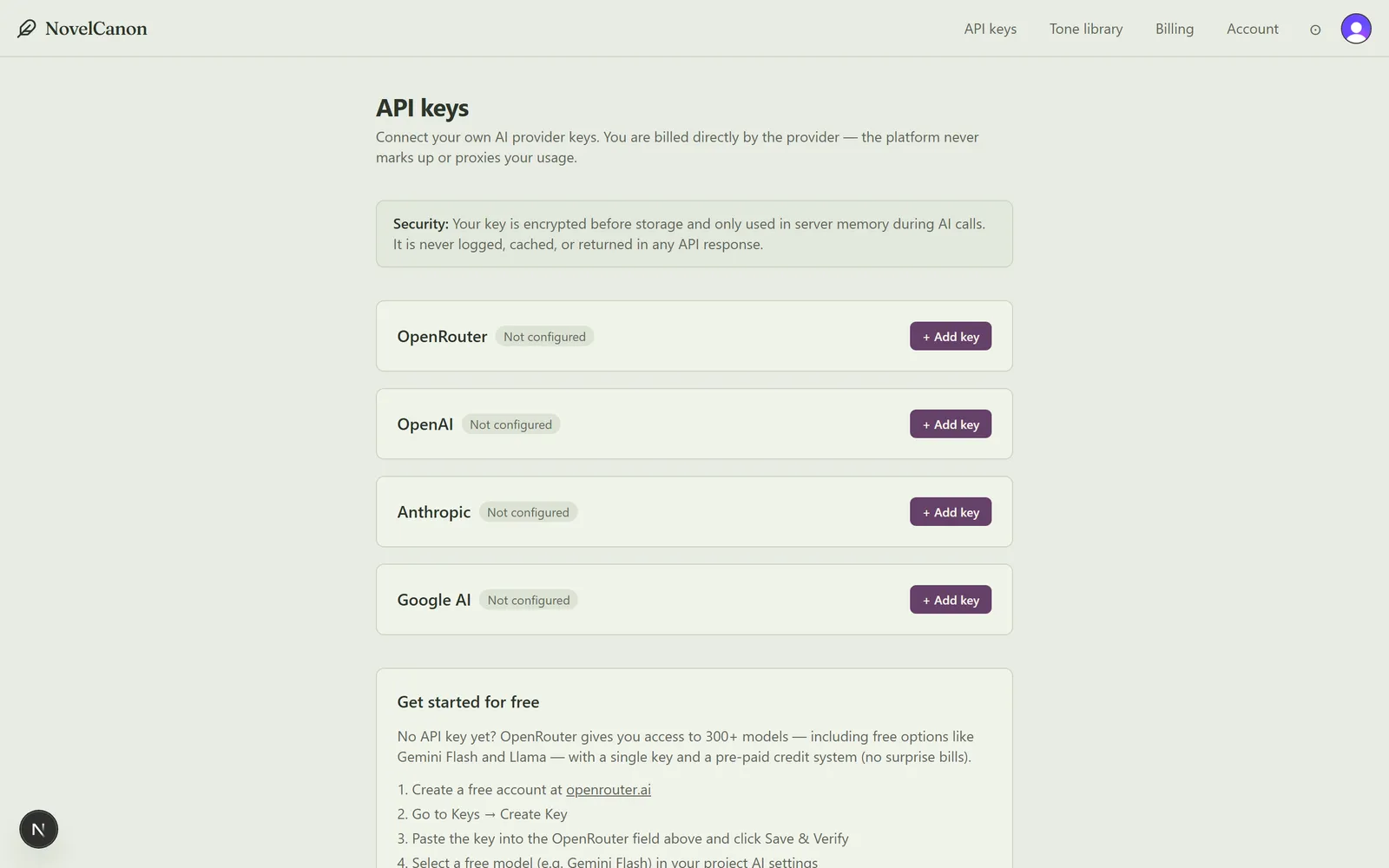
Both tools are bring-your-own-key: connect your own provider key and pay at cost. NovelCanon adds no markup and never proxies your usage.
What NovelCanon adds on top
Beyond the consistency audit, a few things come standard with NovelCanon Pro that are worth weighing:
- Voice matching — upload your own writing and NovelCanon builds a voice profile from it (point of view, tense, sentence rhythm, register) plus excerpts showing your range, then carries both into every generation. You can read and edit exactly what the AI is told.
- Offline drafting — NovelCanon installs as a PWA and works on a plane; your drafts sync when you reconnect.
- Publication-ready export — DOCX, EPUB, and PDF plus a full project backup, and easy Scrivener import if you're migrating.
- A genuine free plan — one project up to three chapters with free models, so you can try the whole workflow before paying anything.
Which is better for a series?
Series writers have the hardest continuity job in fiction — book three has to honour every fact established in books one and two, across hundreds of thousands of words you may have written years apart. Both tools support series work, but they help differently. Novelcrafter's Codex can span a series, giving you one linked reference for recurring characters and lore — powerful, and exactly what many series authors love, as long as you keep it current across every book. NovelCanon's advantage compounds precisely here: the registry is derived from the prose of the whole project, and the deep scan audits across it, so a detail you contradict in book three against book one is the kind of error it's built to surface. If your series is meticulously planned and you enjoy maintaining a canonical bible, Novelcrafter's Codex is a fine home; if your real fear is forgetting what book one established, NovelCanon's audit is the safety net.
When Novelcrafter is the better choice
- You want maximum control over prompts and a highly customisable, power-user workflow.
- You value a mature ecosystem with an established community and courses.
- You need collaboration or team features for co-authoring or editing together.
- You want to start cheaply with an organising tier before adding AI.
When NovelCanon is the better choice
- You'd rather the story bible maintain itself than build and update a Codex by hand.
- You want a real contradiction audit across the whole manuscript, not just context for generation.
- You care about voice matching, offline writing, privacy, and one-click export — and want a free plan to start.
Both are excellent bring-your-own-key tools, and if you're this deep into comparing them, you already care about owning your costs and your words — which is the right instinct. If your deciding question is "who keeps my story straight," try NovelCanon free, see how it stacks up against the credit-based option in NovelCanon vs Sudowrite, or read the complete guide to story consistency for the craft behind the feature — or zoom out to our best AI novel writing software roundup for the whole field.
Frequently asked questions
Are NovelCanon and Novelcrafter both bring-your-own-key?
Yes. Both let you connect your own AI provider key and pay for model use directly, so the difference isn't the pricing model — it's what the software does with your story. That makes this a cleaner comparison than most: same cost structure, different feature philosophy.
What is the difference between NovelCanon's registry and Novelcrafter's Codex?
Novelcrafter's Codex is a manual story bible: you define characters, locations, and lore, and it injects relevant entries into AI prompts. NovelCanon's registry is derived automatically from your prose and adds a contradiction audit — it not only feeds context but scans the whole manuscript for facts that disagree.
Which is cheaper, NovelCanon or Novelcrafter?
They're close, since both are bring-your-own-key and you pay your AI provider directly. Novelcrafter's software tiers run roughly $4–$20/month (2026), with AI features starting mid-tier; NovelCanon is $15/month or $144/year for everything, plus an ongoing free plan. Your total depends mostly on how much AI you use, not the subscription.
Does Novelcrafter check for plot holes or contradictions?
Novelcrafter's Codex, character extraction, and scene summaries help you organise and keep continuity, but it doesn't run a dedicated manuscript-wide contradiction scan. NovelCanon adds that audit layer — a deep scan that surfaces contradictions, dropped threads, and broken world rules across the whole book.
Can I collaborate with a co-author or editor?
Novelcrafter offers collaboration and team management on its top tier, so if shared editing is central to your workflow it has a clear edge today. NovelCanon is currently built around the single author, with easy export to hand a manuscript to an editor.
Do I have to build a story bible by hand in NovelCanon?
No. That is the core difference. In Novelcrafter you build and maintain the Codex yourself; in NovelCanon the story bible is extracted automatically from your prose and updates as you write, so there is no separate database to keep in sync with the manuscript.
Written by
Munib Ali Laghari
Founder, NovelCanon
Building the writing studio he wished he had for keeping a long story straight — one where the AI never loses the thread.