How to Keep Track of Characters in a Novel (Without a Spreadsheet)
Keep track of characters in a novel without a spreadsheet: track each character's changing state — not just eye colour — with a story bible that writes itself.
To keep track of characters in a novel without a spreadsheet, track two different things separately: each character's fixed attributes (name, age, appearance) and their changing state (where they are, what they know, who they've met) at each point in the story. A spreadsheet handles the first and quietly fails at the second — which is where character errors are actually born.
Ask a writer how they keep their characters straight and most will describe a spreadsheet: one row per person, columns for eye colour, age, hometown. It's the standard advice, and for a while it works. Then the cast grows, the plot turns, someone learns a secret in chapter nine — and the grid that was supposed to save you becomes one more thing to keep in sync with a book that won't stop changing. This is a guide to tracking characters the way the errors actually happen, so the system fits the problem instead of fighting it.
Key takeaways
- A character isn't one thing to track — it's two. Fixed attributes (eye colour, age) barely change; state (what they know, where they are, who they've met) changes every scene. Confusing the two is why tracking fails.
- Spreadsheets are great for attributes and useless for state. A static grid can't show what a character knew as of chapter 14 — and knowledge and location errors are the ones readers catch.
- Track minor characters too. The named innkeeper who reappears wrong two hundred pages later is the classic miss.
- Revision breaks character continuity more than drafting does — every moved scene changes who knew what, when.
- The record has to follow the prose. The moment your notes and your manuscript disagree, your notes are lying to you.
- The whole job can be automated. A story bible that builds itself from your prose tracks each character's state without a grid to maintain.
Why do character-tracking spreadsheets stop working?
Because a spreadsheet is built to hold facts that sit still, and half of what you need to track about a character is in constant motion. A grid is perfect for a birth date. It has no good way to answer "what does Ada know, and where is she, as of the scene I'm writing right now?" — and that question is the whole game.
Think about what a spreadsheet cell actually is: one value, true for all time. Elena's eyes are grey — fine, that's a cell. But "Elena knows her brother is alive" isn't true for all time. It's false for twelve chapters and true after that, and if you write a scene where she acts on knowledge she doesn't have yet, no column heading will warn you. To force that into a spreadsheet you'd need a cell per fact per chapter, and within a week you're maintaining a second manuscript made of cells. That's the quiet failure: the spreadsheet doesn't break loudly, it just stops being worth the upkeep, so you stop updating it, and an unmaintained tracker is worse than none because it lies with authority.
The fix isn't a better spreadsheet. It's separating the two kinds of thing you're tracking.
What do you actually need to track about a character?
Two layers, and they behave completely differently. The first is attributes — the fixed facts a character carries from first page to last. The second is state — the facts that change as the story moves. Track them the same way and you'll drown; track them differently and character continuity gets manageable.
| Layer | Examples | How often it changes | The error it causes when lost |
|---|---|---|---|
| Attributes (fixed) | Name and spelling, age, eye/hair colour, height, scars, hometown, core traits | Almost never | Eyes green in ch. 3, brown in ch. 30; an age that doesn't add up |
| State (dynamic) | What they know, where they are, who they've met, what they want now, injuries, relationships | Every scene | A character acts on a secret they were never told; is in two places; heals impossibly fast |
Attributes are the easy half — write them once and check against them. A one-page profile per major character does the whole job: name (and its exact spelling, so "Katherine" never becomes "Katharine"), age, the handful of physical details you'll otherwise contradict, key relationships, and two or three defining traits. Keep it short. A profile so elaborate you won't maintain it fails the same way the spreadsheet does.
The hard half — the half no grid handles — is state. And it deserves its own approach.
Track state, not just stats: the part spreadsheets miss
The single most useful shift in character tracking is to stop recording only what a character is and start recording what a character knows — and where they are, and who's aware of them — at each point in the story. Attributes tell you how to describe a character. State tells you whether the scene you just wrote is possible.
Here's the distinction in practice. "Tomas is a blacksmith, forty-one, missing two fingers on his left hand" is attributes — set once, rarely touched. "As of chapter fourteen, Tomas knows the bridge is sabotaged, is travelling north, and hasn't yet met the widow" is state — and every one of those clauses can be violated by a later scene without a single attribute changing. Readers rarely catch a wandering eye colour. They always catch a character who reacts to news they were never given, because it breaks the logic of the scene in front of them.
So keep, for each significant character, a short running log ordered by the story — not a grid, a timeline:
- Knowledge — what they've learned, and in which scene they learned it.
- Location — where they are, and how they'd get to where they appear next.
- Relationships — who they've met, and the current state of each (strangers, allies, estranged).
- Wants — what's driving them right now, since it shifts across the arc.
The point of ordering it by story rather than by column is that character errors are temporal: they're about before-and-after, not about a value being wrong in isolation. A record that reads in narrative order lets you answer the only question that matters when a character walks onstage — what is true about this person as of this moment? — which is precisely the question a spreadsheet can't answer.
How do you keep track of what each character knows?
Knowledge is the hardest state to track and the easiest to break, so give it its own attention: for every secret or key piece of information, note who knows it and the scene where they found out. Then, before you write a character acting on information, check that they were actually told.
This matters most because of how the error enters — and it's almost never during the first draft. It's during revision. Consider a real-feeling case:
In your first draft, Ada overhears the ambush plan in chapter eight and warns the caravan in chapter ten. Clean. Then, revising for pacing, you move the warning scene earlier — now it's chapter seven. Ada is warning people about a plan she won't overhear for another chapter. Nothing in her attributes changed. Her eyes are the same colour. But her state is now impossible, and on a linear read your eye slides right past it because each scene is fine on its own.
That's the shape of nearly every serious character error: a knowledge or location fact that was true, until a structural edit quietly made it false somewhere you weren't looking. A knowledge log catches it because the moment you move Ada's warning to chapter seven, the log still says she learns the plan in chapter eight — and the collision is visible instead of buried. Without the log, the only thing standing between that error and your reader is your memory of a draft that no longer exists.
The same logic covers location (could this character actually be here, given where they were two scenes ago?) and relationships (have these two even met yet?). All three are state, all three break at the seams between scenes written far apart, and all three are invisible to a tool that only stores fixed attributes.
How do you keep track of characters across a series?
A series raises the stakes because the seams get wider: the gap where continuity breaks isn't between chapters now, it's between whole books written a year apart. The answer is a series bible — the same character records, but persistent across every manuscript, with each character's end-of-book state carried forward as the start of the next.
The classic series failure is a minor character who was vivid in book one and comes back subtly wrong in book three — a changed name spelling, a hometown that migrated, a relationship that resets as if the first book's events didn't happen. Nobody remembers a spear-carrier's details across three years of writing; that's not a discipline failure, it's a memory limit no author beats by trying harder. What beats it is a record that outlives the individual manuscript, so book three checks against book one instead of against your recollection of it. This is the same reason television writers' rooms have run on a shared story bible for decades: continuity across a long, multi-part narrative is impossible without a record that everyone — and every later instalment — writes against.
What are the alternatives to a spreadsheet?
Any of these beats a spreadsheet, because each does something a static grid can't — but they trade off differently between effort and reliability. The right one is the one you'll actually keep current on a long project.
| Method | Good at | Where it fails |
|---|---|---|
| Character one-pagers (a doc per character) | Attributes, voice notes, quick reference | Still manual; state gets stale unless you religiously update it |
| A wiki / linked notes (Notion, Obsidian) | Relationships, worldbuilding links, cross-references | The moment your notes and prose disagree, the notes lie to you |
| Index cards / a timeline board | Seeing state in narrative order, reordering scenes | Physical, hard to search, doesn't travel across a series |
| A self-populating registry (software that reads your prose) | State tracked automatically, always matches the text | Gives up a little manual control to remove the upkeep |
Notice the failure column: every manual option shares one weakness — the record and the manuscript drift apart, because keeping two things in sync by hand is exactly the labour the human mind is worst at over a hundred thousand words. The best of the manual methods is whichever one you'll keep up. But there's a category that removes the drift entirely, by making the record a product of the prose rather than a separate document you maintain beside it.
How do you keep track of characters without it eating your writing time?
Everything above works by hand. It's also, done entirely by hand, a real tax on the part of you that wants to write — updating logs, checking who-knew-what, searching three hundred pages for a name. That's the mechanical, memory-heavy half of the job, and it's exactly the half a computer is good at.
This is the problem NovelCanon's story bible was built around. Instead of a grid you fill in, it reads each scene as you finish it and extracts the character facts into a living registry automatically — who was present, what they now know, where they are, what was established about them. The character records build themselves from your prose, so they can't drift from the manuscript: fix a contradiction in the text and the record updates itself, because the record is the text, structured. It also catches the cheap slips instantly — type "Katharine" after ninety uses of "Katherine" and it flags the near-match right in the editor — and when you do rename a character in chapter twenty, a project-wide find-and-replace fixes every scene at once, with a snapshot to roll back.
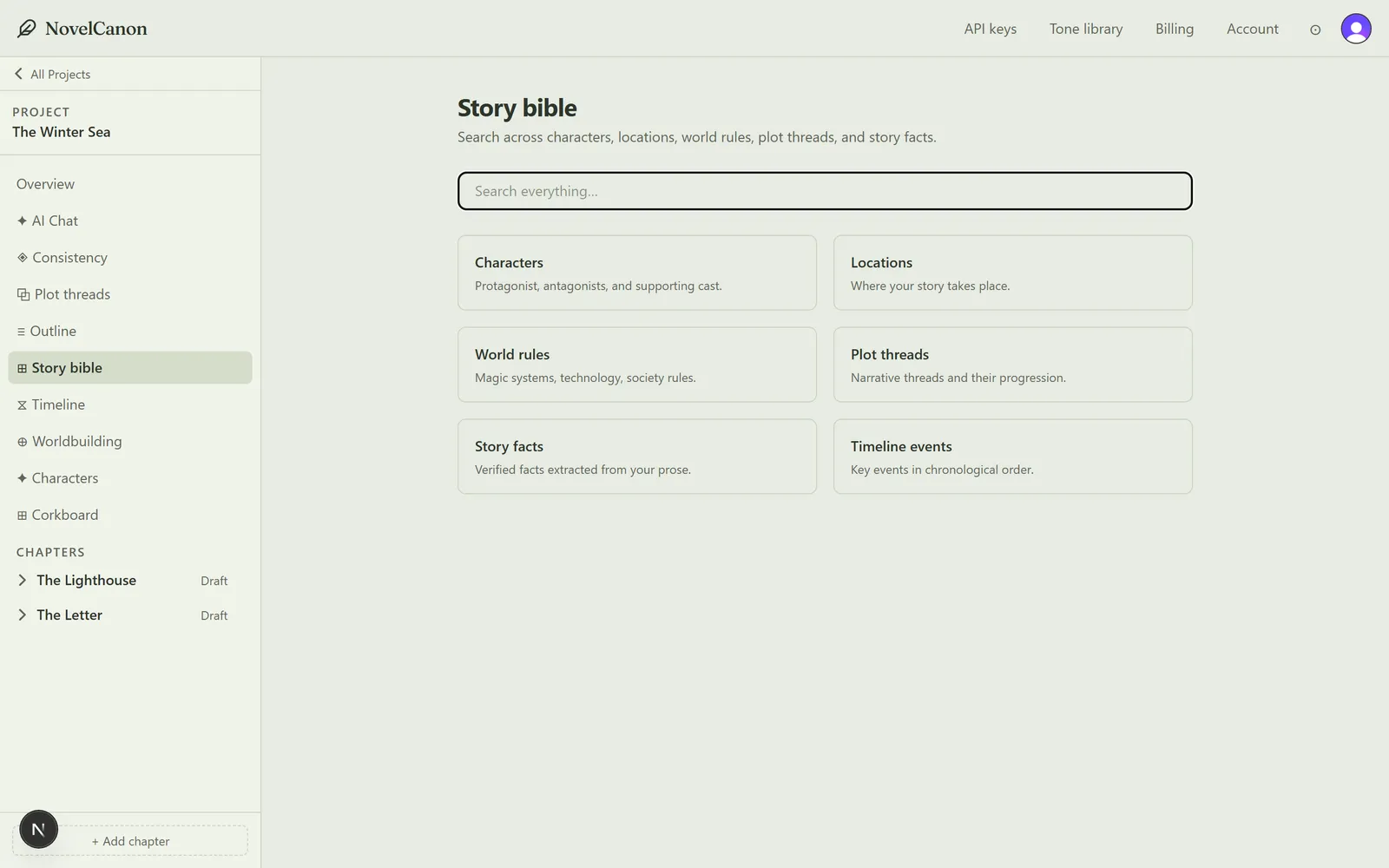
Character cards in the NovelCanon story bible — populated from the scenes themselves, so the record of who each character is stays in step with what you actually wrote.
None of this replaces your judgement about who your characters are — you still decide every fact. It automates the remembering and the cross-checking so your attention stays on the writing. You can read exactly how the Consistency Engine tracks facts across a manuscript, see where character tracking sits in the complete guide to story consistency, or compare the self-maintaining approach to a hand-kept codex in NovelCanon vs Novelcrafter. The full engine is part of NovelCanon Pro; the free plan lets you try the workflow first.
Keeping track of characters was never really a spreadsheet problem. It's a memory problem — and the fix isn't a bigger grid, it's a record that tracks what a character knows, not just what they look like, and that keeps itself honest against the only source of truth that matters: the story you actually wrote.
Frequently asked questions
How do you keep track of characters when writing a novel?
Keep two records for each character: a fixed profile (name, age, appearance, core traits) and a running log of their changing state — where they are, what they know, and who they've met as the story moves. The fixed profile rarely changes; the state changes every chapter, and that gap is where most tracking actually breaks.
What should a character profile include?
The stable facts you'll contradict if you forget them: full name and its exact spelling, age and birth order, physical details (eyes, hair, height, distinguishing marks), key relationships, and two or three defining traits. Keep it short — a profile you can't maintain is worse than none. It's a quick reference, not a biography.
Can you keep track of characters in a novel with a spreadsheet?
You can, and for fixed attributes a spreadsheet works fine. It fails on the moving parts — what a character knows at a given moment, where they are, and who is aware of what — because that state changes every scene and a static grid can't show it in narrative order. Most character errors live in exactly that gap.
How do you keep track of characters across a series?
Promote your character records to a series bible that persists across books, and record each character's state at the end of every book as the starting point for the next. Series continuity fails at the seams between books — months or years apart in writing time — so the record has to outlive any single manuscript.
How many characters is too many to keep track of?
There's no fixed number — the practical limit is how many you can keep straight, which is exactly what a tracking system raises. Trouble usually starts when minor characters accumulate unrecorded: a named innkeeper in chapter two who reappears differently in chapter twenty. Track every character you name, however minor, and the ceiling stops mattering.
Written by
Munib Ali Laghari
Founder, NovelCanon
Building the writing studio he wished he had for keeping a long story straight — one where the AI never loses the thread.