How to Write a Novel with AI (Without Losing Your Voice)
How to write a novel with AI without sounding like a machine: which parts of the job to hand over, which to guard, and a workflow that keeps your voice.
To write a novel with AI without losing your voice, split the work into three layers: decisions, sentences, and bookkeeping. Hand the machine the bookkeeping — continuity, fact-tracking, the things memory fails at — guard the decisions absolutely, and let it near your sentences only if you rewrite every one.
Nearly every guide to writing fiction with AI is really a guide to generating fiction with AI, and the two are not the same job. The generating question was settled years ago: yes, a model will produce a chapter, and yes, it will read like a chapter. The question that actually matters in 2026 is narrower and harder — which parts of writing a novel can you hand to a machine without the book stopping being yours?
This guide answers that. Not with "use it as a tool, not a crutch," which is true and useless, but with a specific division of labour, a diagnostic for catching machine prose in your own manuscript, and a workflow you can run tomorrow.
Key takeaways
- Voice dies at the sentence layer. That's where models reach for the most average available phrasing — and it's the layer most AI writing tools are built to sell you.
- Split the work into three layers — decisions, sentences, bookkeeping — and hand the machine the bottom one first.
- The bookkeeping layer is where AI is genuinely superhuman and costs you nothing: what you named the innkeeper, whether chapter 22 contradicts chapter 4, which thread you never paid off.
- The most useful AI output is often the output you delete. Generate five options at a stall, read them, write the sixth yourself.
- Keep a tell sheet — two columns, your habits and the model's — so the voice pass becomes a checkable task instead of a vague worry.
- Amazon and the Copyright Office have already drawn lines, and they fall almost exactly at the layer boundary. Heavy editing does not turn generated prose into assisted prose.
- Consistency is the one job to automate first, because it's the one where your own memory is provably the weak link — see the complete guide to story consistency.
What does "writing a novel with AI" actually mean?
It means anything from asking a model to name a tavern to having it produce the whole manuscript — and collapsing that range into one phrase is why the conversation is so muddled. "I wrote my novel with AI" describes two writers whose books have nothing in common.
It's worth noticing that the publishing industry has already refused to treat those as the same thing. Amazon's KDP guidelines draw the line in unusually plain language: content is "AI-generated" if an AI tool "created the actual content (whether text, images, or translations)," and — this is the part most writers miss — that classification holds "even if you applied substantial edits afterwards." Content is "AI-assisted" only if you created it and used AI "to edit, refine, error-check, or otherwise improve" it. Only the first requires disclosure.
That distinction is worth internalising as craft advice, not just compliance. Amazon isn't asking how much you edited. It's asking who produced the first version of the sentence. So does your reader, implicitly, and so — as we'll see — does the Copyright Office. The question "how much AI is in this book?" turns out to be less useful than "which layer was it working in?"
Why does AI writing sound like AI?
Because a language model's job is to produce the most probable next thing, and voice is the accumulation of improbable choices made consistently. That single sentence explains almost every complaint about machine prose.
Think about what your voice actually is. It's not your vocabulary or your genre. It's the fact that you end paragraphs one beat earlier than most people. That you refuse semicolons. That your characters interrupt each other. That you'd rather name the specific brand of cigarette than write "a cigarette." Those choices are, statistically speaking, unusual — that's precisely what makes them recognisable as yours.
A model trained to predict likely text is trained, structurally, toward the middle of the distribution. Ask it to continue your scene and it will write competent, fluent, faintly familiar prose, because competent-fluent-familiar is what the average of everything looks like. Nothing is wrong with any individual sentence. That's the trap: there's no error to point at, just a slow slide toward the centre. Writers describe this as their voice "getting away from them," and they're usually right — it doesn't vanish in one paragraph, it erodes over a hundred.
Which leads to the useful reframing. Voice isn't lost by using AI. It's lost by using AI on the layer where voice lives.
Which parts of a novel are actually yours?
Three layers, and only two of them are authorship. Separating them is the whole method, so here they are plainly:
| Layer | What it is | Should AI touch it? | What you lose if it does |
|---|---|---|---|
| Decisions | What happens, who these people are, what the book is about, what it costs them | No | The book. A model doesn't know what you're trying to say, so it optimises for plausible — and plausible plots are the ones readers have already read. |
| Sentences | Word choice, rhythm, image, where the paragraph breaks, what's left unsaid | Only under strict conditions | Your voice, gradually and invisibly. |
| Bookkeeping | Which facts you've committed to, whether they still agree, what you named the innkeeper, whether the thread you set up in act one ever paid off | Yes — first, and as much as it will take | Nothing. This is memory work, not art. |
Read that table with a competitor's feature list next to it and something jumps out: nearly every AI writing product on the market sells you layer two. Expand this paragraph. Describe this room. Rewrite this passage with more tension. Those are the demo-friendly features, the ones that look magical in a thirty-second video — and they're the ones that operate exactly where your voice lives.
Meanwhile the layer where a machine is genuinely, unambiguously better than you — layer three — barely gets marketed at all, because "it remembered what colour her eyes were in chapter four" doesn't make a good demo. It makes a good book.
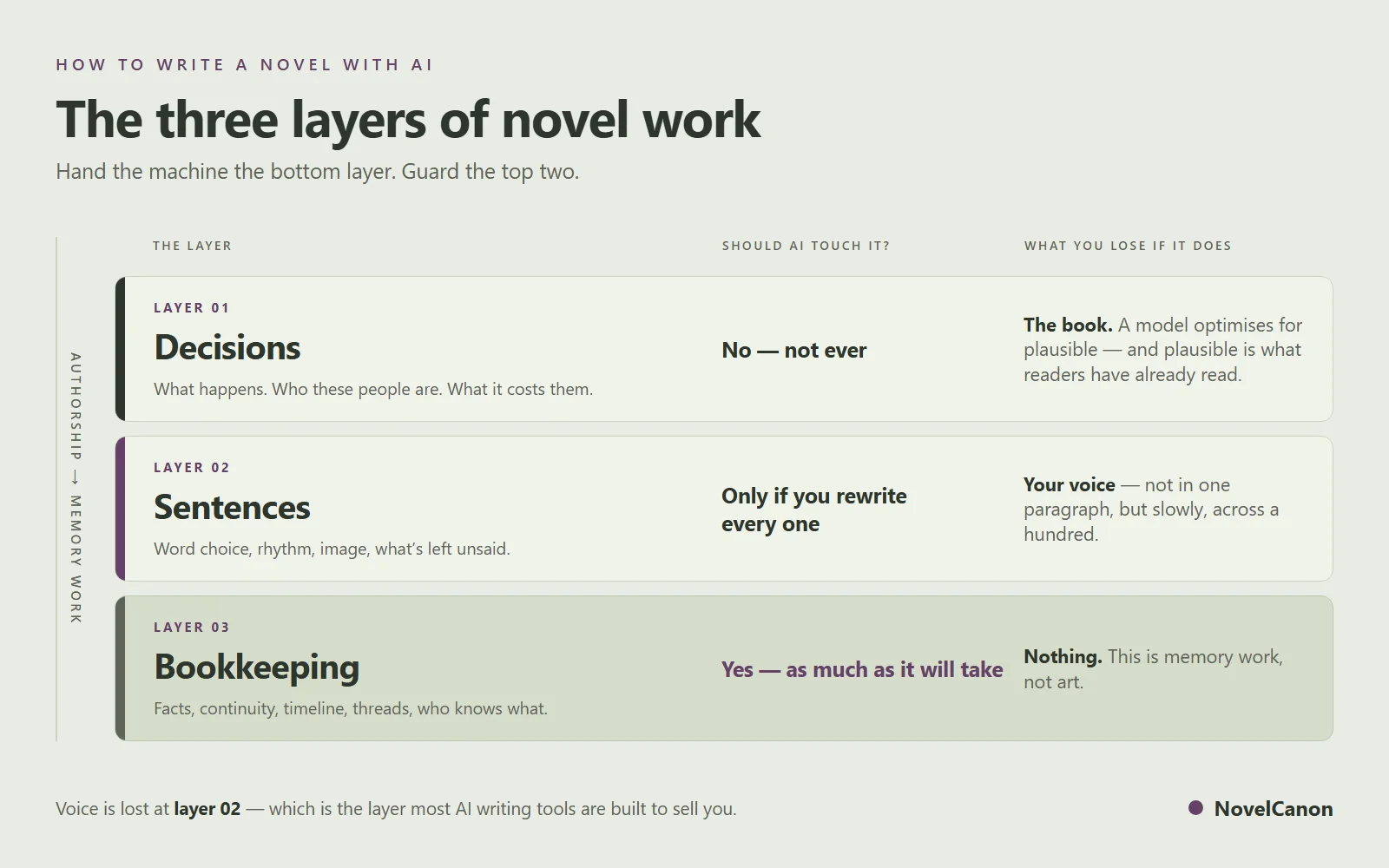
The division of labour in one picture. Voice is lost at layer two — which is the layer most AI writing tools are built to sell you.
What can AI take over without touching your voice?
Everything in the bookkeeping layer, and it's a much bigger share of the job than most writers admit. A novel is not only an act of imagination; it's also a large, tedious database that you are maintaining by hand, badly, from memory, over eighteen months.
Consider the scale. When we pointed our own consistency engine at the full text of Dracula — about 160,000 words — it extracted 4,738 distinct factual claims: who was where, who knew what, what colour, what date, what rule. That is the size of the ledger sitting underneath a single novel. You are not remembering 4,738 things. Nobody is. (What happened when we cross-referenced them all is its own story, and a more surprising one than we expected.)
So the bookkeeping layer includes:
- Continuity of fact — the eye colour, the sister's name, the distance to the coast, the age that has to work out.
- Continuity of knowledge — who has been told the secret, and whether the character acting on it could possibly know it yet.
- Timeline arithmetic — how many days have passed, whether the wound has had time to heal, whether "last Tuesday" can actually have been a Tuesday.
- Thread accounting — everything you set up that still needs paying off.
- The mechanical sweep — you renamed a character in chapter 20 and three scenes still use the old name.
None of that is voice. None of it is judgement. All of it is the kind of work that punishes you for being human, and every hour you spend on it is an hour not spent on the two layers that are actually yours. Handing it over isn't a compromise — it's the highest-return use of AI in fiction, and it's the one nobody argues about on the internet. If you want the manual version of this discipline first, it's worth understanding what a story bible is before you automate it.
How do you use AI on your sentences without sounding like it?
By deciding in advance that nothing it writes survives contact with your manuscript in its original form — and then having a mechanical way to verify that. "Rewrite everything the AI gives you" is standard advice and it fails for a boring reason: after the fourth hour, you can't tell anymore. The prose reads fine. Fine is the problem.
So make it checkable. Build a tell sheet: two columns, kept in the same document as your outline.
Column one — the model's tells. The specific habits you notice in output from the model you use. Some recur almost universally:
| Tell | What it looks like | Why it flattens |
|---|---|---|
| The tricolon | Three parallel beats where two would land harder | Rhythm as decoration; it makes every paragraph sound like a speech |
| "Not X, but Y" | "It wasn't grief, but something quieter" | A reversal used as cadence rather than meaning |
| Abstraction over object | "A weight settled over her" instead of the specific physical detail | The concrete noun is where fiction lives |
| Emotion labelled | "She felt a pang of grief" | Names the feeling instead of causing it |
| The closing chord | Every paragraph resolving on a summarising beat | Real prose is allowed to end mid-thought |
| Uniform dialogue | Everyone speaks in complete, grammatical sentences | Nobody talks like that; character lives in how speech breaks |
Column two — your tells. Harder, more valuable. Open a chapter you wrote before you ever touched an AI tool and find the things you do that other writers don't. Sentence fragments after dialogue. Never using "suddenly." Three-word paragraphs at moments of shock. A particular comma habit an editor once tried to talk you out of. Write them down — this is your voice, made explicit and therefore defensible.
Now the voice pass has a shape. You're not reading and hoping; you're checking one list against the other. Half of column one can be caught with a project-wide search: if "a pang of" appears eleven times in a manuscript you don't remember writing eleven times, you've found the seam.
Two caveats worth stating honestly. First, some of these are also your habits — this isn't a banned-words list, and writing to defeat an AI detector is how you end up with prose contorted for a machine instead of a reader. Second, the tell sheet is a revision tool, not a prompt trick. You cannot instruct a model out of the middle of the distribution; you can only notice when it's pulled you there.
What does an AI-assisted novel workflow actually look like?
Here's the process end to end. It assumes you're writing the book — the AI is doing everything around that.
- Decide before you prompt — and use AI to interview you, not to answer for you. The single highest-value planning move is inverting the usual direction: instead of "give me ten plot ideas," try "ask me fifteen questions about this character I haven't thought about." The answers are yours, which means the decisions stay in layer one. A model is a mediocre novelist and an excellent interrogator.
- Draft cold. Write the scene with the AI panel closed. Not for purity — for sequence. Once you've read a machine's version of a scene, you cannot unread it, and your own version will bend toward it. First contact with the page should be yours.
- At the stall, generate options — then throw them away. This is the technique that changed how we use these tools. When you genuinely don't know what happens next, ask for five ways the scene could turn. Read all five. Then close the panel and write the sixth. Nine times in ten, seeing the obvious options is what tells you which one isn't obvious. The value was in breaking the stall, not in the text — the most useful AI output in fiction is usually the output you delete.
- If you do keep a passage, retype it. Don't paste. Retyping forces every word through your hands, and you physically cannot retype a sentence in someone else's rhythm without noticing. Most of what survives this test survives changed, which is the point.
- Batch the bookkeeping into its own pass. Don't fact-check while drafting; the two modes fight each other. Draft, then run continuity separately — and let the machine run it. This is also where you catch the errors that revision creates, which are the majority of them: most continuity errors are born during editing, not first-drafting.
- Run the voice pass last, against the tell sheet. Read for one thing only: does this sound like me? Every other concern gets its own pass. Mixing them means doing all of them badly.
The shape of that workflow is the point. AI appears at steps 1, 3 and 5 — planning, stalls, and bookkeeping — and is absent from the two steps where the prose is actually made.
How much AI is too much?
The practical answer is set by two institutions, not by taste, and both draw the line at who produced the first version of the sentence.
Copyright. The US Copyright Office holds that copyright requires human authorship, and its report on copyrightability (Copyright and Artificial Intelligence, Part 2, published January 2025) concluded that existing law is adequate to handle AI: material generated by a machine isn't protectable, but a work that is partly human-authored can be registered for the human contribution. Crucially, prompting alone — however elaborate, however many iterations — is not authorship. If your book is substantially your writing, you're fine, and you disclaim the generated parts when you register.
Platform disclosure. As above, Amazon's KDP guidelines require disclosure of AI-generated text and not AI-assisted text, with generated defined by who wrote the first draft of the words — explicitly regardless of how heavily you edited afterwards. Disclosure is to Amazon, not a badge on your product page, and it doesn't penalise the book. Failing to disclose is what carries risk.
Both lines land in the same place, and it's the same place the craft argument lands: the layer boundary. Bookkeeping and interrogation don't approach it. Generated prose crosses it, and heavy editing does not walk it back. That's a clarifying thing to know before you build a workflow on the assumption that enough revision launders the source. For the wider legal picture — training data, agent expectations, publisher contract clauses — Jane Friedman maintains a genuinely reliable AI and publishing FAQ for writers.
None of this tells you where your line should be. It tells you that the line exists, that other people are already drawing it, and that "how much" is the wrong axis. Which layer is the right one.
What this looks like in a tool built around it
NovelCanon is what happens when you design a writing studio around that division of labour rather than around the demo. The AI assistance is deliberately writer-first: it acts only when you ask, generated text arrives highlighted in the editor and unaccepted, and it stays that way until you hit Accept or Discard. There's no invisible drift, because nothing enters the manuscript without a decision.
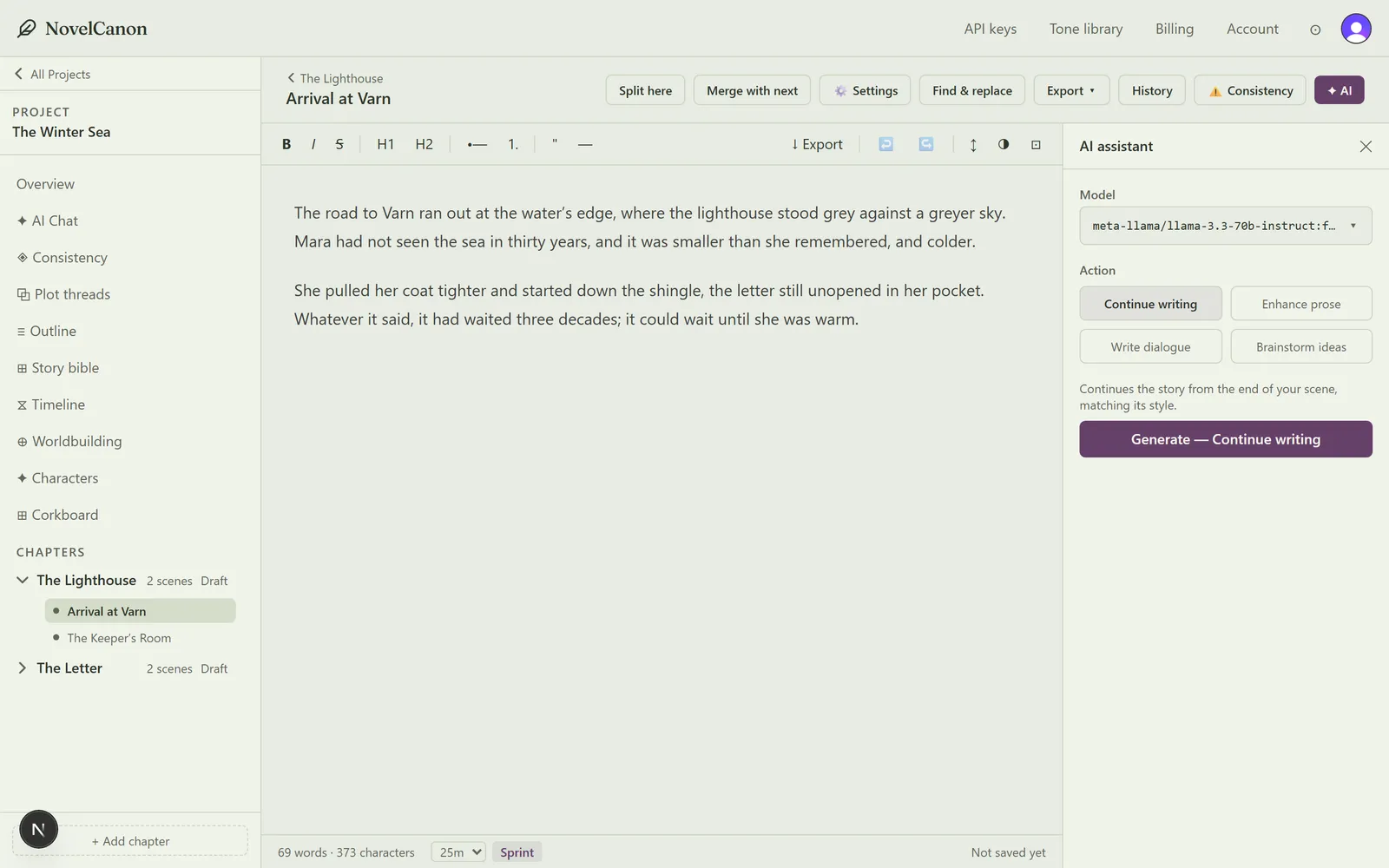
The AI panel in NovelCanon. Four explicit actions, an explicit model, and an explicit Generate — nothing happens to your prose unless you ask for it, and nothing stays unless you accept it.
The parts that matter most for this article, though, are the ones working in layer three:
- The Consistency Engine reads your prose and builds the fact ledger itself — the characters, the claims, the timeline — then audits the whole manuscript for contradictions, dropped threads and broken world rules. It's the bookkeeping layer, automated, and you can read exactly how it works under the hood.
- An optional self-audit on generations, which you switch on in project settings: before you accept an AI passage, it's checked against the facts and characters your story has already established, and flags what looks contradictory. The machine checking its own draft against your book, while it's still easy to reject.
- Voice matching (a Pro feature) builds a profile of your own prose — point of view, tense, rhythm, register — and drafts against it — closer to a defence of voice than a threat to it, though the tell sheet still applies.
- Bring your own API key, so the model choice is yours and you pay your provider directly. Which model suits fiction is its own question, and one worth answering deliberately.
Honest about the boundaries: all three tiers of the Consistency Engine and voice matching are on NovelCanon Pro — the free plan gives you one project, three chapters and 20 AI actions a day, which is enough to test whether the workflow above fits how you write. And if a different tool fits you better, our honest comparison of AI novel-writing software says so plainly, including where a competitor wins.
The part worth remembering
The anxiety about AI and voice is real, and it's aimed at the wrong target. Voice isn't threatened by the existence of these tools. It's threatened by one specific use of them — letting a machine produce the first version of your sentences — and that use happens to be the one the whole category is built to sell.
Everything else is available to you at no cost to the book. The remembering, the cross-checking, the timeline arithmetic, the five options you needed to see before you could write the sixth: hand all of it over. Keep the decisions, keep the sentences, and let the machine hold the ledger that no writer was ever built to hold.
Frequently asked questions
Can you write a whole novel with AI?
You can generate 90,000 words with AI, but you will not get a novel worth reading. Language models write toward the most probable next sentence, and probability is the enemy of voice — over a full book the prose flattens and the story contradicts itself. AI is genuinely useful for the parts of novel-writing that are memory and options, not for the parts that are judgement.
Will using AI make my writing sound generic?
Only if you let it write your sentences and keep what it gives you. Generic-ness enters at the sentence layer, where a model reaches for the most average phrasing available. Using AI to track continuity, generate options you discard, or interrogate your outline touches none of that — your prose stays entirely yours.
Do I have to disclose AI use when publishing on Amazon?
Only for AI-generated content. Amazon's KDP defines "AI-generated" as text an AI tool actually created — and notes that still counts "even if you applied substantial edits afterwards." Content you wrote yourself and used AI to edit, refine or error-check is "AI-assisted", which does not require disclosure. Check the current KDP content guidelines before you publish.
Can I copyright a novel written with AI?
You can copyright the human-authored parts. The US Copyright Office holds that copyright requires human authorship, and that prompting alone — however elaborate — does not make the output yours. A novel that is substantially your own writing remains protectable; wholly machine-generated passages are not, and should be disclaimed when you register.
How much of a novel should AI write?
None of the decisions, as little of the prose as you can manage, and as much of the bookkeeping as it will take. That is not a moral rule but a practical one: decisions and sentences are what readers experience as authorship, while continuity checking, fact-tracking and timeline arithmetic are pure memory work that machines do better than people.
What is the best way to use AI for fiction writing?
Use it at the point of a stall, and throw the output away. Ask for five ways the scene could turn, read them, then write the sixth yourself. The value is in breaking the block, not in the text — which is why the most useful AI output in fiction is usually the output you delete.
Written by
Munib Ali Laghari
Founder, NovelCanon
Building the writing studio he wished he had for keeping a long story straight — one where the AI never loses the thread.